The Year in Albemarle County: A tax rate increase and a major announcement
In a sign that Albemarle County has changed a lot since I wrote my first story about its government in 2004, there was no serious opposition when the Board of Supervisors adopted a budget based on a property tax rate increase. Only one of three districts up for election in November had a contested race.
As the year began for the Albemarle County Board of Supervisors, Samuel Miller District representative Jim Andrews was elected as chair with Jack Jouett District Supervisor Diantha McKeel as vice chair.
“We have a lot happening this year, exciting actions and moves for our community and I think we’re all anxious to get this work done,” said McKeel, specifically mentioning the need to adopt a new Comprehensive Plan.
Albemarle officials appointed Andy Herrick as county attorney in January after a long stint as the deputy.
“Our community is a great team,” Herrick said. “Though not always in agreement on every issue. Our community is very engaged and that’s a good thing. That engagement only enhances the quality of our services and of our community itself.”
Albemarle adopts both a new Comprehensive Plan and economic development plan
The AC44 process had begun in November 2021, over six years after the last Comprehensive Plan was adopted. Before that wrapped up, Albemarle County also updated a new Economic Development Strategic Plan.
Albemarle sought feedback in late January on the EDSP. Supervisors got a briefing in June from the project manager with the firm Resonance.
“We’re not working on an economic development plan for a community that’s in decline,” said Steven Pedigo. “We’re not even working on an economic development plan for a community that’s really stagnated. There is a lot of momentum happening in the county that really sets us up to do really outstanding work together.”

Meanwhile, the AC44 Comprehensive Plan update continued with a chapter-by-chapter review with a summary of changes to the Development Area Land Use Chapter presented to Supervisors on April 2.
In July, the Weldon Cooper Center for Public Service at the University of Virginia released updated population projections which show Albemarle increasing from a 2020 Census count of 112,395 to a population of 152,770 in 2050. A major reason for AC44’s existence is to provide a broad overview of how that growth will be accommodated.
In contrast, the number of people who have participated in the AC44 process is much smaller. At a Planning Commission work session in August, planner Ben Holt said that as of August 26, there had been around 400 visits to the website for Phase 4. Of that, sixteen people filled out a survey seeking comment. Thirty people attended a public overview session on August 21.
A decision was made early in the AC44 process to not expand the growth area boundaries. However, language was included in the new version of the growth management policy to state that it might be necessary if possible if development area land is not used effectively.
“AC44 emphasizes maximizing efficient land use within the current boundaries and does not recommend boundary revisions,” reads page 11 of the growth management plan. “Looking longer term, it is also essential to plan for potential future revisions, even if none are currently anticipated.”
In 2026, Albemarle planning staff will begin to use a new tool to measure proposed developments against the theoretical maximum allowed under the Comprehensive Plan. Supervisors got a preview in September.
The Planning Commission recommended adoption of AC44 in September 30 after a public hearing. An advocacy campaign sought to remove language related to development area expansion.
“Because premature expansion of the development areas would undermine the county’s growth policy, we remain concerned about the inclusion of criteria for development area boundary revisions in the Comprehensive Plan,” said Carroll Courtenay of the Southern Environmental Law Center. “Such criteria should instead be developed through a separate planning process in order to give them appropriate, appropriate attention and to allow for adequate public input.”
Planning Commissioner Nathan Moore of the Rio District said he felt it was time to expand the growth area or at least talk about doing so.
“It’s not full, per se, but we’re getting there and we’re going to get there,” Moore said. “It’s just five percent of the county’s land. And I feel like we should be starting these conversations now about, you know, where to expand the development area.”
Supervisors held their public hearing on October 15 and adopted the plan after a series of last minute attempts at amendments. AC44 goes into effect on January 1, 2026.
View the adopted plan:

Developing a budget
Albemarle County Supervisors learned in mid-January that property assessments went up another year.
“The tax basis has gone up 5.09 percent, or about 5.1 percent,” said county assessor Peter Lynch said. “The values haven’t gone up as much as they did in ‘22 and ‘23, but they are still climbing.”

In late February, County Executive Jeffrey Richardson proposed a $648.4 million budget based on a four cent increase on the property tax rate. Eighty-percent of the new revenue would go to paying for firefighters initially hired under a federal grant.
“Four years ago we knew that we faced the inevitability of a real property tax increase at some point in time,” Richardson told the Board of Supervisors in late February. “We had stronger than anticipated natural revenue growth combined with success in competitively earning federal SAFER grant money that we pulled down from the federal government that when you combine those two things, it delayed the inevitability of a tax rate increase.”
More details on the need to replace SAFER funding with local dollars are available in a report on grants received by the county as I reported in June.
Ten percent of the new revenue would go to Albemarle County Public Schools and the rest would go to affordable housing. Richardson’s budget also proposed another $3 million in “one-time money” for housing.
The first public hearing for Albemarle’s budget was held on March 3 and there were many people who wanted to have their say. That included people seeking more funding for education as well as representatives from the group IMPACT pushing for more spending on affordable housing.
At the first work session, Scottsville District Supervisor Michael Pruitt said he wanted the county to spend more in the present and hold fewer resources in reserve.
“I don’t think the role of government is to be a bank,” Pruitt said. “It is not to prepare for tomorrow. It is to realize the needs of citizens today. And I am always, I think, deeply hesitant about reserve funds and the size that they are and whether or not they are as lean as they could be.”
During the budget process, former Albemarle Fire Chief Dan Eggleston and Police Chief Sean Reeves appeared before Supervisors to explain in more detail why they needed the additional revenue that would come with the tax rate increase. At another work session, Supervisors learned how Albemarle would continue to fund climate action programs.

Toward the end of the budget process, Supervisors directed staff to add $1 million to the affordable housing fund for FY26 to bring it to a total of $5.2 million. The additional money came from their strategic reserve. They also added an additional $200,000 to the Albemarle County Emergency Relief Program.
Throughout the process, staff provided written answers to questions from Supervisors. I wrote up a summary in April.
At a final budget public hearing on April 23, one representative from IMPACT noted that Supervisors fell short of their request.
“We’re disappointed, however, that once again the county has been unwilling to fund affordable housing at the level that it is needed to truly address our community’s housing problems,” said the Reverend Susan Carlson of the Universalist Unitarian Church.
Other group asked for more spending on climate action initiatives and Supervisors agreed to contribute another $300,000 and would get a briefing in September on how it was being spent.
Supervisors adopted the budget on May 7. Halfway through the discussion, Rivanna District Supervisor Bea LaPisto-Kirtley had a question.
“I’ve been hearing a lot from my constituents who don’t, who it’s not clear to them if our assessments are going up so much,” LaPisto-Kirtley said. “You know, over the past couple few years our assessments have gone up a lot. Why doesn’t that cover the cost of what we want to do?”
Richardson said he is asked that question a lot and he understands concerns. He said there are many reasons why the county increases spending to cover the needs of a growing population.
“We have an extremely ambitious capital plan, most of which is devoted to core service delivery,” Richardson said. “When we look at courts, when we look at jail renovation, when we look at investment in recycling, solid waste, convenience centers. When we look at investment in three new schools, we’ve done renovations, we’ve done expansions, but three new schools over a five year [Capital Improvement Program].”
Soon after the budget was adopted, Supervisors received a briefing on the latest “Cost of Community Services Study” from the Weldon Cooper Center for Public Service.
Data for the 2023 study is based on the county’s audited books for 2022, officially known as the Comprehensive Annual Financial Report. (take a look here)
For that year, residential land brought in over $264.8 million in revenue, or 70.18 percent of the total tax receipts. The county spent over $346.7 million in services, or 90.11 percent of total expenditures.
Commercial brought in 27.32 percent of revenues or over $103 million. Services provided cost nearly $33 million, or 8.57 percent.
Agricultural and open space brought in $9.42 million but only cost $5.06 million in services.
Learn more in the story I wrote at the time.

In addition to the Comprehensive Plan and the Economic Development Strategic Plan, there’s also the strategic plan. That’s another tool used to direct activities of local government in Albemarle.
“We want to make sure as a local government that we are measuring and that we are transparent and communicating our progress and performance,” said Kristy Shifflet, chief operating officer in Albemarle County, at a briefing in August.
The preparation for the FY2027 is underway. In November, Supervisors got a briefing on the five-year financial plan, a tool that allows officials to weigh the immediate impacts of spending.
“Long range planning is very different because it’s more about what are the decisions we’re making today and how might that influence where the county’s forecast and revenues and expenditures will be 3 to 4 to 5 and so on years from now,” said Andy Bowman, the county’s assistant chief financial officer. “The annual budget is required to be balanced. The long range five year plan is not.”
For instance, if a decision is made to move forward with a major capital project, the plan projects costs into the future to determine the revenue gaps.
On December 3, Supervisors learned that the School Board wants to build a fourth high school in the next five years at a cost of $230 million. This is sure to be one of the biggest drivers in the budget for FY2027.

Rivanna Futures investment appears to pay off with AstraZeneca announcement
Albemarle County made a big investment in economic development in May 2023 when the Board of Supervisors agreed to pay $58 million to purchase around 462 acres of land around Rivanna Station for what would essentially be a new business park.
In 2024, the county served as developer of the land and sought a rezoning to allow for intense use at the site. They also pursued several funding mechanisms available through groups like the Go Region 9 Council including money to help prepare the site to be certified “business-ready” by the Virginia Partnership for Economic Development. That group awarded $613,750 to Albemarle in late March for Rivanna Futures.
In April, UVA Health named Mark Esser as the first director of the Paul and Diane Manning Institute of Biotechnology under construction at the Fontaine Research Park. At the time he was vice president for vaccines and immune therapies at the firm AstraZeneca. Esser said the new institute would be a boon for economic development.
“It’s going to create a lot of high quality jobs for folks here in the Virginia life sciences sector, which today is, although small compared to other parts of the country, is an $8 billion industry here in Uva alone,” Esser told the UVA Board of Visitors in early June.
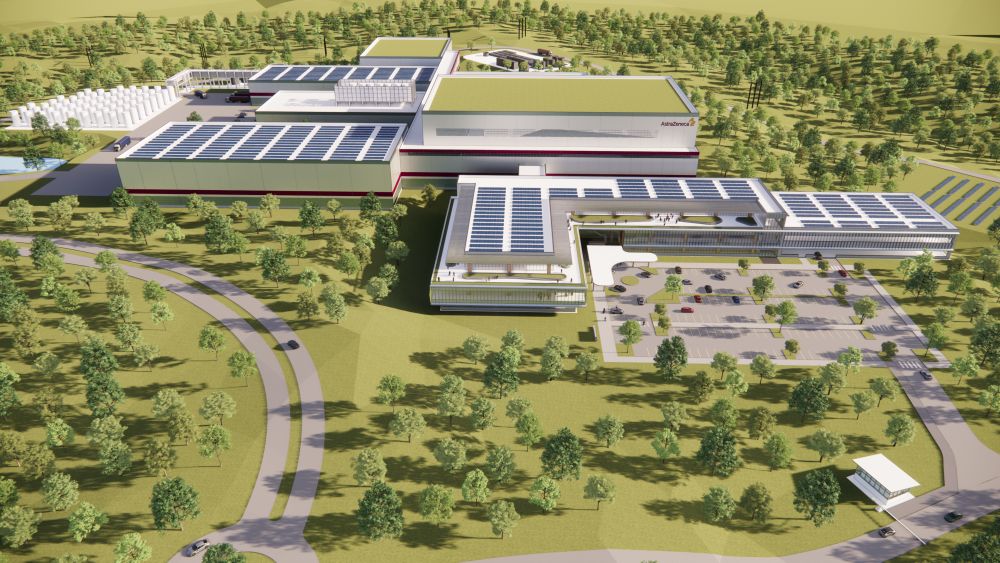
Four months later, Governor Glenn Youngkin was on hand for the official groundbreaking of AstraZeneca’s $4.5 billion pharmaceutical manufacturing center to be built at Rivanna Futures. So was the company’s CEO, Pascal Soriot.
Pascal Soriot said he first visited the Rivanna Futures land two months ago.
“A bit more than two months ago, I came here as we were selecting a site, and I came to this place and immediately fell in love with this site,” Soriot said. “A beautiful site. I love trees, many trees here. And I looked at it and I thought, there’s also enough space for expansion so we can continue building here.”
In all, AstraZeneca plans two manufacturing facilities at the site with one to produce medicines for chronic diseases and the other specifically for what a press release calls “antibody-drug conjugates” which are intended to attack cancer cells with fewer side effects than treatments like chemotherapy.

A few days later, the Supervisors and staff discussed AstraZeneca further.
“It’s a biopharmaceutical manufacturing campus, two specialized production facilities and processes,” said County Executive Jeffrey Richardson said. “About 75 acres of the Rivanna Futures property will be provided to AstraZeneca. They will build in that footprint buildings that will house 600 direct new jobs. The minimum salary will be $125,000 per year.”
Richardson added the presence of AstraZeneca will help the county on its quest to diversify its tax base by increasing the share that comes from commercial sources. That was noted by Supervisor Diantha McKeel.
“I remember twelve years ago when I was campaigning for this seat, one of the things I was saying was how appalling it was that we only had about 18 to 20 percent of our revenues coming in from businesses,” McKeel said. “That was part of my campaigning and we are now at 13 percent. “And I was saying at that point we need to be 25 or 30 percent. So this helps us.”
As mentioned, Albemarle County is serving as the development for the project. They filed an initial site plan for the project. Around the same time, Supervisors approved a zoning change requested by the county to make it easier to exceed building heights in industrial districts. The Planning Commission recommended approval in September, before the AstraZeneca project was known. Since then, Supervisors approved a special exception.
A look at some developments in Albemarle in 2025
- The first rezoning filed for the year is still in review. Piedmont Realty Holdings III has asked to rezone four lots on Rio Road West totalling 3.2 acres from Commercial Office to the Neighborhood Model District which allows for mixed use. The project would preserve five townhomes and anticipate construction of 148 apartments. Staff issued a comment letter in September that stated they were not ready to recommend it for approval. That’s the most recent file in the Civic Access portal. (read original story) (ZMA-2025-00001)
- The second rezoning in 2025 is also still in review. The Housing Lab and Kennon Williams Landscape Studio initially submitted a proposal to develop the former Cville EcoVillage site with 75 townhouse units. A second submission for Lochlyn Commons later in the year reduced that to 70. (read original story) (ZMA-2025-00002)
- An initial site development plan was filed in the spring for 17 single-family homes at 535 Rio Road East. The property is zoned R-4 and this is a by-right development. The land is on the eastern side of the road across from Lochlyn Hills and abuts land in the City of Charlottesville. (SDP-2025-00025)
- A rezoning was filed in May for 22 units on 3.15 acres in Crozet at a density slightly higher than recommended in the Comprehensive Plan. A second application was filed and the developer now seeks a maximum of 18 units. (ZMA-2025-00007)
- In September, the Albemarle Planning Commission held a public hearing on Riverbend Development’s rezoning for the southwest quadrant of the U.S. 29 / Interstate 64 intersection. They asked for a deferral after the panel’s members called the proposal too vague. A resubmission went back to the body in mid-December and the project was recommended for approval. I still have to write the newsletter version of that story, but here’s the C-Ville Weekly edition.
Other Albemarle items:
- This year Albemarle made an abrupt switch to the way it provides information to the public about land use applications. The Civic Access software went live in mid-January.
- In January, Albemarle County’s Parks and Recreation Department asked for the public’s input on whether the remaining tennis courts at Darden-Towe Park should be converted to pickleball. Albemarle and Charlottesville co-own the park and a joint governing body made the decision to do so in March with the cost of conversion to be paid for by the Albemarle Parks Foundation.
Before you go: Paid subscribers cover the cost of conducting research for all articles on this website. This edition was originally published on December 31, 2025 in the Charlottesville Community Engagement. You can either subscribe through Substack, make a monthly contribution through Patreon, or consider becoming a sponsor. The goal of Town Crier Productions is to increase awareness about what is happening at the local, regional, state, and federal government levels. Please share the work with others if you want people to know things.
Discover more from Information Charlottesville
Subscribe to get the latest posts sent to your email.