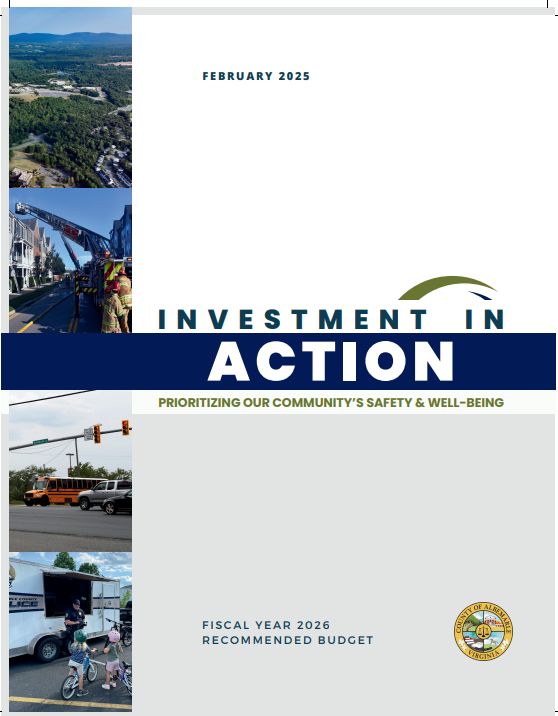
The Albemarle County Board of Supervisors will adopt a new budget for fiscal year 2026 on May 7. They made one last adjustment after a public hearing on April 23 to take public comment on the final document that reflects input from the six elected officials.
Before they opened the public hearing, Chief of Budget Andy Bowman presented an overview of what changes were made.
“Over the last two months, the board has invested a lot of time into this budget,” Bowman said. “This is the start of the 34th hour of a public meeting that we’ve had after all of our town halls and work sessions.”
Bowman’s presentation was similar to that at previous public hearings and the many town halls held to present the draft budget to the public.
The first speaker, Carolyn Crutchfield, is a resident of the Crozet Meadows community, an apartment complex reserved for older community members people with disabilities. She said she wants the county to exercise more scrutiny over how such places are managed and said there had been a lot of turnover with property management.
“I just got out of a meeting coincidentally today where they told us that they treat us the same as everybody else,” Towns said. “I’d like to see that happen. So I’d like to see more control of the communities, low income communities, communities that we build in this county so that we have choices.”

The second speaker was the Reverend Susan Carlson of the Universalist Unitarian Church. She’s a co-president of IMPACT, an advocacy group that is part of a coalition asking for a commitment of $10 million a year toward affordable housing.
This year’s budget includes for the first time a dedicated portion of real property tax revenue for housing as well as $4 million in one-time spending for a total of $5.2 million for affordable housing. While she is glad there is some commitment, Carlson said it is not enough.
“We’re disappointed, however, that once again the county has been unwilling to fund affordable housing at the level that it is needed to truly address our community’s housing problems,” Carlson said.
The third speaker also came from IMPACT who said the county may have been able to prevent the sale of the Cavalier Crossings apartment complex if they had previously invested in a housing trust fund.
“If we had had this fund that we’ve been asking for for years, the county would have been able to purchase that property,” said Denise Zito. “Instead, that complex has been purchased by who knows who, and they are turning it into, yeah, luxury apartments.
A journalist knows who and reports it as I did last September. The firm Bonaventure used an entity called Wahoo Way Investments to purchase Cavalier Crossings for $20.5 million in a deal that closed on May 10, 2024. The property had last sold in September 2017 for $11,199,000.
The second public hearing also offered another chance for other advocacy groups to call for more spending. One is a tenth grader from the Community Lab School who called for $1 million to be put into a fund to be used for projects to respond to climate change.
“These include increasing the extent of sidewalks and bike lanes to reduce reliance on gas powered cars, providing incentives for private renewable energy development and increasing tree cover in urban areas,” said Reed Chrobak.

Several other speakers echoed the call for additional funding for climate action.
This advocacy was organized by the group Community Climate Collaborative, a nonprofit with revenues of $1 million in 2023 according to ProPublica.
“C3 has earned the broad support of this community,” said executive director Susan Kruse. “More than 90 percent of our budget is funded by individuals, private foundations and local businesses. They count on us to hold you accountable.”
Kruse said that funding for recycling and purchases for things like street sweepers should not be considered as investments in climate action because they do not directly reduce greenhouse gas emissions.
After the public hearing, Supervisor Michael Pruitt repeated that he would like to see a higher tax rate to allow for more spending but that is too late for this budget cycle. He said he wanted to make a motion to re-allocate $300,000 from a strategic priority fund toward climate.
Supervisor Ann Mallek said she would want to know more about how that money would be spent before allocating it.
“In order to really support a transfer of this money, I would need to know more about or establish a report back or some other definitions before money goes out the door of where it’s going to go,” Mallek said.
Supervisor Bea LaPisto-Kirtley said she would support such a transfer but agreed that the money should go to where it would have the most impact.
Supervisor Ned Gallaway said he would support Pruitt’s motion, but he would prefer that $300,000 go toward housing first given there has been advocacy for that as well. He said he wanted any funding spent on the issue to be used well. Gallaway was on the Board when they adopted a Climate Action Plan.
“One of my concerns about the plan was identifying actual action steps that we could take to not just achieve the objective we were stating, but also was a way that said we are being responsible with your dollars,” Gallaway said.
Gallaway added that funding for things like bike lanes comes mostly from the state and federal government and would not necessarily be counted in a climate action fund. He pointed out many things can move action forward such as in 2015 when Albemarle became one of the first school systems to install solar arrays on roofs.
“Wasn’t our idea, can’t take claim for it,” Gallaway said. “It was Albemarle High School students coming and doing what these very students did. A project based piece that got the policymakers to go, you know what, that’s a great use of time. It was cost effective and it achieves a goal that we were starting to talk about back then.”
Supervisor Diantha McKeel pointed out that activities to reduce greenhouse gas emissions can take many forms and some of them will take a while. She said the county recently joined Charlottesville in forming a regional transit authority that may one day lead to a bus system that will be used by more people.
“I want to just remind folks too that emissions from transportation make up half of the county’s emissions,” McKeel said. “Transportation is a huge part of our problem.”
As the conversation continued, Albemarle County Executive Jeffrey Richardson suggested staff could make an adjustment.
“It feels like based on the discussion, that there’s energy with the board, with four more folks that are saying they’d like to see the staff come back with consideration of an additional $300,000 making that climate action fund for next year 500 with a focus on greenhouse emergency,” Richardson said.
However, Supervisor Pruitt said he wanted to take a vote on a motion to send a clear message and it passed unanimously.
There was also a public hearing on the property tax rate on April 30, 2025 at which two people spoke. I’ll have more details in a future edition of Charlottesville Community Engagement.
Before you go: This story originally appeared in the April 28, 2025 edition of Charlottesville Community Engagement. This is a production of a Town Crier, as opposed to Town Criers, so it takes a bit to get to everything. If you want to increase the chance of plurality, support the info!
Discover more from Information Charlottesville
Subscribe to get the latest posts sent to your email.