The Albemarle Board of Supervisors reaffirmed a commitment to reduce greenhouse gas emissions in September 2017, just six years after a Republican majority on the Board ended participation in one initiative to do so.
Three years later, Supervisors adopted a Climate Action Plan which has the goal of reducing greenhouse gas emissions by 45 percent of 2008’s levels by 2030 and by being carbon neutral by 2050.
As fiscal year 2027 looms, Albemarle’s Director of Facilities and Environmental Services told the current Board on May 4, 2026, that the county is deeply committed to sustainability and programs are interwoven throughout the local government.
“Rather than isolating climate action into a single budget line-item our program, we integrate sustainability and climate action priorities throughout the organization including our annual budget process and most all the services provided to the county to achieve sustainability goals and serve our residents,” said Jeff Dumars.
Dumars’ department is responsible for implementing the Climate Action Program based on that Climate Action Plan adopted in 2020.
“Last year in FY26 we shifted our focus from planning and outreach efforts towards implementation of efforts and projects that directly reduce greenhouse gas emissions, energy consumption and prioritize our efforts to deliver measurable on-the-ground emissions reductions,” Dumars said.
Resources for this story:
That involved a reorganization that created two project manager positions with one focused on upgrades to Albemarle facilities to reduce emissions in county building operations. The other will manage “sustainability environmental projects.”
Supervisors set aside $300,000 in one-time funds for climate action in the fiscal year that begins on July 1. This will be split between transportation projects and improving energy use in buildings. The department itself will utilize another $150,000 for several projects including an organic waste feasibility study.
“Transportation emissions fundamentally are reduced by developing projects that decrease vehicle miles traveled,” Dumars said. “The building emissions sector are reduced by developing projects that decrease energy usage, improve energy efficiency or transition energy sources.”
More details on how that money will be spent will be shared as the fiscal year gets underway.

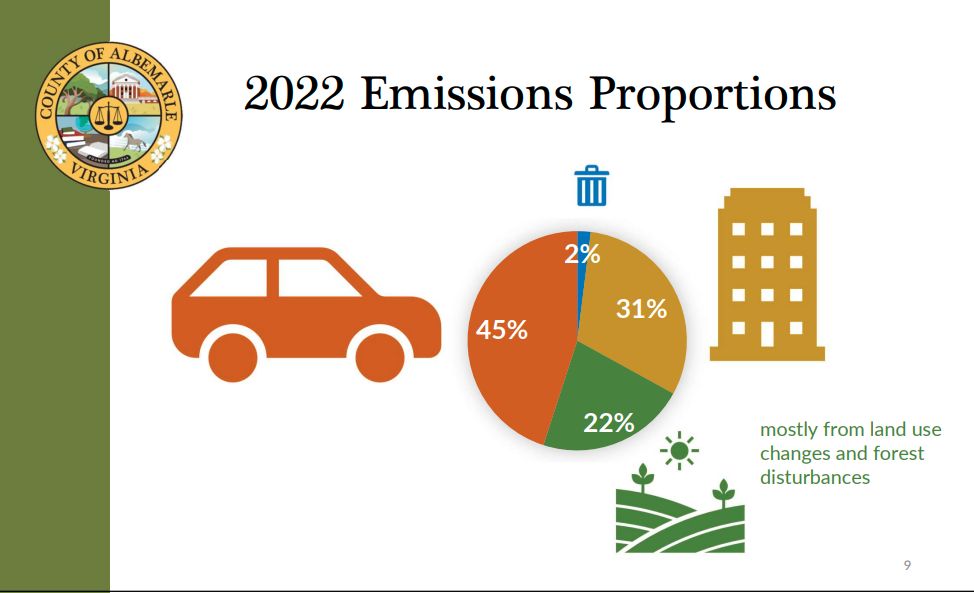
Greg Harper, Albemarle’s Chief of Environmental Services, said the latest emissions inventory for the county is from 2022. He said that’s not unusual due to a lag-time in reporting. Harper showed a chart that seemed to indicate the county’s emissions were above the target for that year.
“In 2020, the year of COVID we actually were below our target and we’ve unfortunately been coming up since then,” Harper said. “From 2022, we still need to drop about 400,000 metric tons of carbon per year in order to meet that 2030 target.”
Harper went through some of the investments in the current fiscal year including $387,000 for residential improvements conducted by either LEAP or the Albemarle Housing Improvement Program. An example of an improvement would be upgrading heating, ventilation and cooling systems.
“With the completion of 74 homes there will be a 75 metric tons of CO2 equivalent reduction,” Harper said. “So that’s about one metric ton per home.”
Albemarle also contributed $63,000 to the Energy Resource Hub which serves as a way for households to find local, state, and federal programs to assist with the cost of improving energy efficiency.
“So far in the first year of its existence, there have been 31 homes and 15 businesses that have actually followed through with energy upgrades using funding from external sources,” Harper said. “And that has resulted in about 33 metric tons of CO2 reductions.”
The county’s climate action plan also now includes collaboration with the Community Development Department as they oversee the writing of a new zoning code.
Another big project coming up will be the placement of solar panels on top of the county’s office building at 1600 5th Street Extended. As with Charlottesville’s projects at the high school and middle school, the county is seeking to enter into a power purchase agreement.

Before the presentation on May 4, a longtime environmental activist told Supervisors the recently adopted Comprehensive Plan failed to acknowledge the severity of future crises.
“Scientists warn that our current state is unsustainable and we must change the way we live to avoid triggering more and worst ecological catastrophes,” said Tom Olivier. “By mid century, our planet will be a dangerously different place.”
Olivier was a member of the now defunct group Advocates for a Sustainable Albemarle Population which claims the landscape cannot handle the amount of people currently here. He
recently published a long article for the Center for the Advancement of the Steady State Economy that critiqued Albemarle’s recent emphasis on economic development.
On May 4, Olivier called upon Supervisors to fund another climate position, employ a planner for rural area protection, and to create a department to emphasize the link between biodiversity and climate action. You can read the proposal for the latter here.
Before you go: The goal of Town Crier Productions is to increase awareness about what is happening at the local, regional, state, and federal government levels. Please share the work with others if you want people to know things. Paid subscribers cover the cost of conducting research for this article which was originally published in the May 29, 2026 edition of Charlottesville Community Engagement. You can either subscribe through Substack or make a charitable contribution.
Discover more from Information Charlottesville
Subscribe to get the latest posts sent to your email.