The Virginia Department of Environmental Quality will hold a public meeting on Monday night to take feedback on a company’s request to renew a permit allowing them to apply treated sewage on agricultural land.
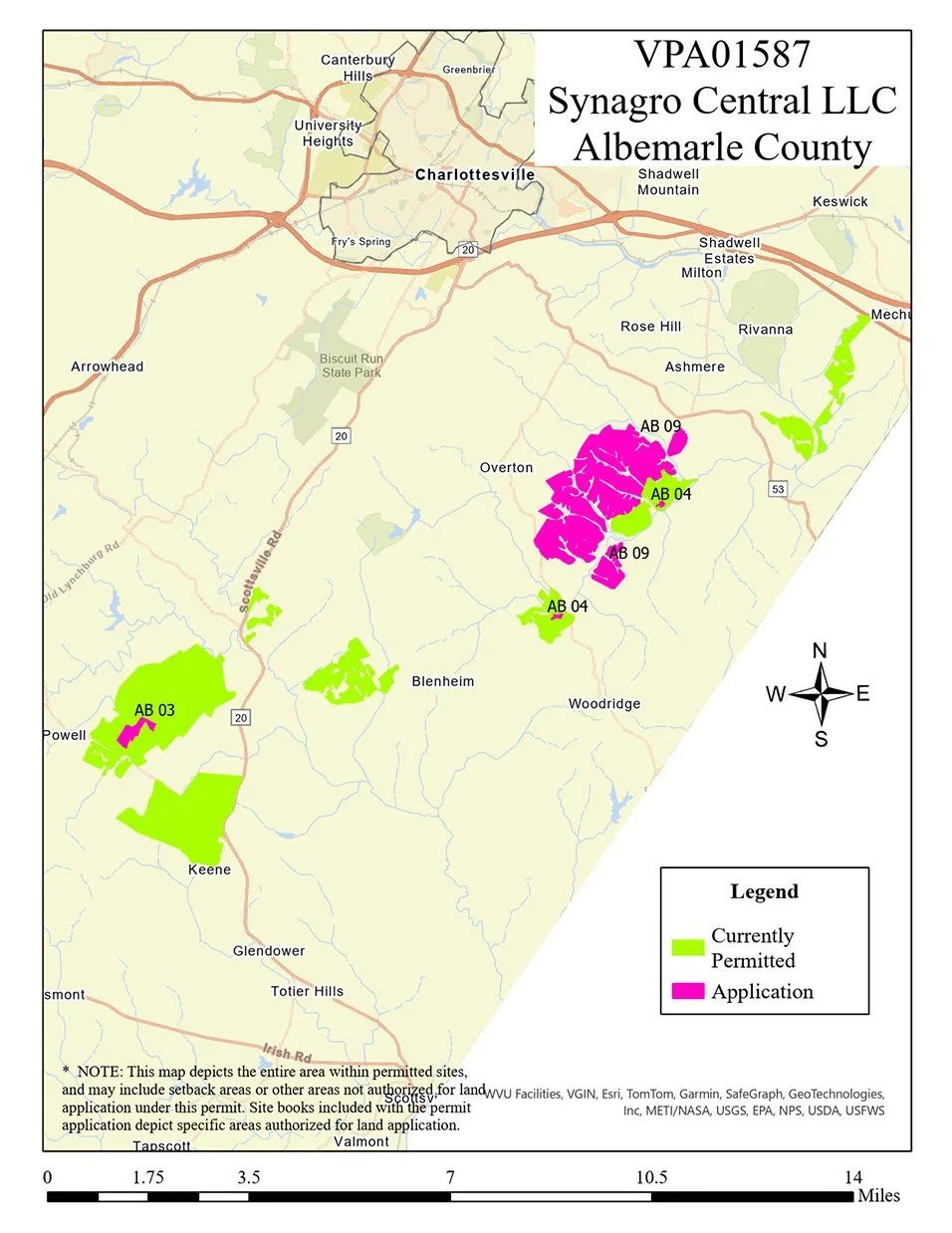
The firm Synagro Central LLC had originally sought to add about 1,702 new acres of land to their list of places eligible to receive what the industry refers to as biosolids.
“The permit authorizes the land application of biosolids and water treatment plant residuals as fertilizer to specific sites in Albemarle County and limits the application of nutrients, metals, and pathogens contained in these materials to amounts that protect water quality and human health,” reads the meeting notice on the Commonwealth Calendar.
This week Synagro amended their request and removed most of the new land.
“On May 26, 2026, Synagro Central, LLC. removed the AB 09 site from the reissuance application reducing the total acreage to 4,133.5 at 7 sites, of which 53.4 acres is new land application area,” reads a more specific public notice on the DEQ website.

The details on AB 09 can be found here.
The meeting will be held at 6 p.m. in the Bolick Center Event Space B at Piedmont Virginia Community College.
Supervisor Ann Mallek told her colleagues about the meeting at the May 20 meeting of the Board of Supervisors.
“This is a time for individuals to learn about the process and to share their concerns,” Mallek said.
Legislation passed the General Assembly this year which requires operators of sewage treatment plants to test processed biosolids for perfluoroalkyl and polyfluoroalkyl substances, or PFAS.
“Farmers are in a bad spot because for fifty years, they’ve been told this is all fine,” Mallek said.

The prospect of having more land eligible to have sludge applied helped fuel the creation of a new group called Don’t Spread on Me.
“We’re working to change the policy and practice of dumping sewage sludge on farm land,” said Stuart Overby at the May 20 meeting of the Board of Supervisors. “Don’t Spread on Me has been working as part of a coalition of local conservation groups to raise awareness and get county residents to come to this meeting.”
The DEQ will also hold an in-person meeting in Richmond on June 1 at which there will be another conversation about biosolids. In 2024, the General Assembly passed legislation creating a PFAS Expert Advisory Committee and they’ll meet at 10 a.m. in the Bank of America Building at 1111 East Main Street in Richmond. More information here.
One of the items on the agenda is “Biosolid Legislation Enactment Clause Overview and Initial Discussion.”
My colleagues and I covered the issue for Charlottesville Tomorrow in the early 2010’s. Here are some of the articles.
- Landowners concerned about dumping of D.C. sewage in Albemarle, Sean Tubbs, January 31, 2011
- Sewage waste applied next to Carrsbrook neighborhood, Sean Tubbs, May 31, 2011
- Albemarle Supervisors briefed on state biosolids rules, Sean Tubbs, July 6, 2011
- As biosolids applications begin, practice still has champions and detractors, Ian Lamb, July 1, 2012
Before you go: The goal of Town Crier Productions is to increase awareness about what is happening at the local, regional, state, and federal government levels. Please share the work with others if you want people to know things. Paid subscribers cover the cost of conducting research for this article which was originally published in the May 29, 2026 edition of Charlottesville Community Engagement. You can either subscribe through Substack or make a charitable contribution.
Discover more from Information Charlottesville
Subscribe to get the latest posts sent to your email.