



First of several parts
The second presidency of Donald Trump has introduced many novel approaches to governance in the United States, including pressure on legislators in Texas to break from precedent to redraw Congressional districts in advance of the 2026 mid-term elections.
Traditionally redistricting happens every ten years as mandated in Article 1, Section 2 of the U.S. Constitution. States can determine the method of how they draw districts but for many years Southern states were required to submit boundaries for review to ensure compliance with civil rights legislation such as the Voting Rights Act of 1965.
The Republican Party currently holds a narrow majority in the U.S. House of Representatives with 219 members to 213 Democrats with three vacancies. One of those vacancies has been filled in a special election in Arizona won on September 23 by Democrat Adelita Grijalva but Speaker of the House Mike Johnson has so far refused to swear her in until he calls the full House of Representatives back into session.
The audio version of this story appears in the October 29, 2025 edition of Charlottesville Community Engagement. Take a listen!
According to the Texas Tribune, redistricting in Texas is expected to create five additional safe seats for Republicans. The state’s delegation of 38 Representatives consists of 25 Republicans, 12 Democrats, and one vacancy. Governor Greg Abbott signed the new Congressional map on August 29 with no need for voters to approve the measure.
In response, California Governor Gavin Newsome, a Democrat, suggested legislation called the “Election Rigging Response Act” in direct response to the new maps in Texas, and a voter initiative to redraw maps in the nation’s largest state mentions efforts underway by Republicans to redistrict in Florida, Ohio, Indiana, Missouri, New Hampshire, Nebraska, and South Carolina. Proposition 50 is on the ballot on November 4.

Last week, the Virginia Political Newsletter reported that Democrats who control a narrow majority in the General Assembly are seeking to follow California’s lead. On Monday, the House of Delegates agreed to take up House Joint Resolution 6007 which would amend the Virginia Constitution to allow the General Assembly to make a one-time adjustment.
The General Assembly is able to meet because a special session from 2024 was never technically adjourned. To allow consideration of the Constitutional amendment, the joint resolution that sets the rules for the special session had to be changed and agreed to by both the House of Delegates and the Virginia Senate.
One adopted on February 22 of this year lists six items of acceptable business including memorials and resolutions commending people or businesses. A seventh was added to House Joint Resolution 6006 which was introduced by Delegate Charniele Herring (D-4) on October 24. This would allow a “joint resolution proposing an amendment to the Constitution of Virginia related to reapportionment or redistricting.”

Both the House of Delegates and the Virginia Senate convened on Monday, October 27.
As the debate in the House of Delegates began, Delegate Bobby Orrock (R-66) made a parliamentary inquiry.
“My first inquiry would be given that special sessions have by their very nature only occurred for specific reasons. Ergo, we have resolutions controlling what can be considered during them. And subsequently, to my knowledge and experience here, they’ve never extended for more than a one year period.”
Orrock said the 2024 Special Session was continued to allow progress toward adopting a budget that year. He said that had taken place and the stated reason for the special session was moot.
The amendment itself was not made available until Tuesday afternoon. More on that later.
Delegate Jay Leftwich (R-90) read from §30-13 of the Virginia Code which lays out what steps the Clerk of the House of Delegates has to take when publishing proposed amendments to the Constitution.
“It goes on to say, Mr. Speaker, the Clerk of the House of Delegates shall have published all proposed amendments to the constitution for the distribution from his office and to the clerk of the circuit court of each county and the city two copies of the proposed amendments, one of which shall be posted at the front door of the courthouse and the other shall be made available for public inspection,” Leftwich said.
Delegate Herring countered that that section of code predates the Virginia Constitution of 1971 which does not have those requirements. Leftwich continued to press on this note but Speaker of the House Don Scott ruled that his questions were not germane to the procedural issue.

Delegate Lee Ware (R-72) said the move across the United States to redraw districts mid-Census to gain partisan advantage was a bad idea no matter what party was proposing it.
“Just because a bad idea was proposed and even taken up by a few of our sister states such as North Carolina or California, is not a reason for Virginia to follow suit,” Ware said. “ For nearly two and a half centuries, the states have redistricted following the decennial census, responding to the population shifts both in our country and in the states.”
A motion to amend HJ6006 passed 50 to 42.
The House of Delegates currently only has 99 members due to the resignation of Todd Gilbert. Gilbert had been named as the U.S. Attorney for Western Virginia but lasted for less than a month. Former Albemarle Commonwealth’s Attorney Robert Tracci was appointed to the position on an interim basis.
Virginia Senators pre-debate the amendment on Tuesday
The Virginia Senate took up the matter on Monday as well. Democrats have a 21 to 19 majority and were unable that day to suspend the rules to immediately consider an amendment to HJ6006. They had a second reading on Tuesday.
The initial discussion of the Constitutional amendment took place during a portion of the meeting where Senators got to speak on matters of personal privilege. As with the House of Delegates, many inquiries from Republican legislators happened because the document itself was not yet available for review.
Senator Bill Stanley (R–20) rose to remind his colleagues that the General Assembly passed a bipartisan Constitutional amendment to require that redistricting be conducted by a nonpartisan committee.
“We listened to Virginians who were tired of the gerrymandering,” Stanley said. “In 2019, polls showed 70 percent of Virginians supported redistricting reform. Not 51 percent, not 55 percent, [but] 70 percent. The Mason Dixon poll showed 72% support. And crucially, over 60 percent of Republicans and Democrats alike supported this amendment. Equally when it came to a vote in the Commonwealth. This was not partisan.”
Senator Mamie Locke (D-2) served on the bipartisan redistricting committee and reminded her colleagues that the process broke down in October 2021, as I reported at the time. The Virginia Supreme Court ended up appointing two special masters to draw the current boundaries.
“There was constant gridlock and partisan roadblocks,” Locke said. “[Those] Were the reasons why the Supreme Court ended up drawing the lines because the commission ended up discussing things as tedious as which university could be trusted to provide unbiased data.”
Locke said the proposal in Virginia would still have a bipartisan commission draw new maps after the 2030 Census and that voters in Virginia would still have to approve the amendment.

Senator Scott Surovell (D-34) said the amendment is intended to step in when other branches of government are not exercising their Constitutional authority to provide checks and balances. He echoed Locke’s comment that the redistricting commission would continue to exist.
“There’s no maps that have been drawn,” Surovell said. “There’s no repeal of the constitutional amendment. The only thing that’s on the table or will be on the table later this week is giving the General assembly the option to take further action in January to then give Virginia voters the option of protecting our country.”
Senator Richard Stuart (R-25) said he thinks President Trump is doing a job of bringing manufacturing back to the country and dismissed Surovell’s notion that democracy is at threat.
“I’m not seeing any threat to democracy,” Stuart said. “I heard the word king, and I would remind the Senator that if he was a king, he would be beheaded for what he just said. But in this country, we enjoy free speech. We get to say what we want to say, and that is a valued right and privilege.”
Senator Barbara Favola (D-40) said many of her constituents are concerned about cuts to federal programs due to the recent passage of the One Big Beautiful Bill including threats to Medicaid. She explained why she supports her Democratic colleagues in Congress in the current state of things.
“We are in a shutdown situation because the Democrats are standing up and saying we must extend the tax credits that are available on the health marketplace so individuals can afford their insurance,” Favola said. “Health insurance. This is not going unnoticed by the Virginians we represent.”
Senator Mark Peake (R-22) said Republicans were entitled to govern how they want because they are in control of the federal government.
“The current president won an overwhelming majority in the Electoral College and he won the popular vote by over 4 million or 5 million votes,” Peake said. “That is called democracy. That is what we have. And the Republicans won the Senate and they won the House of Congress. We will have another election next year and it will be time for the citizens to vote. But we are going under a democracy right now, and that’s where we stand.”
The points of personal privilege continued. Senator Schuyler VanValkenburg (D-72) said elections are a chance for citizens to weigh in on a presidency that started the process of mid-Census redistricting.
“The key point is this,” VanValkenburg said. “The president’s ideas are unpopular. He knows it. He’s going to his ideological friends, he’s asking them to carve up maps, and now the other side is upset because they’re going to get called on it in elections.”
The Senate adjourned soon afterward and will take up a third reading of HJ6006 today.
Democrats file Constitutional Amendment for first reference
Early discussions about a potential constitutional amendment in the House of Delegates and the Virginia Senate this week did not include a lot of details about how a mid-Census Congressional redistricting would take place.
House Joint Resolution 6007 was filed with the Virginia Legislative Information System on Tuesday, October 28. As of this publication it is in the House Privileges and Elections Committee because the Senate has not yet given itself permission to take up the matter.
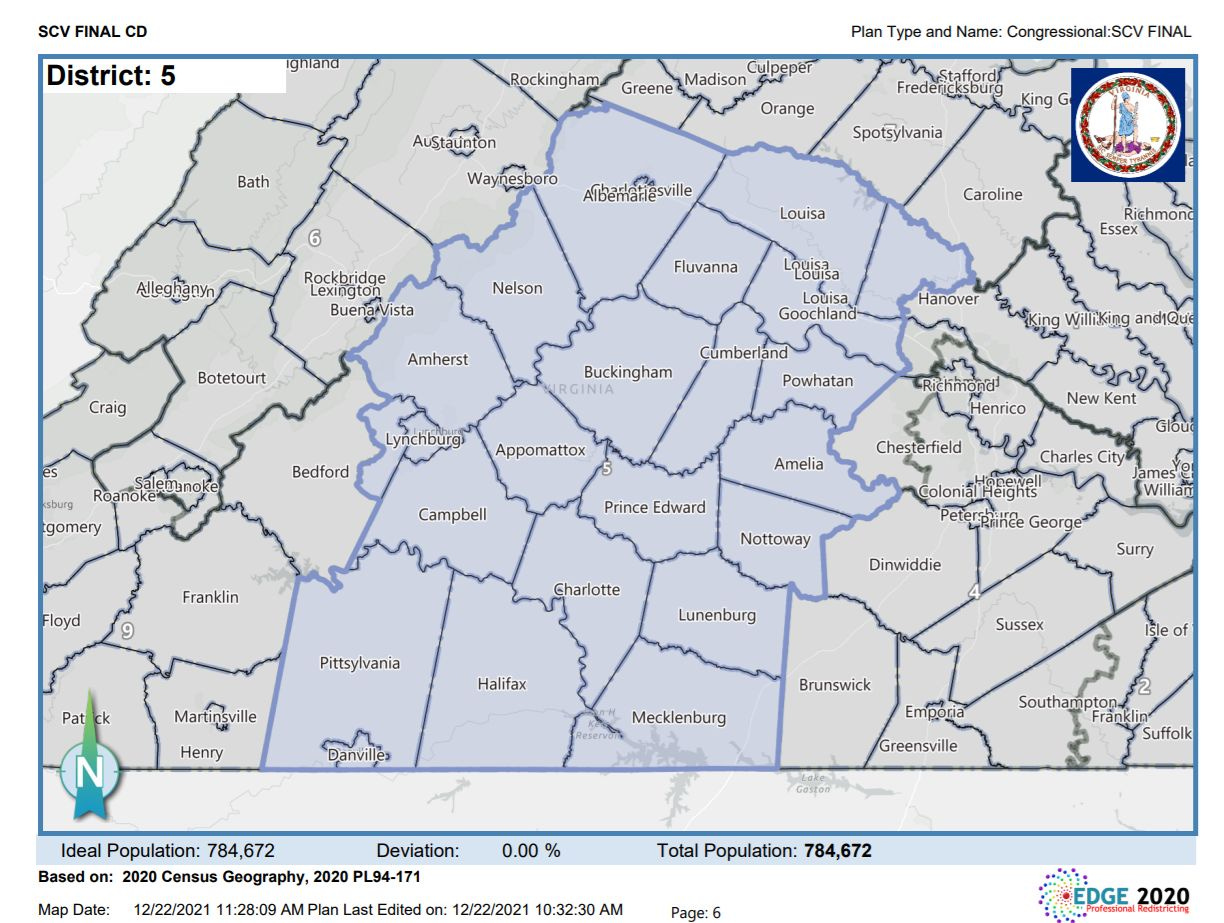
The amendment would amend Article II, Section 6, of the Virginia Constitution to insert language into the second paragraph.
Here is the full text, with italicized words indicating new language.
The Commonwealth shall be reapportioned into electoral districts in accordance with this section and Section 6-A in the year 2021 and every ten years thereafter, except that the General Assembly shall be authorized to modify one or more congressional districts at any point following the adoption of a decennial reapportionment law, but prior to the next decennial census, in the event that any State of the United States of America conducts a redistricting of such state’s congressional districts at any point following that state’s adoption of a decennial reapportionment law for any purpose other than (i) the completion of the state’s decennial redistricting in response to a federal census and reapportionment mandated by the Constitution of the United States and established in federal law or (ii) as ordered by any state or federal court to remedy an unlawful or unconstitutional district map.
Take a look at the whole text here. I’ll continue to provide updates.

Before you go: Paid subscribers cover the cost of conducting research for this article which was originally published in the October 29, 2025 edition edition of Charlottesville Community Engagement. You can either subscribe through Substack, make a monthly contribution through Patreon, or consider becoming a sponsor. Another way you can help is to share this article with people you might be interested. Thank you for reading!
Discover more from Information Charlottesville
Subscribe to get the latest posts sent to your email.

Thanks for the up[date. FYI – It\’s Newsom (not Newsome) Let\’s get it right out of respect for what he\’s trying to do, no?
mrs