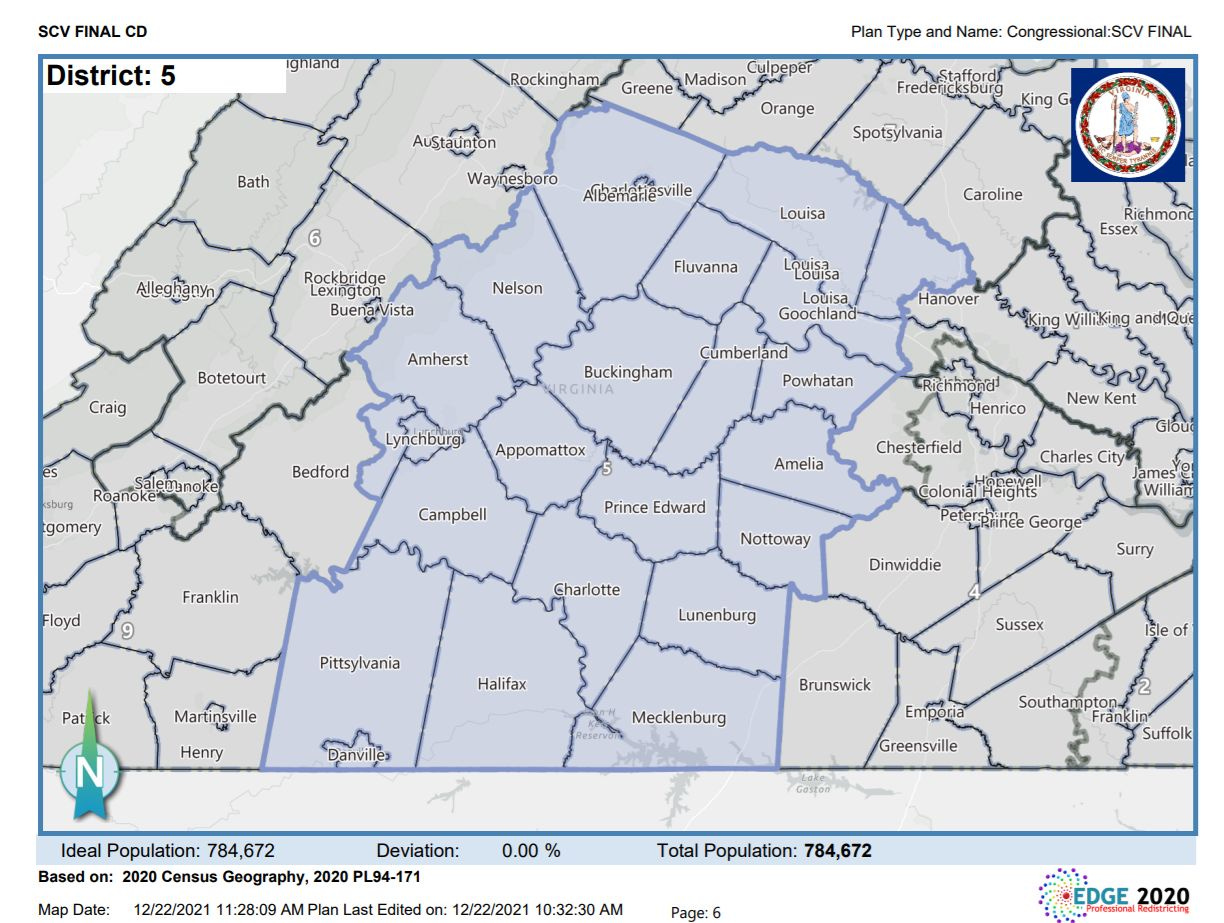
When Virginians go to the polls on November 3 for the mid-term Congressional elections, they will select from candidates who are running under boundaries established in late 2021 after a bipartisan commission failed to reach consensus on how they should be drawn.
A split Virginia Supreme Court ruled today in a 4-3 decision in Scott v. McDougle that the majority party in the Virginia General Assembly did not comply with the method set out in the state Constitution when authorizing a special election to redraw Congressional boundaries to give a 10-1 partisan advantage.
“We hold that the legislative process employed to advance this proposal violated Article XII, Section 1 of the Constitution of Virginia,” reads the decision authored by Justice D. Arthur Kelsey. “This constitutional violation incurably taints the resulting referendum vote and nullifies its legal efficacy.”
Read the full 46-page opinion here.

In Virginia, proposed Constitutional amendments must pass both chambers in one session. If that happens, an election of the House of Delegates must be held before the second reference can be adopted.
In 2020, two-thirds of Virginia voters said yes on a question to amend the Constitution to hand over redistricting powers to an independent commission with the Virginia Supreme Court serving as a back-up if that group could not reach consensus. Such a deadlock did occur in early October 2021 and the Court appointed two special masters to draw the lines.
“We unanimously ordered that the prior district maps be replaced with wholly new maps that commentators across a wide spectrum of political views later deemed to be free of partisan bias,” reads page 3 of the ruling.
Now those maps will likely be in place for at least three more election cycles until the next Census.
National commands lead to an effort to redraw Virginia’s maps
Last summer, President Donald Trump directed elected officials in states with Republican majorities to redraw their lines to increase the chances of holding on to the U.S. House of Representatives.
The legislature in Texas obeyed and redrew the maps in late August 2025 to give a potential five-seat advantage. North Carolina followed in October with a realignment to allow Republicans to pick up one seat and Ohio redrew districts to give Republicans an advantage to pick up two more seats.
Voters did not play a role in any of those three states, but Californians did have a chance to go to the polls on November 4 and approved a redistricting to give Democrats an additional five seats.
Last fall, Democrats in Virginia reconvened a special session that had been called in 2024 for the purposes of finalizing the budget. Such sessions have narrow parameters of what can be considered and on October 27, 2025, the House voted 50 to 42 to allow consideration of a redistricting amendment.
The House of Delegates approved the first reference of the Constitutional amendment on October 31 on a 51 to 42 vote. Later that day, the Senate approved the first reference on a 21 to 16 vote.
“During the 2026 Regular Session that began in January, the General Assembly again voted by a party-line vote to approve the proposed amendment,” reads page 4 of the ruling. “In February 2026, the General Assembly enacted and published a new map for Virginia’s 11 congressional districts contingent upon approval of the proposed constitutional amendment by a majority of the voters and upon certification of such results.”
A pair of lawsuits were filed in Tazewell County Circuit Court seeking to halt the special election from taking place and Judge Jack Hurley Jr. issued an injunction in both of them seeking to stop the early voting period from beginning on March 6. The Virginia Supreme Court allowed voting to proceed and agreed to hear the case after the results were known.
“To guard against hasty changes to the Commonwealth’s organic law, Article XII, Section 1 also slow-walks the constitutional-amendment process,” reads page 10 of the ruling. “The General Assembly must twice vote in favor of a proposed amendment at two separate legislative sessions with an intervening election of the House of Delegates.”
One of the issues in the oral arguments held on April 27 is what the word “election” refers to in the Constitution.
- Attorneys representing Speaker of House Don Scott argued that it solely meant November 4, 2026, the day votes began to be counted.
- Attorneys representing Republican Senator Ryan McDougle argued the election began on September 19, the day early voting began.
Page 12 of today’s ruling notes that 1.3 million people had already cast their votes in the 2025 general election which included all 100 seats in the House of Delegates. That’s about 40 percent of the vote.
A majority of four Justices sided with McDougle.
“The metes and bounds of an election begin with the point of casting votes and end with the point of receiving votes and closing the polls on the last day of the election,” reads page 20 of the ruling. “Election Day is the boundary marker for the last act constituting an election.”
Halsey’s opinion was joined by Justice Stephen R. McCullough, Justice Teresa Chafin, and Justice Wesley G. Russell Jr.
A dissenting opinion was written by Chief Justice Cleo Powell with Justice Thomas P. Mann and Justice Junius P. Fulton III joining in.
“Today the majority has broadened the meaning of the word ‘election,’ as used in the Virginia Constitution, to include the early voting period,” reads the opening line of the dissent. “This is in direct conflict with how both Virginia and federal law define an election.”
The 2026 election will now proceed under the boundaries selected in late 2021. The primary will be held on August 4.
Early voting for the primary will begin on June 19. The deadline to register to vote in the primary is July 24 but same-day registration can continue with provisional voting beginning on July 25.
Those who want to run for the Congressional races now have until May 26 to complete paperwork if they are pursuing a party nomination or August 4 if they want to run as an independent.
State Board of Elections officially cancels work on April 21 special election
Five hours after the Virginia Supreme Court issued a 4-3 ruling invalidating the results of the April 21 special election on redistricting, the agency that oversees voting officially announced the end of work on the ballot question.
“As a result of the court’s ruling, the State Board of Elections will take no further action in relation to the election,” reads an information release sent out at 3:25 p.m. “Further, for the 2026 Primary and General Elections, no changes will be made to the congressional district boundaries that existed prior to the Redistricting Referendum Special Election.”
The release also included a link to an interactive map that shows the restored boundaries.
Here are the rest of the bulleted points in that release:
- While the Redistricting Referendum Special Election was ruled void, the Primary Election will still take place on August 4. The filing deadline for U.S. House of Representatives candidates is still May 26. An interactive map of the existing congressional districts that will remain in place for the 2026 Primary and General Elections can be viewed at: elections.virginia.gov/casting-a-ballot/redistricting/interactive-map/
- The 2026 Primary Election will be held on August 4 for all offices in the 2026 election cycle, including U.S. Senate, U.S. House of Representatives, and local. There is no primary election in June.
- The 2026 General Election will be held on November 3.
- Eligible individuals may register to vote.
- Registered voters may check their voter information (including polling location), using the online Citizen Portal at: elections.virginia.gov/VoterInformation
- U.S. House of Representatives candidates running for party nomination must file by May 26.
- Independent U.S. House of Representatives candidates must file by August 4.
- Candidates can find additional information at: elections.virginia.gov/candidatepac-info/
Elected officials react to the ruling, Attorney General Jones weighing pathways forward
Today’s ruling invalidating the April 21 election is the latest chapter in a tumultuous cycle of accelerated partisanship. Both opinions also unleashed a fresh round of statements.
Senator Ryan McDougle, a party in the case, issued a statement in support of the 4-3 ruling.
“The Justices of the Supreme Court of Virginia after careful and thorough review of this matter affirmed that even the General Assembly must follow the law,” McDougle wrote. “This ruling is not a partisan one. It is a Constitutional one. The rule of law is the foundation of our Commonwealth, and today it has been upheld.
Majority Leader Scott Surovell (D-34) was one of the major architects of the redistricting effort. He issued a statement calling the majority decision wrong and unprecedented.
“The Constitution of Virginia, in Article II, Section 4, expressly empowers the General Assembly to ‘regulate the time, place, manner, conduct, and administration’ of elections,” Surovell wrote. “The General Assembly has done exactly that in Code §24.2-101, which defines a general election as one held ‘on the Tuesday after the first Monday in November.’”
Governor Abigail Spanberger issued a statement expressing disappointment in the ruling.
“More than three million Virginians cast their ballots in Virginia’s redistricting referendum, and the majority of Virginia voters voted to push back against a President who said he is ‘entitled’ to more Republican seats in Congress with a temporary and responsive referendum,” Spanberger said. “They made their voices heard.”
Attorney General Jay Jones called the 4-3 ruling dangerous because it invalidated the results of an election.
“My team is carefully reviewing this unprecedented order and we are evaluating every legal pathway forward to defend the will of the people and protect the integrity of Virginia’s elections,” Jones wrote.
Albemarle County would still have been intact under the new map but now will remain as the northernmost locality in the Fifth District. Phil Riese, chairman of the Albemarle County Republican Committee, disagreed with Jones.
“It was the General Assembly that silenced 1.3 million early voters by passing a constitutional amendment 42 days after voting in the November 2025 general election had already begun, denying those voters any opportunity to weigh it when choosing their delegates,” Riese said.

Attention turns to the Fifth District
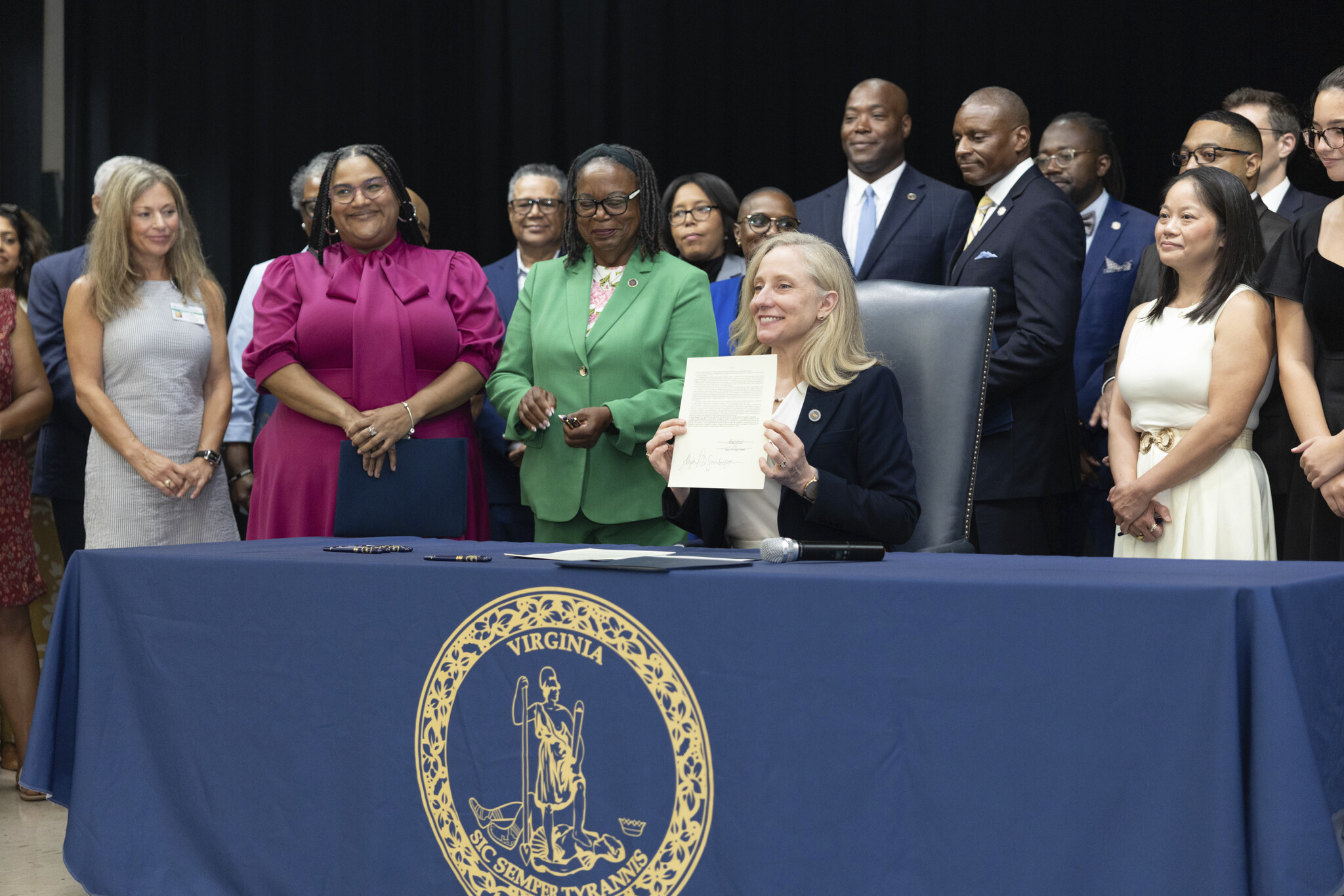
In February, Governor Abigail Spanberger signed legislation moving party primaries to August 4 to give time for the redistricting election to be held. With that process at a conclusion and the 2021 boundaries in place, attention now turns to who will be on the ballot.
Under the now-discarded maps, Albemarle and Charlottesville would have been included in a new 6th District designed to include several cities along the I-81 corridor. However, Albemarle and Charlottesville will continue to be in a district that extends south to Danville.
In 2008, the district was configured differently but still covered wide swaths of southside Virginia. Democrat Tom Perriello won a narrow victory over Republican Virgil Goode in 2008 with 158,810 votes to 158,083 votes. He served one term before being defeated by Republican Robert Hurt in a three-way race.
Perriello announced in December he would seek another term, entering a race that included Albemarle County Supervisor Mike Pruitt. Pruitt and other candidates would later drop out of the race to endorse the former Congressman.
Perriello had been anticipating a run in the Sixth District but today announced he would take on incumbent Republican John McGuire in the 5th.
“I won this district by focusing on cutting costs, increasing paychecks, and putting common sense back in the driver’s seat,” Perriello wrote in a Facebook post. “McGuire has voted to take money out of our pockets to support the corruption and kickbacks the Mar-a-Lago set.”
McGuire issued a statement commending the majority on the Supreme Court for the ruling.
“Virginia Democrats’ hasty, dishonest, and illegal attempts to redraw our maps proved how desperate they are to take away our representation,” McGuire said. “Democrat politicians in Virginia tried to cheat by violating our constitution, but thank God they didn’t get away with it.”
According to the Virginia Public Access Project, other Democrats in the case are Suzanne K. Krzyzanowski of Lynchburg and Rob Tracinski of Louisa County.
McGuire faces a primary challenge in Melanie Lucero.
Two independent candidates are Cooke Costa Harvey and Chris Register.
Before you go: The goal of Town Crier Productions is to increase awareness about what is happening at the local, regional, state, and federal government levels. Please share the work with others if you want people to know things. Paid subscribers cover the cost of conducting research for this article which was originally published in the May 8, 2026 of Fifth District Community Engagement.
Yes indeed! I ended up going off of hiatus for a special edition that asks in the epilogue if there’s a chance of raising funds to turn that newsletter into a training platform? Worth a shot. If you’d like to make it happen, make a charitable contribution.
Discover more from Information Charlottesville
Subscribe to get the latest posts sent to your email.