There have been several stories in Charlottesville Community Engagement recently about the generation and transmission of electric power.
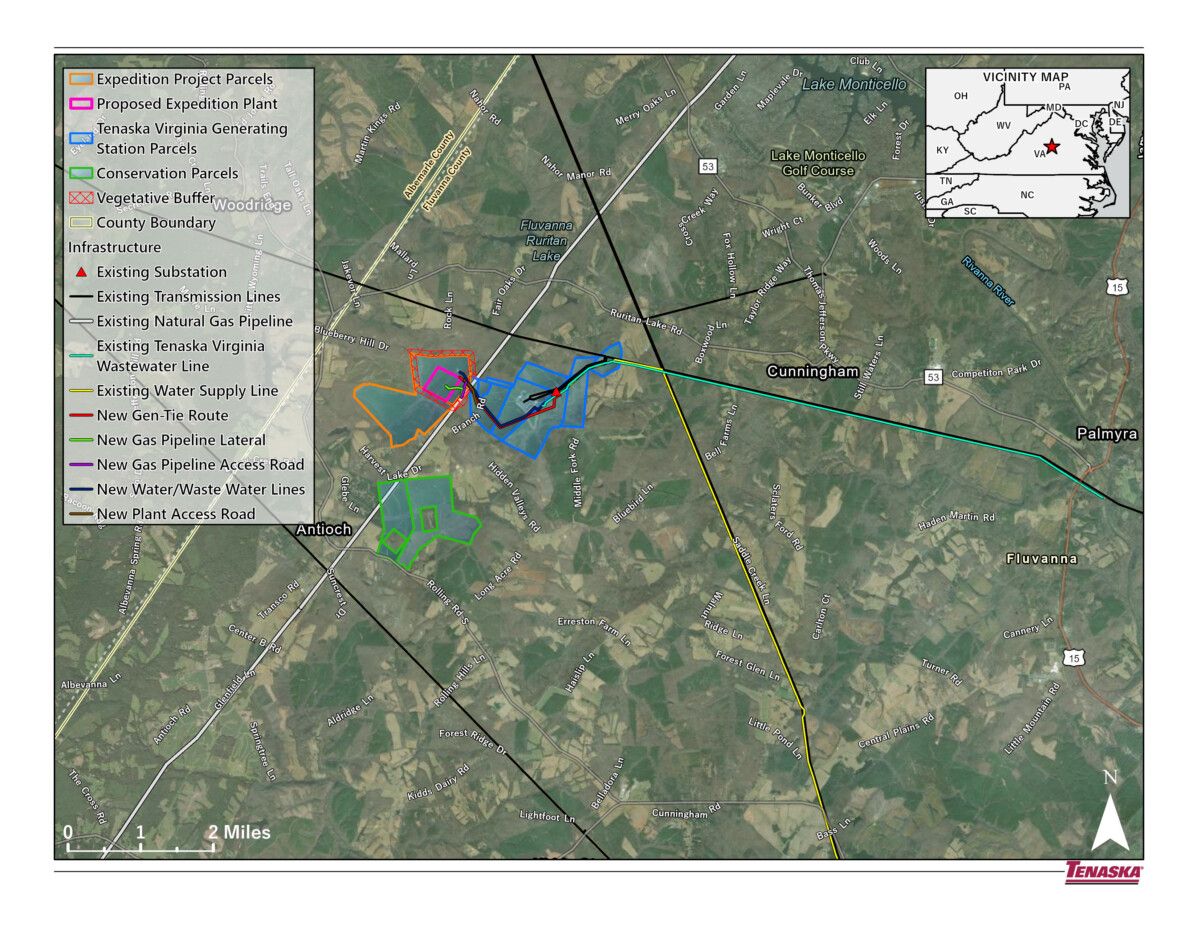
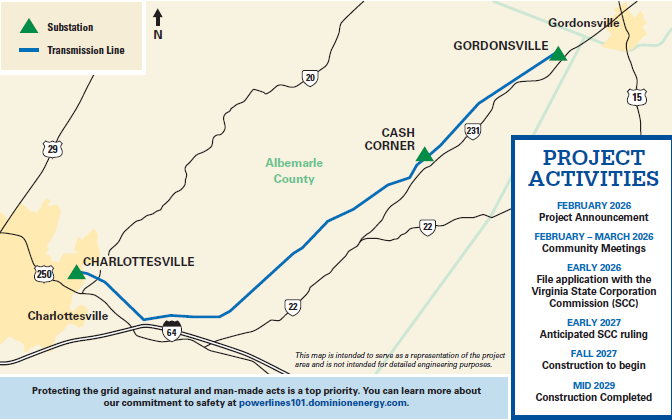
Dominion Energy and NextEra want to merge, Tenaska is moving ahead with a second natural gas plant in Fluvanna County, and there’s a public hearing in Charlottesville City Council Chambers on October 22 for the rebuild of a power line from the city to Gordonsville that will double pole heights.
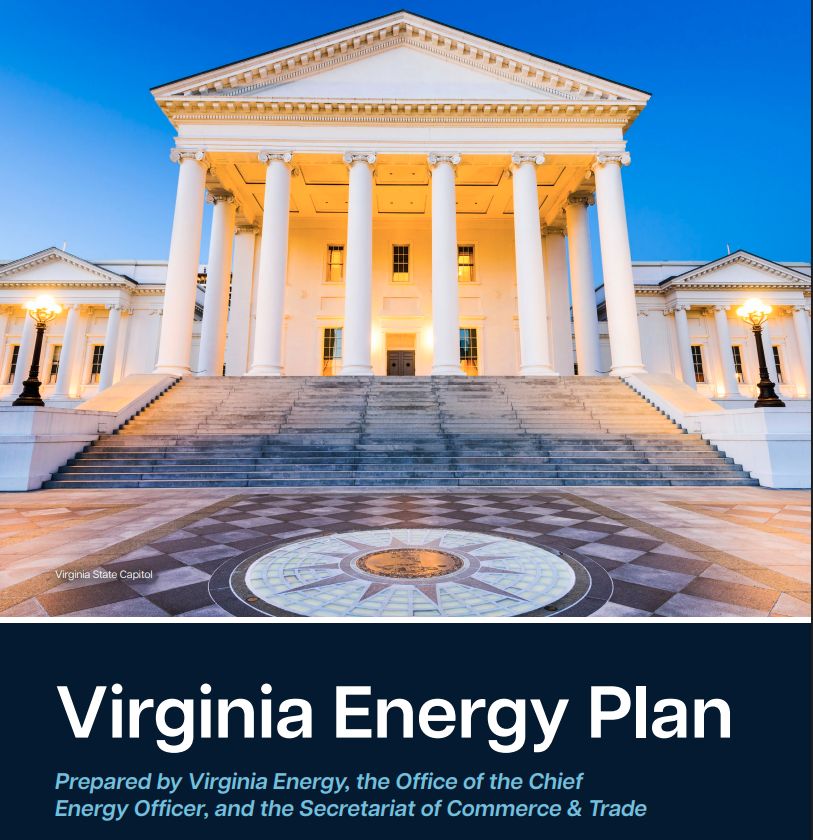
Amidst all of the pending issues, Governor Abigail Spanberger has released her administration’s version of the Virginia Energy Plan to guide executive policy in the next four years.
“We have written this Energy Plan at a moment unlike any in the recent past,” reads a letter that accompanies the 192-page document. “Electricity demand is rising rapidly, and our energy system will need to grow at a pace we have not seen in more than 80 years.”
Spanberger said the plan is informed by public comment as well as modeling of four pathways to meet growing demand for energy and all are intended to help Virginia meet a goal of being net-zero emissions by 2050.
“The Energy Plan also models the cost of walking away from our clean energy commitments,” reads the plan. “While some might question whether abandoning Virginia’s Clean Economy Act or once again exiting the Regional Green House Gas Initiative could produce cost savings, the model quantitatively disputes this notion.”
The plan begins with three pages of acronyms ranging from the Accelerated Clean Energy Buyers to Weatherization Deferral Repair. In this plan, ICE stands for internal combustion engine. And IOU stands for “investor-owned utility.” VEP is Virginia Energy Plan
Virginia law calls for the creation of such a plan every four years for guidance. This new version states that forecasts for electricity demand currently contain a lot of uncertainty.
“The VEP recognizes these challenges and provides a blueprint for how Virginia manages growth while maintaining reliable energy service, allocating costs equitably, considering environmental impacts, public health, and natural resources, and improving outcomes for residents and businesses,” reads page 7 of the plan
Over 3,000 people took part in a public survey and six regional meetings were held throughout the Commonwealth. The plan also documents the existing mix of energy sources in Virginia. In 2024, petroleum was the most used followed by natural gas and nuclear.

According to the plan, energy consumption grew substantially in the last four decades of the 20th century but remained fairly flat from 2000 to 2024 in part because of gains in energy efficiency. In recent years, though, data centers have begun to consume a tremendous amount of power.
“Data centers now account for approximately 31 percent of Virginia’s annual electricity consumption as of 2025, while residential use has remained comparatively flat as efficiency gains offset population growth,” reads page 25 of the plan. “Transportation electrification has started contributing to electricity demand but remains a relatively small portion today.”
The plan is also a useful guide to learn the policy landscape and recent history such as the 2007 Virginia Electric Utility Regulation Act and the 2018 Grid Transformation and Security Acts which forced Dominion Energy and American Electric Power to begin implementation of solar and wind generators.
The 2020 Virginia Clean Economy Act established a mandatory “renewable portfolio standard” and set targets for the two power companies to retire fossil fuels by 2045. That same year, the General Assembly voted to enter into the Regional Greenhouse Gas Initiative. Governor Glenn Youngkin pulled Virginia out of the interstate compact but the Spanberger administration has rejoined.
“The 2026 General Assembly passed several bills that expanded the requirements of VCEA and address the evolving energy context within Virginia and regionally,” reads page 20 of the plan.

There are four types of energy producers. The first is “investor owned utility” and that consists of Dominion, AEP, and Kentucky Utilities. The latter only serves a small portion of southwest Virginia.
There are also thirteen member-owned electric cooperative. Some communities own their own power plant. Then there are independent power producers who sell into either PJM Interconnection or the IOUs. This latter category includes companies that work with localities no installing solar projects as part of a power sharing agreement.
PJM itself is a network of high-voltage lines across 13 states and the District of Columbia.
“Regional coordination supports reliability by enabling utilities to share reserves, dispatch available generation across state lines, plan transmission jointly, and purchase energy and capacity through competitive markets,” reads page 29.
Yet, there are trade-offs.
“Virginia customers are exposed to regional market prices, transmission costs, resource constraints, and planning decisions that may originate outside the Commonwealth,” the plan continues. “PJM’s recent challenges—including interconnection delays, rising capacity prices, transmission constraints, and uncertainty associated with rapid load growth—therefore have direct implications for Virginia.”
After a long discussion of capacity for each type of power generation, the plan has a section on data centers which require a lot more power than other commercial uses and other types of large load customers such as factories and hospitals. But the report notes that not all data centers are alike.
“Some support government, defense, communications, financial, or other critical functions, while others serve commercial computing needs,” reads page 49 of the plan. “Facilities can differ
in size, cooling systems, water use, backup-power arrangements, efficiency, and ability to shift computing activity—factors that all impact energy consumption.”
The price of energy fell from 2015 to 2025 when adjusted for inflation. That begins to change from 2024 to 2025 when retail prices grew by 4.6 percent, faster than the inflation rate. One reason is higher capacity prices charged by PJM.
“Today, the surge in data center demand (further discussed in Section 2D) has exceeded available grid capacity, creating upward pressure on rates due to additional generation, transmission, and distribution capacity that needs to be built out to serve this load,” reads page 80 of the plan.
As for the path forward, the plan recommends several strategies such as accelerating the development of clean energy such as utility-scale solar and improvement of the existing grid. Another is to ensure that data centers pay for capacity expansion. Details begin on page 129.

Before you go: The goal of Town Crier Productions is to increase awareness about what is happening at the local, regional, state, and federal government levels. Please share the work with others if you want people to know things.
Paid subscribers cover the cost of conducting research for this article which was originally published in the October 1, 2026 edition of Charlottesville Community Engagement. You can either subscribe through Substack or make a charitable contribution.
Discover more from Information Charlottesville
Subscribe to get the latest posts sent to your email.