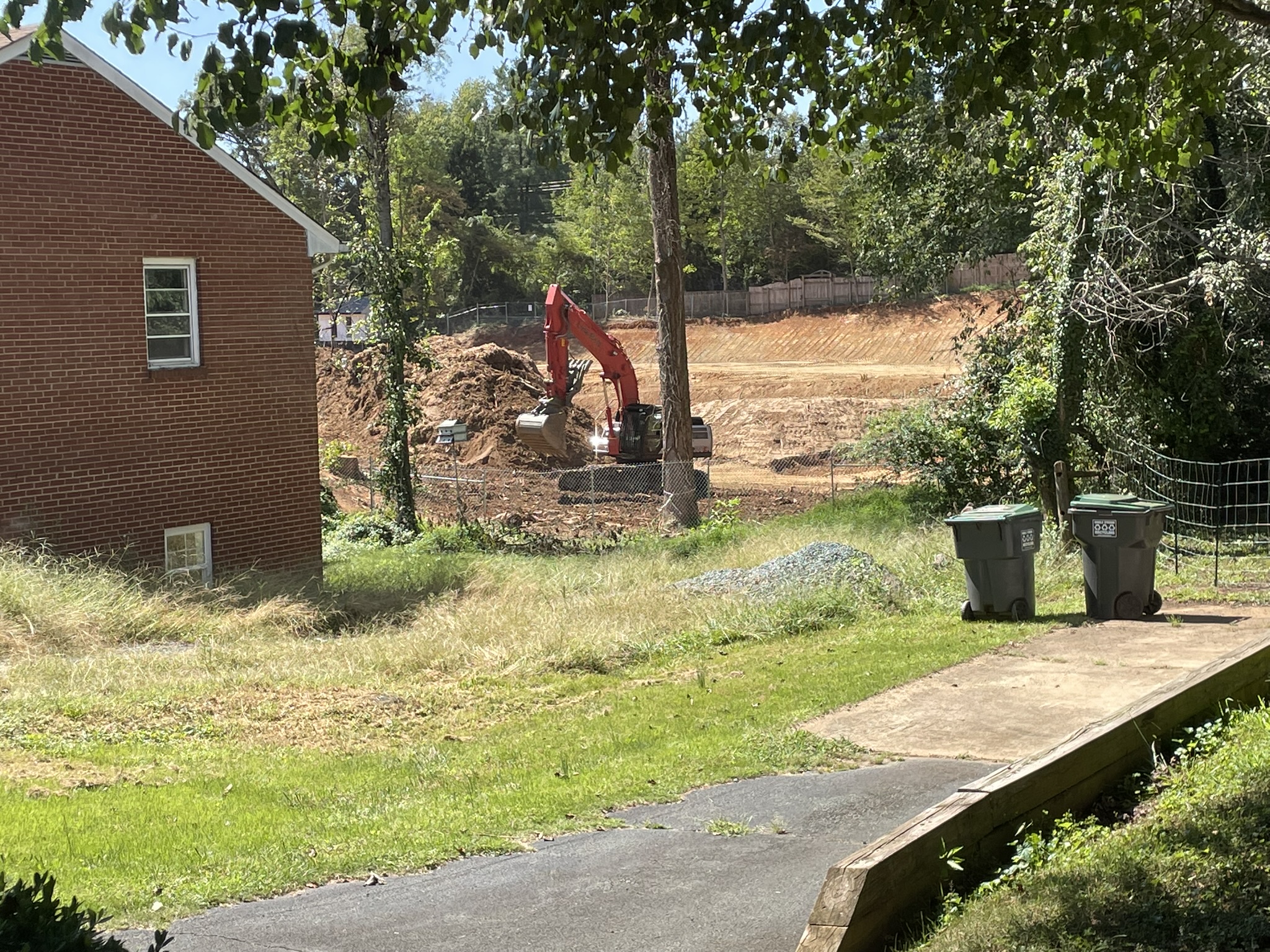
A group of residents of the city’s Fry’s Spring neighborhood continue to have questions about whether the developer of a 45-unit residential project complied with conditions of a waiver granted by City Council years before construction began.
“We’re asking you to bring Stanley Martin back to the table and give this council and this community the opportunity to address deficiencies we have identified and documented and hold Stanley Martin accountable for disregarding the conditions of its waiver,” said Jesse Harper, the first of several speakers to address the issue at Council’s September 8 meeting.
Council voted 3-2 on January 3, 2023 to approve a waiver to allow a disturbance of what are known as critical slopes in both the 2003 zoning code and the Development Code approved by City Council in December 2023. The land is in between Monte Vista Avenue and Azalea Drive.
The rules for critical slopes are in the Environmental Sustainability division of the Development Code. The intent is “to protect and maintain the environmental quality in the City by limiting development and disturbance of steeply sloped areas near waterways, adjacent properties, and environmentally sensitive areas to protect those steeply sloped areas and waterways from the negative impacts of erosion and stormwater as well as preserve their ecological value.”
Buildings are not allowed on sections of land above a 25 percent grade nor can that land be disturbed. Under the old code, a developer could seek a critical slopes waiver but under the new one relief is granted through a special exception. A major difference is that special exceptions do not require public hearings.

In the case of Azalea Springs, Stanley Martin Homes had the right to build up to 88 units on lots platted in the early 20th century. That meant they did not have to honor the critical slopes provisions because the new rules did not apply. Civil engineers working for the company sought the critical slopes waiver to provide a better product to their customers.
Bulldozers and excavators begin clearing the land for development in late July under the watchful eye of many in the neighborhood concerned with the removal of a forest. A storm in early August overwhelmed silt fences with stormwater that fell on the disturbed land causing a lot of sediment to be transported downstream into the Moores Creek watershed. The Virginia Department of Environmental Quality is still investigating a complaint. (take a look!)
Harper told Council that the neighborhood’s position is that Stanley Martin Homes did not follow the conditions called for in the waiver.
“Immediately after construction began, Stanley Martin disregarded and failed to implement the protective measures demanded by their waiver,” Harper said. “And the result is still sitting downstream— sediment equivalent to 10 or more full-size dump truckloads. This wasn’t an accident. It was an intentional disregard of this Council’s conditions and a failure to implement even the most basic stormwater management measures.”
The city issued a stop work order soon after the incident but has since lifted it. Harper said he’s been told by staff that the city will not pursue the maximum penalty and he called on Council to intervene.

After public comments, City Engineer Brennan Duncan was called up to address the topic and he confirmed that the stop work order had been lifted but it was in place for most of August while the site was brought into compliance.
“It’s to the point where we were, we felt comfortable that what had happened with the discharge was not going to happen again,” Duncan said.
Duncan said staff have been reviewing the incident against the stormwater pollution protection plan (SWPPP) that was in place.
“We’ve done one final SWPPP inspection to make sure there weren’t any other items outstanding,” Duncan said. “The SWPPP inspection is really kind of where they’re supposed to keep track of everything that happened and, you know, all of their tests that they did on the water as they were dewatering, all that kind of stuff. So we wanted to make sure that they captured all that properly.”
A consent order will be drawn up with a list of corrective actions and this is where the fines will come in. That was not known as of September 8. According to Duncan, the maximum fine per day is $32,500 but that high range is seldom charged.
“That’s usually used for infractions where, you know, somebody didn’t have a permit at all, there is a, you know, a large fish kill, there’s chlorine or something like that,” Duncan said. “I anticipate it will probably be in the tens of thousands of dollars, but I don’t have the exact number.”
Other speakers during public comment had noted that the removal of the forest took place at a sensitive time for wildlife who called seven acres of mature forest home.
“The developers started removing them in July,” said Jess Wenger. “If July doesn’t strike any chords with you, that is resident and migratory songbird nesting season. It is pup season for bats, both threatened and endangered, and just bats in general are kind of struggling right now. And also, many urban-dwelling mammals have babies this time of year.”
Duncan said there are state and federal rules but they don’t always apply because the city has not adopted a local ordinance.
“If we’re working on a [Virginia Department of Transportation] project, you know, we have to follow that,” Duncan said. “But currently we do not have anything in our environmental regulations that speak to only cutting down the trees in a specific time of year.”

City Attorney John Maddux had more details.
“We’re talking about the Migratory Bird Act and various protections that are enforced by Virginia Fish and Wildlife, Federal Fish and Wildlife,” Maddux said. “They are the enforcers of those rules. We are enforcers of our own rules.”
As for revocation of the waiver, Maddux called that a “very thorny legal issue” in part because there is no provision in the code for such an action. He said he would need to do more research.
“We would have to explore that in some depth and be very careful because we are dealing with development approvals and zoning approvals, and these are things that are rife for litigation,” Maddux said.
Duncan also provided more description of how the stormwater water pollution prevention plan is supposed to work. He said inspections are required every 14 days and also within 48 hours of a significant rain event. Days before the storm, the city found a violation and gave the developer a notice to comply.
“In essence, the reason that the discharge occurred, they’re supposed to only disturb, I’ll call it, I don’t know the exact percentage, but say ten percent of the property to get down to the bottom and construct the detention basin or the, you know, down at the bottom to hold the water as they’re building the site,” Duncan said “They had not built that up. They had not built that when they had cleared, I’ll call it 60 percent of the site. So they cleared five, six times the amount that they were supposed to at that point.”
Duncan said the site is now in compliance and explained that the systems are now in place to prevent a future sizable discharge. Inspectors are visiting the site every few days as opposed to every 14.
There is more to tell of this story as it develops.
One other issue in this story is the existence of another paper street that is owned by the City of Charlottesville but not maintained. Several speakers asked for the city to begin to do so. If you missed it, check out a story I did a few weeks ago about how one paper street has been handled in Belmont when Council ceded its claim to a developer on a 4 to 1 vote.
Before you go: The goal of Town Crier Productions is to increase awareness about what is happening at the local, regional, state, and federal government levels. Please share the work with others if you want people to know things. Paid subscribers cover the cost of conducting research for this article which was originally published in the September 9, 2026 edition of Charlottesville Community Engagement. You can either subscribe through Substack or make a charitable contribution.
Discover more from Information Charlottesville
Subscribe to get the latest posts sent to your email.