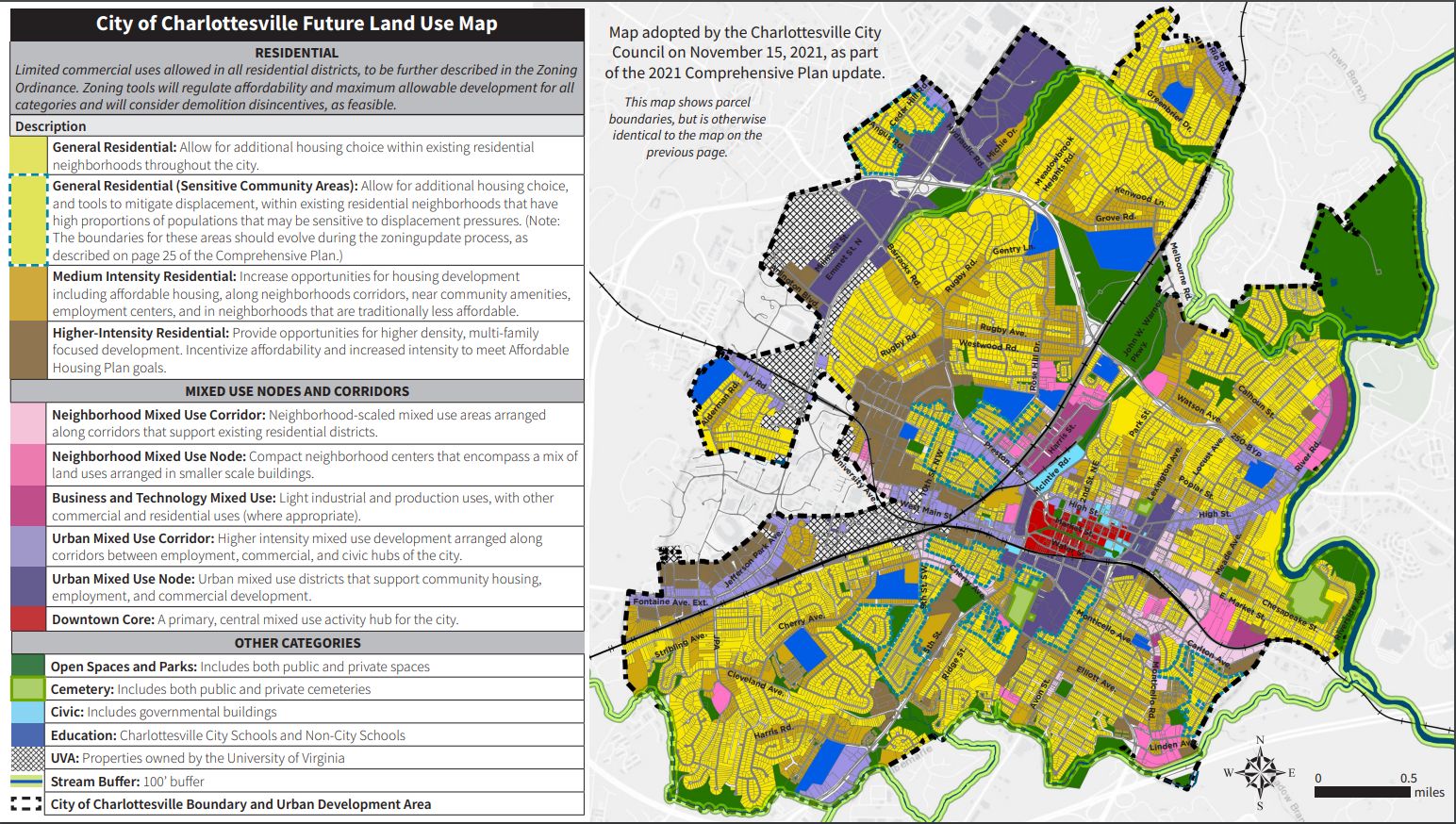
A major feature of Charlottesville’s relatively new zoning code is a reduction of City Council’s involvement in determining the level of residential density allowed on a property. Land owners across practically most of the city have more development rights without the need for elected officials to grant a special use permit.
However, the Council still has a large role to play in making other decisions such as whether to give up public land that has been set aside for streets that never got built. These are known as “paper” streets. On August 17, the elected officials were asked by a developer if they would vacate a 162-foot-long unbuilt section of Castalia Street in the Belmont neighborhood.
“This is for a development project that has been proposed at 303 Palatine as well as 221 Palatine,” said city engineer Brennen Duncan. “The property owner owns both of these parcels on either side of the current street.”

The proposed development would include 13 units across both properties with the vacated land serving as a private alley to support the residences. Staff recommended proceeding because of the county’s housing goals.
Developer Nicole Scro said that other portions of this paper street were vacated a quarter of a century ago so it cannot be used to reach Rockland Avenue to the north. She explained the roadway would still be accessible to the public and to the Charlottesville Fire Department. There is also an unimproved alley that runs east-west between Palatine Avenue and Rockland Avenue.
“All of the pedestrian and vehicular and whatever access you would like is going to be preserved,” Scro said. “Another point is that that’s an unimproved alley, but if anyone were to improve it, we would preserve that connection.”
Several people spoke before the item to ask Council to deny the request.
Anne Lassere said she understands that Charlottesville needs more housing and said she supports the higher density but she said it would set a precedent to hand over the land to the developer.
“This 162-foot street is a public asset, and these historic alleyways are one of the things that make the Belmont neighborhood special,” Lassere said. “Public rights-of-way serve a vital long-term purpose for our neighborhood connectivity, future pedestrian pathways, and public infrastructure easements. Once the city surrenders public land to a private entity, it’s gone forever.”
Lee French said that the submission has twice been denied by Neighborhood Development Services staff but it also must be noted that is a routine part of an iterative review process.
“Without this public land, the developer will be forced to design a project that actually fits in the geographic and infrastructure constraints of our existing neighborhood,” French said. “The city’s primary responsibility is to protect the public space and the neighborhood livability, not to optimize private development assembly.”

What’s the policy?
Councilor Lloyd Snook said in recent years the city has been less willing to give public property over to developers for free.
“If we sell it, by my calculations, if it’s 132 feet long and 22 feet wide, and the land is being sold at the same rate as adjoining property is assessed on a per square foot basis for the land, that would be about $60,528,” Snook said.
Snook was elected in November 2019. Since then there have been several times when Council expressed reluctance to part with small strips of public land.
- On June 21, 2022, Council was asked to convey a 20-foot strip of right-of-way in Fifeville for an unbuilt section of Oak Street. Former Councilor Sena Magill called for a halt on such transfers until there was a specific policy in place. Councilor Juandiego Wade said he thought they could be held on a case-by-case basis. The item was deferred to July 18, 2022. (read the story)
- Also at the June 21, 2022 meeting, Council voted 4 to 1 to deny a request from the owner of 815 East Jefferson Street for the city to hand over 0.02 acre sliver of land between his property and 9th Street NE. Wade was the dissenting vote. (read the story)
- Wade was not present at the July 18, 2022 meeting and so action on the Oak Street land was deferred until August 15, 2022 and then deferred a second time until October 3, 2022. At the July meeting, Council had learned that the now-defunct Office of Community Solutions was to come up with a policy. (read the story)
- The October 3 reading was deferred until November 7, 2022 when former City Attorney Lisa Robertson gave a presentation on vacating rights-of-way. There is no written staff report and I did not write this into a story but the totality of the minutes are an image below. According to the minutes, Robertson said the Office of Community Solutions would provide a new policy.
- Robertson resigned abruptly two months later. (read the story)
- Councilor Sena Magill resigned in early 2023. (read the story)
- In the summer of 2023, an entity called Main Street West LLC asked to purchase a sliver of land in the 600 block of West Main Street for $119,108. A public hearing was held on August 21 that year. A majority supported selling the land. Councilor Michael Payne said he did not support the sale. (read the story)
- At the next Council meeting, several people asked the city to keep the land. City Manager Sam Sanders announced the sale would not proceed. (read the story)
- Sanders eliminated the Office of Community Solutions in June 2025. (read the story)

At the August 17 discussion on the Castalia paper street, Snook said the policy should be that the city does not give away land.
Sanders said that is not currently the city’s policy.
“I would just indicate that you would need to be clear that that’s a policy that you are asking for, because it does not exist today,” Sanders said. “It may be practice that has occurred here and there, but if we could, Mr. Mayor, make sure that we get enough of the direction, and we’ll do the work on crafting said policy for going forward.”
Mayor Wade said he supported moving forward with giving the land up because it would support the goal of more housing. Snook suggested $60,000 is not too high a number to stop a 13-unit development from moving forward. He also pointed out that there has been a lot of staff turnover since 2022.
John Maddux has been City Attorney since May 2025, succeeding Jacob Stroman who was on the job for less than a year before retiring after having been on administrative leave. Maddux said this was the first time an alley vacation had come up during his term.
“We do have a 2019 street alley closure policy,” Maddux said. “There are exemptions in here. There’s a whole scoring rubric. There’s a process that requires negotiation through the City Attorney’s Office. There’s a lot of stuff with this that I’m not prepared right at this moment to say what does and does not apply from standing right here.”
Civil engineer Kelsey Schlein said she has been working with Scro on the project for the past 18 months and said there had been no mention of being required to pay for the land.
“That is not a policy that’s in place,” Schlein said. “We have checked every single box. We nearly have a fully approved site plan. We couldn’t get before you without spending tens of thousands, many tens of thousands of dollars, nearly $100,000 on surveying, engineering, study, study, study to get to this point just for you to be able to consider this.”
Councilor Jen Fleisher said she wants a policy in place for the future but was willing to proceed with vacating this particular location.
“I’m ready to go forward with giving up the alley and get the project going per the request,” Fleisher said. “But I would want from here on in this to be clarified and properly— not codified, but…
“Formalized,” said City Councilor Natalie Oschrin.
“Formalized,” Fleisher confirmed.
Neither Oschrin nor Fleisher were in office in Council in November 2022 when Council was told there would be a policy in place about this very issue.
Snook said the developers should not have expected to get the land for free.
Deputy City Manager James Freas said in this case, Scro would grant the city an access easement on improved property.
Keep reading Charlottesville Community Engagement for more stories about how the city’s built environment changes over time.
Before you go: The goal of Town Crier Productions is to increase awareness about what is happening at the local, regional, state, and federal government levels. Please share the work with others if you want people to know things. Paid subscribers cover the cost of conducting research for this article which was originally published in the August 26, 2026 edition of Charlottesville Community Engagement. You can either subscribe through Substack or make a charitable contribution.
Discover more from Information Charlottesville
Subscribe to get the latest posts sent to your email.