


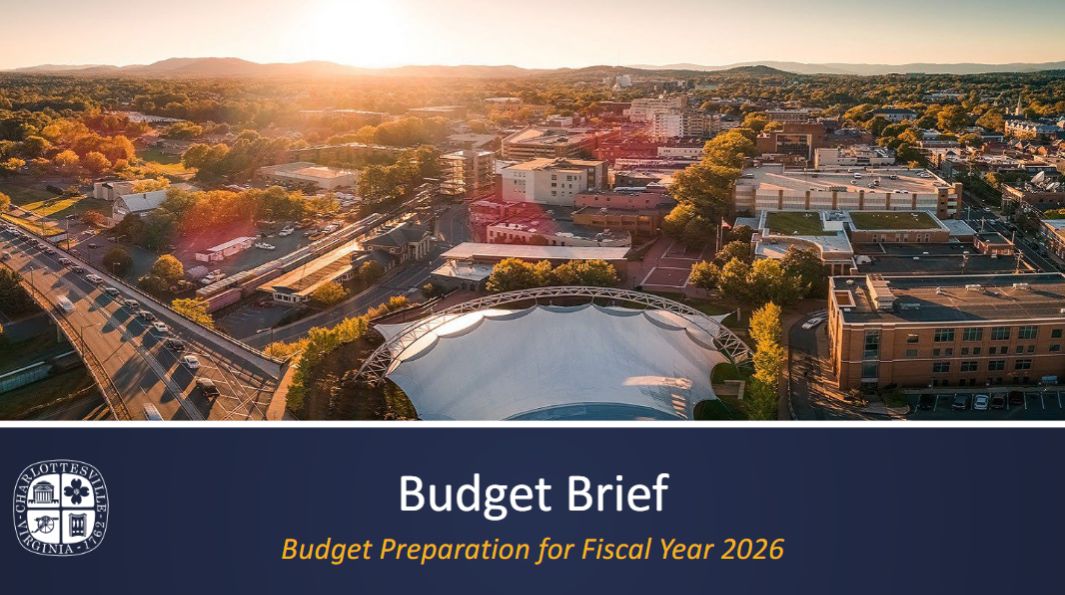
There are about two and a half months before Charlottesville City Manager Sam Sanders will deliver a proposed budget to Charlottesville City Council but he gave the third and final briefings to elected officials on December 16.
“It’s a three part series that I wanted to spend a little more time in advance of bringing Council the balanced budget that I’m required to bring in March,” Sanders said. “A chance for you all to begin to see and hear some of the challenges that we face as a budget team as we work to put together this next fiscal budget.”
More information on revenue will be known at the end of January when the real property assessments will be published for 2025.
Sanders said the costs for nearly everything are increasing and the 40 minute conversation went through many examples.

Fire Department and Police Department
There’s an identified need to hire a full-time equivalent in order to comply with changes to state and federal law that require fire and EMS departments to provide more scrutiny over pharmaceuticals.
“We have been receiving the drugs that we use on the ambulances from the university hospital,” Sanders said. “They put that package together and we received that. And that’s how we would outfit each of the units that we use. That’s changed. We now have taken on that responsibility ourselves.”
Sanders said localities across the Commonwealth are having to add similar positions in order to comply.
“Any fire department that is running what’s called advanced life support or paramedics, where they’re dealing out drugs is going to have to have kind of that pharmaceutical arm under the new state statute,” said deputy city manager Eden Ratliff.
Legislation in Virginia traces back to the 2013 Drug Supply Chain Security Act which passed the U.S. Congress. This is a story to track over time.
The fire department also seeks to hire someone to review land use plans to ensure they comply with safety regulations. A person who has been doing that work has retired.
Sanders also identified $4 million in equipment replacement over the next five years.
“Those are not items that we’re really wrestling with because I know that you want me to make sure that we have the equipment to fight fire,” Sanders said.
Sanders said the police department is currently three officers shy of capacity but the hope is to have as many officers as authorized. That will mean higher equipment costs because Chief Michael Kochis has attracted new recruits.
“As we bring those folks on board then we have to outfit vehicles, provide them the resources that they need,” Sanders said. “And that would include a car fully outfitted.”
Officers can also take their cars home, which means officers can be at the ready if called to action. This program is now part of the collective bargaining agreement.
Emergency Management
Sanders said local governments need plans for major disasters and major incidents such as the Unite the Right Rally in August 2017. He said the city’s emergency management coordinator has made several requests to ensure readiness.
“There’s been conversation about do we put bollards along the crossings on the Mall and therefore we no longer have to have personnel and vehicles do that,” Sanders said. “We just go and attach the bollards to serve in the capacity of blocking a car from being able to continue on.”
Other desired items include an emergency radio system for city staff who aren’t in public safety as well as planning for scenarios such as evacuating the city for some reason.
“All that has to be planned for, and all that comes at a cost,” Sanders said. “So part of what the conversation is right now is to what degree do we plan for that, to what degree do we, the city of Charlottesville, have to independently be able to address that?”
Sanders said Albemarle and the University of Virginia has more advanced plans in place and he wants the city to be able to catch up. He didn’t provide any cost estimates.
Transit
Sanders broke down what ended up being a conversation on transit into three categories: Planning, capacity, and capital investment.
Under planning, he said the city would need to set aside money to help launch the Charlottesville Albemarle Regional Transit Authority. He also said the city is moving forward to electrify the school bus fleet as well as investment in hydrogen fuel pilot for Charlottesville Area Transit.
“We took two groups to Champaign-Urbana, Illinois,” Sanders said. “We learned that this is an opportunity for us to help stabilize the idea that maybe a fully battery electric bus fleet is not stable, that we might be able to mitigate some of the impacts by having a dually fueled system.”
I was able to cover one of those trips back in May if you want to read the story or hear the audio version.
Sanders said CAT would need 12 additional drivers to allow for further optimization phases to be implemented, but each new driver comes with a cost and a dozen would cost a million.
“I cannot say at this moment that I see a million dollars just for that particular line item,” Sanders said. “But I do recognize that there is a need for us to make significant improvements and changes to our routes.”
Sanders said the collective bargaining agreement with transit employees has been a challenge and more staff hours are needed to help with negotiations. For instance, he said his staff recently had a four-hour budget meeting.
“It took us four hours to get through it because there’s so many different parts and pieces to what’s going on,” Sanders said. “It’s complicated and expensive and it just causes us to have to make sure that we ask all the right questions.”
Sanders said there is also interest in a pilot program to operate MicroCAT within a portion of city limits. Albemarle County has been under a pilot program since November 2023 and a city pilot would cost $475,000. He’ll seek further comment from Council on whether to spend the money for a small geographic area.
“It is not citywide,” Sanders said. “It does not serve every single person in this community. It is a small geography near the Best Buy. That’s the best way for me to describe it. And it’s an opportunity for us to ensure that that service, which has really, really been extraordinarily above all expectations, it’s a chance for us to try to distinguish bus service in this area.”
Sanders said Charlottesville will also need to begin to cover the costs of local matches for state and federal transit funding now that there is no more federal COVID-relief funding. That’s an increase of at least $400,000.
Council met with the Charlottesville School Board on Thursday to hear more about their request for FY26. Sanders also said Council should have sat in on the December 10 public hearing the Planning Commission had on the Capital Improvement Program but will have their own public hearing in the future.
Before you go: The time to write and research of this article is covered by paid subscribers to Charlottesville Community Engagement. In fact, this particular installment is from the December 18, 2024 edition of the newsletter. To ensure this research can be sustained, please consider becoming a paid subscriber or contributing monthly through Patreon. There will be new options in 2025 if you’d like to wait. Just please know I’m glad you’re reading!
Discover more from Information Charlottesville
Subscribe to get the latest posts sent to your email.


