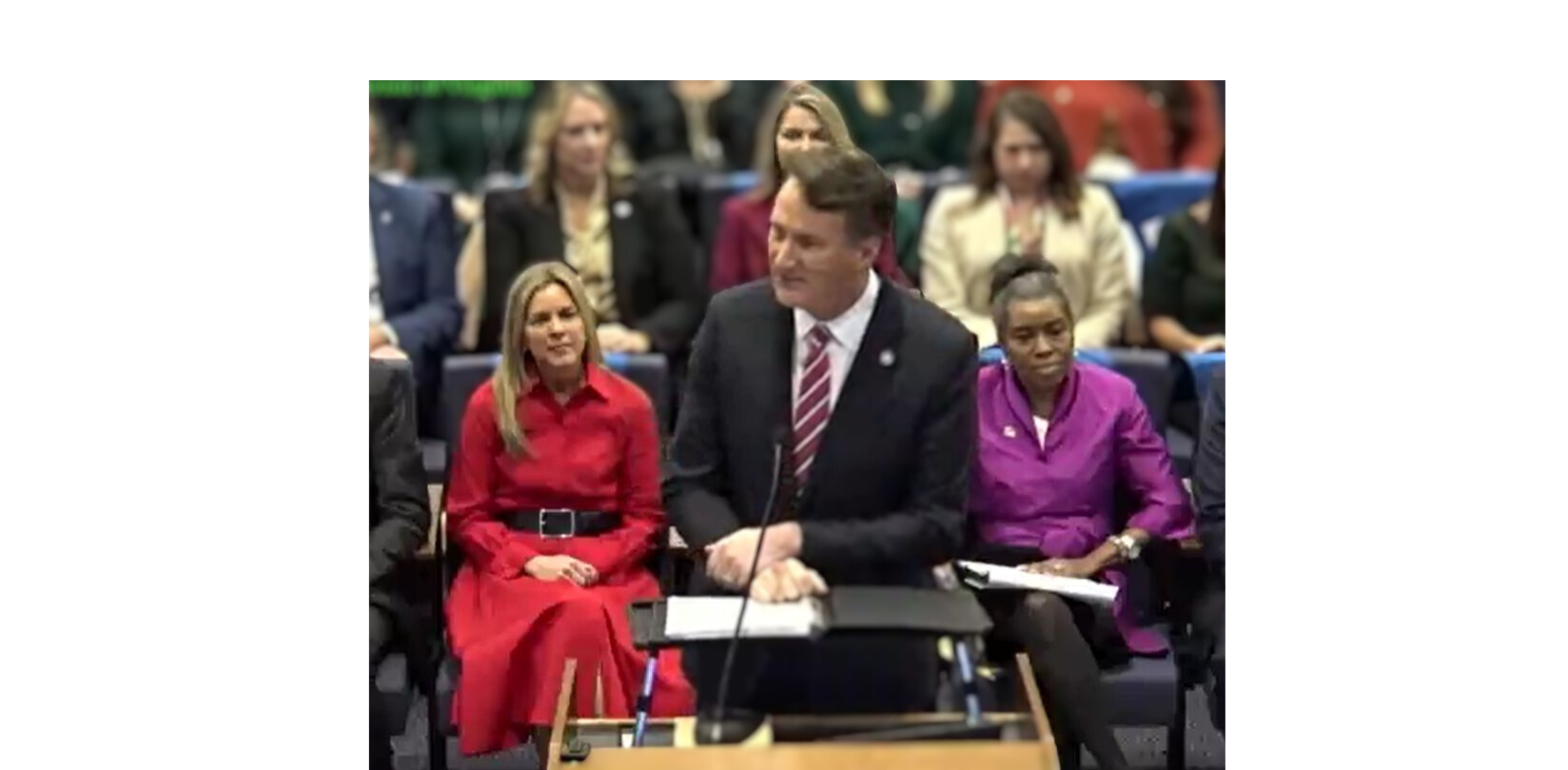
An annual rite of passage took place in Richmond the morning of December 18 as Governor Glenn Youngkin appeared before legislators on the four money committees of the General Assembly. He shared credit with Senators and Delegates for what he called a “roaring” economy.
“Together we provided generational tax relief, invested record amounts in education, public safety and behavioral health,” Youngkin said. “We reopened Virginia’s economy after a global pandemic, all while delivering surplus after surplus after surplus.”
The meeting consisted of the finance and appropriations committees of both the Senate and the House of Delegates. Youngkin said Virginia had been preparing for a recession that did not come and said it is time to prepare for a new forecast of continued growth.
“There is reason to be optimistic about our economic outlook,” Youngkin said. “Small business optimism is at a three year high. Consumer confidence is rising rapidly. Foreign businesses are reshoring to America and Virginia. The stock market is strong.”

Youngkin presented a revised budget forecast with an additional $3.2 billion in revenue over the biennium. He told the money committees he wants to eventually phase out the tax on personal property tax, but may not be able to do in a shorter General Assembly session in 2025. He did suggest a proposal for the short-term.
“Under my amendments this morning, a family of four will be fully reimbursed with the working class car tax credit, a permanent refundable income tax credit of up to $150 for individuals earning under $50,000 a year and up to $300 for joint filers with under $100,000 of annual income,” Youngkin said.
As the personal property tax is collected by localities, this would be paid for through a $1.1 billion deposit into a relief fund.
Another idea is to eliminate service tips from Virginia’s income tax, something previously announced this week. A third idea is to make permanent the allowed standard deduction on income taxes of $8,500 for individuals and $17,000 for joint filers. This is currently set to expire on January 1, 2026.
Youngkin also suggested some spending as well, including an additional $1 billion for public schools. He also that while there is half a billion in capital funds for higher education, there will be no increase in operating funds for public universities and a 2.5 percent cap on tuition increases.
“I’ve been clear with our Boards of Visitors and Presidents, it’s time for our colleges to cut the administrative bloat, find savings and get a handle on cost escalations without asking taxpayers for more money,” Youngkin said.
The University of Virginia does not appear to be a recipient of any of that half-billion but eight other new projects are in Youngkin’s amendments. These include an expansion of the Virginia Tech – Carillion School of Medicine and the Fralin Biomedical Research Institute.
Resources to learn more:
- Economic Outlook and Revenue Forecast from Secretary of Finance Stephen E. Cummings
- Governor Youngkin’s Proposed Amendments to the 2024-2026 Biennium
- Watch the video here
Before you go: The time to write and research of this article is covered by paid subscribers to Charlottesville Community Engagement. In fact, this particular installment is from the December 18, 2024 edition of the newsletter. To ensure this research can be sustained, please consider becoming a paid subscriber or contributing monthly through Patreon. There will be new options in 2025 if you’d like to wait. Just please know I’m glad you’re reading!
Discover more from Information Charlottesville
Subscribe to get the latest posts sent to your email.