For nearly forty-five years, Albemarle County has had strict rules in place that prevent non-agricultural businesses from operating in the rural area. That’s around 95 percent of the locality’s 726 square miles.
Those who wish to operate a business in the rural area do have the right to petition Albemarle’s Board of Supervisors to grant a special use permit.
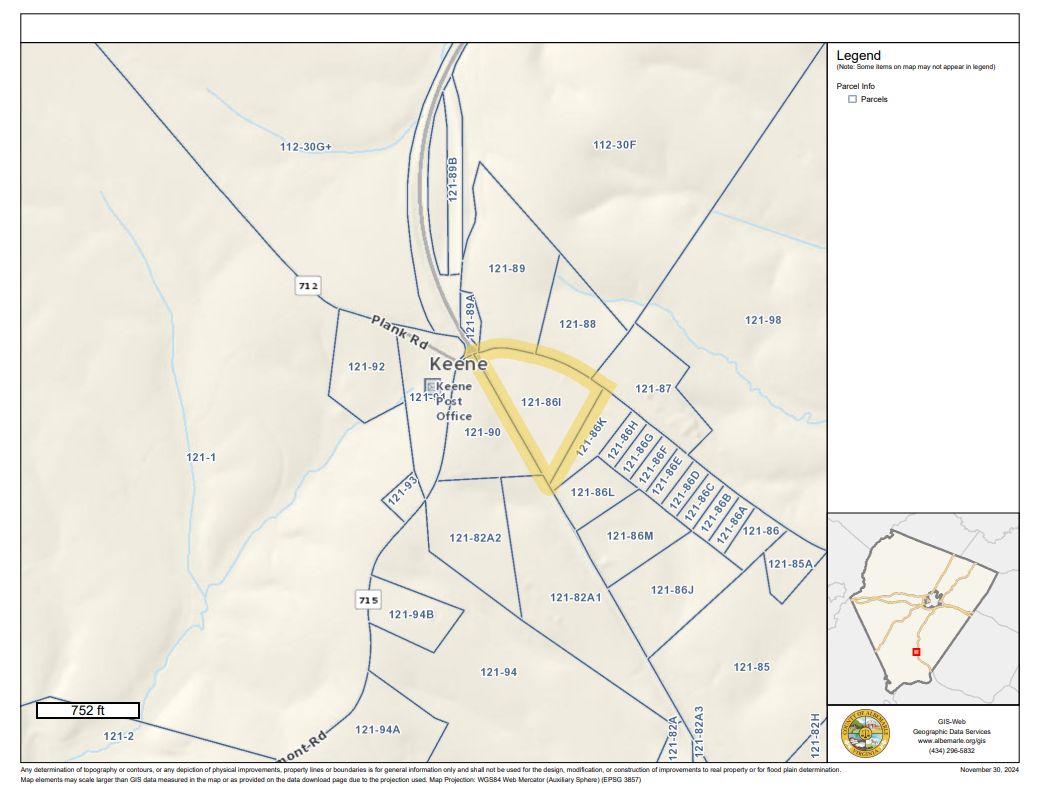
Such is the case for Thomas and Tracy Shull who have sought to expand their towing business with an additional location in Keene, an unincorporated community along Route 20 between Charlottesville and Scottsville. The property in question is 6.41 acres in size and the application sought to develop 2.8 acres for an automotive repair business. A public hearing was held on November 12, 2024
“It is right at the southeast corner of the intersection between Scottsville Road, Coles Rolling Road and Plank Road,” said Cameron Langille, a principal planner with Albemarle County. “There’s a variety of surrounding uses in the immediate vicinity of the property. There’s the Keene Post Office. There’s also the Piedmont Veterinary Service Clinic, the Green Mountain Country Store.” (view the staff report)

Under Albemarle’s zoning ordinance, the use requested is that of a “public garage” that Langille said allows for vehicles to be serviced. Body work would not be allowed as that is a separate kind of use.
There was a public hearing for this permit in March at which a dozen people spoke out against the request. The Shulls sought a deferral to allow them to work up a new concept. The resubmission now includes a gate as well as a six foot tall fence.
“The most critical things to talk about in terms of changes from what we saw in March is that there is only 2.8 acres of land disturbance now that has been reduced from 3.02 acres with the original proposal,” Langille said. “Only 1.05 acres of the property will actually be developed for things like building, parking and travel ways.”
Another change is that a series of storage containers would be replaced with an accessory building.
Clint Shifflett of the Timmons Group led the presentation for the Shulls. He said they’ve been trying to reduce the impact the development would have on the landscape and did so again after the deferral in March.
“Tommy and I went back to the drawing board, figured out how can we dial the project back the impact on the site and preserve more buffers and things of that nature,” Shifflett said.
Shifflett also said the Shulls agreed to restricted hours of operation and an agreement that vehicles can only be stored on the property for 30 days. He also said if approved by the Board of Supervisors, the Architectural Review Board would look at the site plan because Route 20 is an entrance corridor. Shifflett also said it was not anticipated this site would be used for the towing business.
“A majority of Tommy’s operations for tow service is operated out of his Avon parcel, much closer to town where a vast majority of the towing is taking place,” Shifflett said.
The first speaker at the public hearing was Jerome Beazley who lives across the street. He noted that Shull has another property nearby on which there have been reports of zoning violations with storage of commercial vehicles. He reminded the Planning Commission that many members of the public stated a lack of trust at both the March public hearing and the required community meeting.
“The establishment of an auto mechanic shop, hundreds of feet of fencing along Highway 20 and Crow’s rolling Road, and a parking lot for industrial equipment, which starkly contrasts with the rural charm of the area, diminishing its character and appeal,” Beazely said.
This same theme came up several times.
“A massive public garage like what was just presented is completely at odds with the pretty community crossroads picture that we have been painted,” said Sarah Sargent of Esmont, the third speaker.
The fifth speaker questioned whether towing vehicles from Charlottesville on Route 20 was a good idea given existing safety concerns with the two-lane road. The seventh speaker made an accusation that Shull just wanted the public garage use to expand the towing business.
“The applicant has a successful towing, impoundment and vehicle storage business on Avon Street Extended, as you know, and he would like to replicate much of that business in Keene,” said Peter Bertone. “But knowing that such a commercial establishment would not be allowed under the regulations in a rural area, the applicant is trying to position the proposed facility as a pro, as a public garage. Do not be fooled. It is no public garage.”
Bertone said there were four other garages in the Keene area, and all of them use less asphalt. He said Shull is seeking to have 40,000 square feet of asphalt as well as a gate for an impoundment lot.
The ninth speaker, Paula Beazley said the community did not want an industrial-sized use in the rural area and the recent construction of the nearby Southern Convenience Center should not be used as a precedent. She said the Planning Commission needed to follow through with the Comprehensive Plan.
“Who will be protecting the interests and voices of The elderly widowed residents having lived there over 50 years with the expectation the rural area zoning will be honored,” Beazley said. “Forfeiting their quiethood to bolster the profits of one man, they will experience a detrimental change in their environment and way of life and certainly interrupt the harmony of the area with the beeping of trucks backing up the ambient noise of a commercial enterprise and trying to avoid them in the 18-wheelers when driving to the Green Mountain store or town for groceries and supplies.”
The public hearing continued with many of the same arguments. But one neighbor spoke out in support of the special use permit because it would provide a service that supports agriculture.
“I would argue that Mr. Shull’s business is actually beneficial to the farms,” said Collins Huff. “I’d much rather have a horse trailer broke down and fixed in Keee than towed all the way up Route 20.”
Huff said he has taken one of his trucks to Shull’s Avon location for service in the past. He was the lone voice in support at a public hearing at which over a dozen people spoke.
At the end of the public hearing, Shiffett said Shull is not under any zoning violations for this property or the nearby parcel he owns. He acknowledged his client has worked with the county’s manager of code compliance to address some potential violations on that property, but that was not the subject of the special use permit request.
“We just want to reiterate the intent for the project which is to be able to continue to utilize the Avon facility which has been growing, kind of busting at the seams, to be able to split apart the bulk of the repair work for this location and continue to utilize the Avon site as a quote unquote tow truck depot,” Shifflett said.
Shifflett said the zoning ordinance would allow policing of noise and require screening of vehicles from the roadway. He said he would be willing to add further conditions to ensure the site is not used as an impoundment lot.
Commissioners wanted to hear more about the potential zoning violations. Code Compliance Manager Lisa Green confirmed the county is working with Shull on the other property.
“There’s a process that’s outlined by the state,” Green said. “We investigate. We work with an owner to see if they will come into compliance without further court action. Then we send notice and if an owner works with us, we don’t take them to court, but we send notice and then we follow a court process outlined by the state. And at that point there are fines.”
Commission Chair Fred Missel said that he and other commissioners take the Comprehensive Plan seriously and urged those who appeared at the public hearing to get involved with the AC44 process.
“I just want to reiterate that that is an incredibly serious and focused point of conversation for us,” Missel said.
Commissioner Lonnie Murray said review of the the rural land use chapter of in the AC44 process is a time to discuss potential new uses that might be allowed. He said this special use permit was a litmus test for the county.
“I think the question is the primary use of this facility to support the rural area,” Murray said. “And I think we heard the applicant say himself, and you’re hearing the citizens themselves say that the primary use is not to support them, that the primary use is to support their Charlottesville business.”
Murray said that meant he could not support a recommendation to approve the permit.
Commissioner Luis Carrazana said for him it was a question of scale and if there are to be only three or four cars worked on each day, he was unclear why they needed a space as large as the one proposed.
Commissioner Corey Clayborne said he felt something seemed off about the plan.
To be clear, I have no issue with a four bay garage in the rural area at all,” Clayborne said. “It’s more about the scale. And there’s something that’s not coalescing with me with the visual graphics that I see in the narrative. Something that’s just not there. Right. I take my car to NTB, right on Long Street. It looks nothing like that.”
Soon after that comment, the Planning Commission voted on a motion to recommend that the Board of Supervisors deny the permit. The motion passed 6 to 0. Commissioner Julian Bivins was absent.
Before you go: The time to write and research of this article is covered by paid subscribers to Charlottesville Community Engagement. In fact, this particular installment is from the November 26, 2024 edition of the newsletter. To ensure this research can be sustained, please consider becoming a paid subscriber or contributing monthly through Patreon.
Discover more from Information Charlottesville
Subscribe to get the latest posts sent to your email.