A crucial question for the ongoing sustainment of a civilization is what do with all of the waste generated by the people and businesses within.
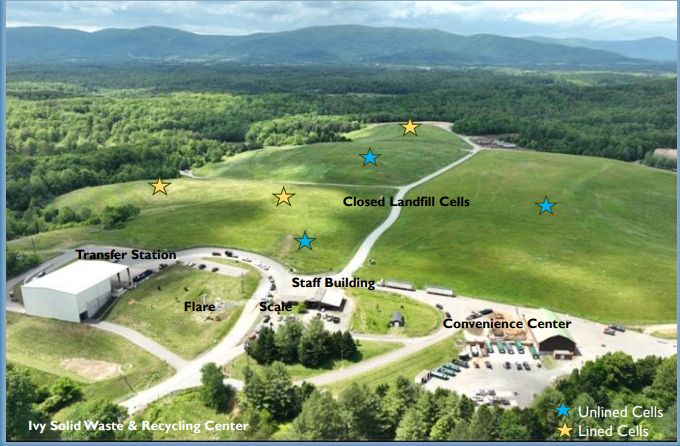
Both Albemarle and Charlottesville are members of the Rivanna Solid Waste Authority, an entity created in 1990 to help plan for the pending closure of the Ivy Landfill. The RSWA now operates the recently renamed Ivy Solid Waste and Recyling Center at 4576 Dick Woods Road.
Charlottesville currently contracts with GFL Environmental to haul solid waste to a transfer facility and to provide curbside recycling. Participation is not mandatory and city residents are allowed to instead hire a private company to haul their trash. Albemarle residents must hire a private contractor or take waste to the solid waste center or to the southern convenience center.
Some of that waste is transferred to the Ivy facility. In total, the RSWA received 240.17 tons of material at Ivy in September and that figure dropped to 213.51 tons in October. Overall, the trend is toward more solid waste going through the processing facility. Another increasing trend is the number of people who participate in a program to drop off electronic waste for free.
“It’s growing,” said Bill Mawyer, executive director of the RSWA. “And it looks like we’ve grown about 33 percent from Albemarle county residents in the last three years. About a 43 percent increase in city customers have used that program.”

With that as background, Mawyer gave the RSWA Board a presentation on future challenges facing the solid waste industry. One thing he has to be concerned with is the growth in capacity in a community where at least one entity plans continued growth.
“We’re blessed that we have the University of Virginia here that provides a stable economic foundation for the community continuing to grow,” Mawyer said. “They’re adding about 200,000 square feet of infrastructure of buildings every year.”
Mawyer also keeps an eye on population projections from the Weldon Cooper Center at UVA that show Albemarle growing to around 155,000 people in 2050. He added that number could be higher as sea level rises pushes people to attractive areas.
That will mean new buildings and construction is a major source of waste, possibly as much as 20 percent of the waste stream according to data from the U.S. Environmental Protection Agency.
The Virginia Department of Environmental Quality keeps track of capacity for the 49 landfills in Virginia that accept municipal solid waste. A report from 2023 indicates there is enough room left for 236.1 million metric tons. That’s the equivalent of 20.1 years left at current rates.
“All the refuse that we transfer from Ivy goes to a private landfill in Henrico County,” Mawyer said. “And what we understand is that has a remaining life of 17 years.”

Mawyer said solid waste authorities and municipalities are concerned about what to do with refuse as landfills close. He said it is difficult to permit new facilities in the face of public opposition and tough regulators. One to watch is the Green Ridge Landfill proposed in Cumberland County that has received at least a partial approval. (visit the DEQ site)
There’s also the possibility landfills fill up more quickly as more electronic waste is generated.
“Electronic waste has almost doubled in the last 14 years,” Mawyer said. “And that waste can be a hazardous product. It depends on what of elements are in the particular waste of laptops, cell phones, computers.”
The less landfill space available, the more costly tipping fees will be.
Compounding the issue is that China stopped taking waste products from foreign countries in 2018. Their decision has created a need to reduce materials that don’t really get recycled in significant numbers. Mawyer said some companies are seeking to implement the use of more robotics to sort through waste to improve rates of what gets reused.

Another challenge is material that leaches out of unlined landfill cells as rainwater passes through the land. At Ivy, the leachate is channeled into a pond and pumped out into a truck for disposal. The RSWA is monitoring for PFAS and other “forever chemicals” as well as other pollutants.
The future may involve additional methods of disposing of refuse. One could be increased incineration, but this adds more carbon dioxide into the atmosphere. Composting is another option as are bioreactor landfills.
Mawyer said there is the chance there will be deregulation in a new Trump administration that has pledged to slash federal rules.
“Whether the regulations are going to continue to become more stringent or there’s going to be a relaxing, there is it going to be a reality check that we’ve got to put this stuff somewhere every day, where are we going to put it?” Mawyer said. “And if the regulators say, wait, there’s no landfills, we’ve really got to think hard to be creative on what we’re going to do with the products.”
Before Mawyer’s presentation, former Albemarle Supervisor Liz Palmer had taken the opportunity at the public comment period at the November 19, 2024 meeting to ask the city to work with Albemarle on joint planning for solid waste disposal.
“There are plans for significant redevelopment, which means lots of demolition debris and then there’s special collections, curbside bulk pickup, composting, et cetera,” Palmer said. “I’m here today to ask this board to consider the formation of a new group with joint city county participation under the leadership of RSWA for strategic planning for the next 10 years.”
Charlottesville recently issued a request for proposals for a firm to study its current solid waste system in advance of the FY26 budget cycle. Bids were due on October 15 and so far no notices have been given.
Before you go: The time to write and research of this article is covered by paid subscribers to Charlottesville Community Engagement. In fact, this particular installment is from the November 27, 2024 edition of the newsletter. To ensure this research can be sustained, please consider becoming a paid subscriber or contributing monthly through Patreon.
Discover more from Information Charlottesville
Subscribe to get the latest posts sent to your email.