


While Albemarle staff may have had the ability to put the county’s Comprehensive Plan process on hold earlier this year to make changes, the final say on how the document will be updated will be up to the six people elected to the Board of Supervisors.
On October 16, the six elected officials got the first chance to review some of the new language staff has introduced at the beginning of the third of four phases of the AC44 process. They spent two and a half hours in a conversation that included discussion of a growth management policy that is largely remaining the same as the one in place for decades and most recently ratified in June 2015 when the Comprehensive Plan was last updated.
“Currently, the development areas are approximately 37 square miles, or five percent of county land, and the rural area is 95 percent of county land,” said Tonya Swartzendruber, a planning manager in Albemarle.
As they did with the Planning Commission on October 8, county staff described what they’ve been up to since the end of the second phase of the four phase AC44 process. If you’re unfamiliar with some of these terms, take a look at the story linked above for additional background.
Resources:
“The document had sort of a structure previously, and it’s taken several months of internal work to come up with a revised structure,” said Planning Director Michael Barnes. “The new one is going to have these four sections of the introduction, the growth management policy and ten topic area chapters. The real change here is putting the growth management policy front. It’s a master policy that really governs everything that we sort of do in the community.”
Another change made by staff is that the “economic development” will now be called “thriving economy.” Anything related to climate change is in the “resilient community” chapter.
Between now and April there will be work sessions on each chapter. The Planning Commission will review the land use chapter on Tuesday, October 22. Barnes said the hope is to have a public hearing on the entire plan in July 2025.
Supervisor Ned Gallaway of the Rio District said he understood why staff was introducing each chapter individually, but he wanted to be clear that he may need to reserve judgment until he’s seen the entire document.
“It’s very iterative, it’s very disjointed,” Gallaway said. “But I don’t want anybody getting unhappy if it seems like you guys are pulling into the parking lot for the final time. And I said, let’s go back out for a run.”
Supervisor Ann Mallek of the White Hall District also said all of the ten chapters will need to fit together.
“Philosophically, all ten of them make up our quality of life, and so they live together in the same bucket,” Mallek said. “And we will get there eventually. But I agree with Ned. We’re going to have to keep stirring the pot until we get it just right. And I am very happy, as one person, to have extra meetings to make sure we do this right.”
One of the items for review was language in the Growth Management Framework.

Supervisor Ann Mallek said she felt there was language missing from the framework that explained why the rural area was created in the first place. Soon after the South Fork Rivanna Reservoir was created in 1967, officials realized it was silting in quickly and intense development nearby would speed up that process by increasing the amount of stormwater runoff.
“What is missing here is mention of the drinking water, watershed protection for the growth area,” Mallek said. “I think it’s really important for the community to understand where their drinking water comes from and to know that it’s not just frou frou scenery out there, but it is real survival out there that’s being provided.”
Supervisor Mike Pruitt of the Scottsville District, the youngest member of the Board, said he appreciated understanding the historical reasons why the growth area was put into place.
“I did not originally appreciate as a newcomer to this community the role that water quality had made in the formulation of our Comprehensive Plan,” Pruitt said. “I do think that detail is something that is critical and something that when we communicate with, frankly, young people in the urban ring, young people in Charlottesville, people who have arrived in this community and don’t quite understand the history of this plan.”
Supervisor Gallaway said the decision on whether to expand the growth area is a political conversation. He added there are many people who want to expand the growth area who also want to protect water quality.
Staff will come back with suggested language on this point at their next meeting with the Board.
Strange bedfellows
Before Supervisors got into their review, two members of the public took advantage of the comment period.
Crozet resident Tom Loach has been a watchdog on the growth area for many years. He has recently been calling upon Supervisors to end the land use taxation program that allows rural area property owners to pay a lower amount if they are engaged in agricultural activity.
“While I don’t often agree with the development community on growth and development issues, I have to agree that the county can no longer kick the can down the road when it comes to growth area expansion,” Loach said. “If in fact a trajectory towards expansion of our growth areas, or conversely, the end of rural preservation, then note there is no further need for land use tax subsidy program.”
Loach said the program has cost residents hundreds of millions of dollars over the years to subsidize rural preservation and it will be up to Supervisors to decide how to proceed.
Neil Williamson of the pro-business Free Enterprise Forum used his public comment to ask a series of rhetorical questions about whether Albemarle is truly a “welcoming” place before giving the position his organization has advocated for over 20 years.
“While residents and electeds say they wish to be welcoming, their actions say otherwise,” Williamson said. “Our community should be encouraging new residents. It should be encouraging diversity and inclusion. How could Albemarle be more welcoming? By expanding the 1970s era development area boundaries.”

This is an image from a presentation to the Board of Supervisors given in 2008 (Credit: Albemarle County)
Monitoring how the growth area is used
The next Comprehensive Plan will have clearer language about how the county will measure its progress toward accommodating population growth.
“We need to know where we stand on the actual build out and land capacity of the development areas,” Swartzendruber said. “While the most recent land use build out analysis done in 2022 indicates there is sufficient capacity to accommodate projected growth over the next ten to 20 years, this hinges on projects building at the high end of recommended density and intensity of uses.”
That analysis concluded developments in Albemarle created through rezonings have come in at 58 percent of total capacity. Staff wants to keep a closer eye on that number by performing a new analysis every two years.
Supervisor Pruitt said that recurring analysis also has to come with some sense of how the county might expand should certain targets get hit.
“At some point if our growth patterns do not change, I think the whole board recognizes that the development area will have to change,” Pruitt said. “And I’m not saying that’s today, I’m not saying this something we have to decide today, but it is something that has to happen.”
Pruitt said that means the county should be identifying where the expansion might be when the time comes and how that might happen. He suggested the county consider creating a new place where development could be focused rather than what he described as “nibbling around the edges.”
Jodie Filardo, Albemarle’s Community Development Director, said that sort of information will come later during the Comprehensive Plan process.
“We’re trying to get to the biggest picture tonight and then we’ll start the drill down with the subsequent chapters that you’ll see,” Filardo said.
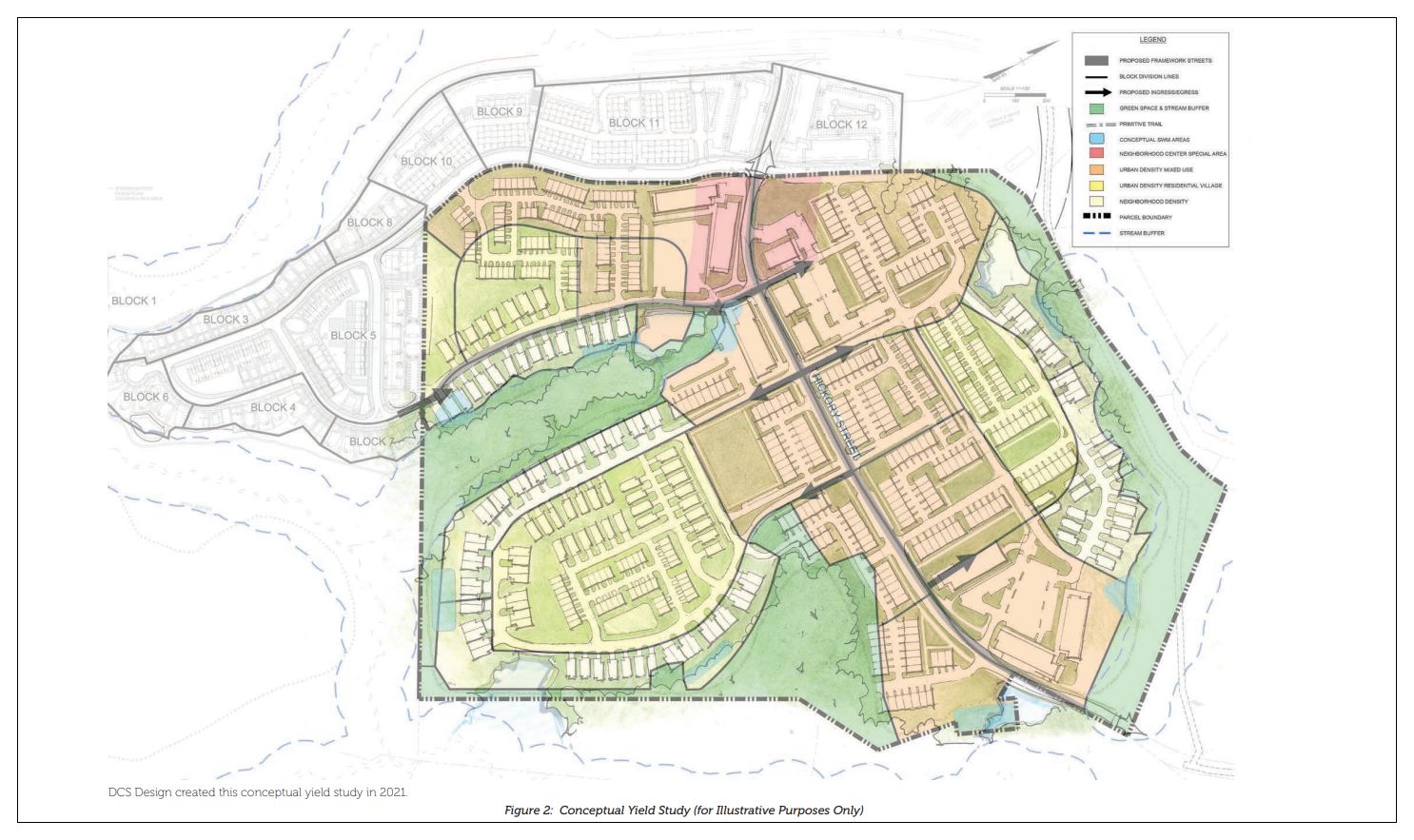
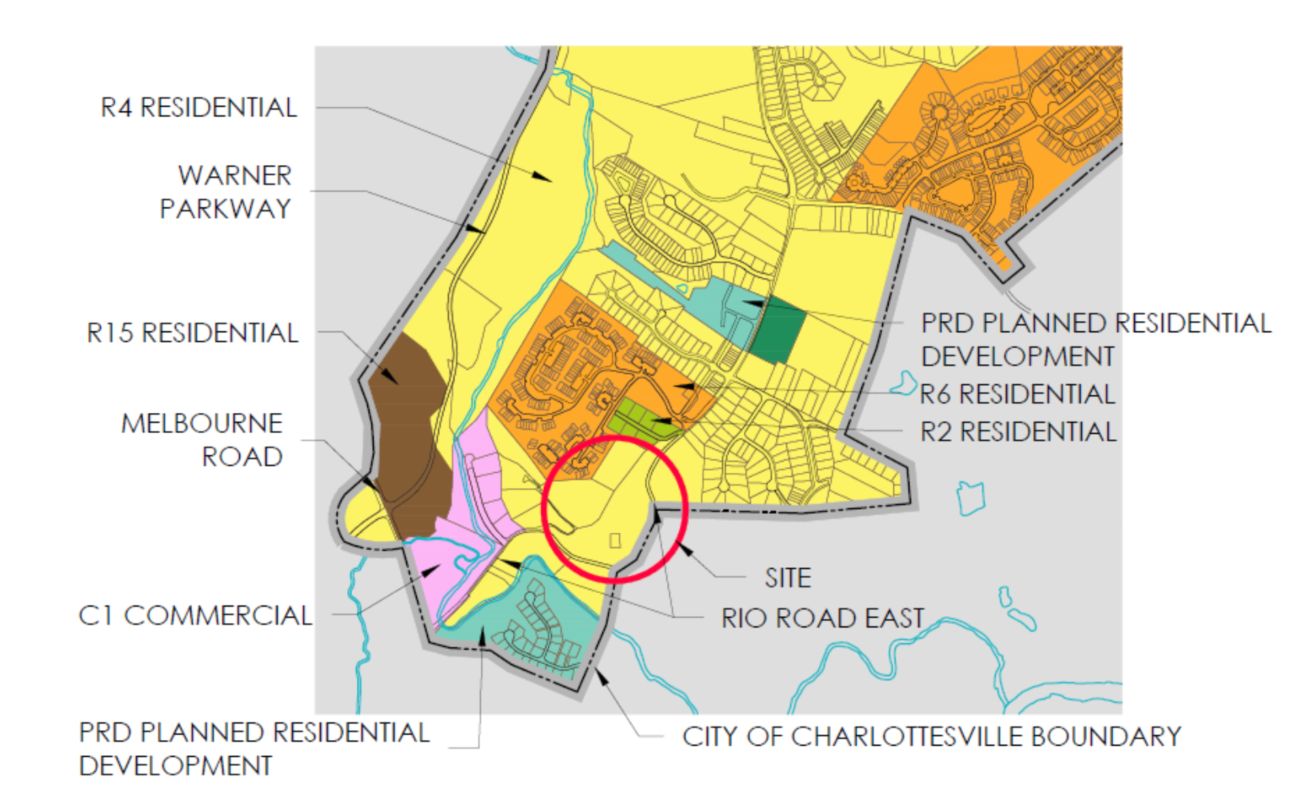
Rather than a two-year review, Gallaway suggested that each rezoning application have a narrative explaining what the effect will be on the overall growth area. He said he was opposed to the rezoning for what will be the Rio Point subdivision because he felt there was too much density at that location.
Gallaway brought up a rezoning in the Village of Rivanna growth area near Glenmore that had been sought by Southern Development. They wanted to convert 84 acres in the growth area from Rural Area zoning to R-4, which generally allows four units per acre. After opposition from nearby residents, the request was whittled down to 160 units. Supervisors deadlocked on a vote in January 2021 for that proposal, but later approved an 80 unit development on October 6, 2021.
At the time, Gallaway warned about the lost potential toward the county’s overall Comprehensive Plan goals.
“In that conversation we should have said that’s a defined development area and if we only approve one unit per acre there, here’s what that means for the rest of the development area,” Gallaway said. “If we’re not getting the density out of a Village of Rivanna , that’s a defined development area, where can we get that density back at that’s reasonable without necessarily changing the 5 percent.”

Supervisor Bea LaPisto-Kirtley said she listened to opponents of the Breezy Hill rezoning who argued for the lowest density range. She now wishes Supervisors had approved more density and said the body has to get better at approving the residential density called for in the Comprehensive Plan.
“I’m not one that wants to see the development area expanded at this time, I think in the future, and I’ve told people that maybe 10, 20, 30 years down the road, I’m not sure when, but I think we need to make use of what we have,” LaPisto-Kirtley said.
Barnes said the next chapter that will come before the Board is a discussion of the land use chapter that might recommend changes such as allowing additional density by-right. Gallaway said that was an example of how the current AC44 process is disjointed.
“In a development utilization review, if we’re talking about the capacity, then we need a baseline,” Gallaway said. “It is a policy decision to allow redevelopment from R-2 to R-6 by-right. And if it’s going to allow the development area to stay as it is longer, then we need to know what that means.”
Supervisor Ann Mallek said too much has been made about the figure of 58 percent because its based on a theoretical maximum of 36 units per acre, a residential density that hasn’t been built anywhere in Albemarle. For instance, she said the apartment complex at Old Trail is at 19 units per acre.
Supervisor Diantha McKeel agreed with Gallaway about the notion of trading out development areas if the Village of Rivanna will not be built out.
“It’s been sitting there,” McKeel said. “So if we can look at somehow or another and maybe this is not the right place to talk about it, but trading land without expanding but looking at where there are possibilities to do some trade where it’s actually going to happen?”
Supervisor Jim Andrews suggested the county should base decisions based on capacity versus the build-out analysis.
“There’s an amount of land here and that land is finite and we can try to keep track of it and we don’t have to look at numbers, percentages that don’t necessarily mean anything to us, when we could actually have a better sense of what is the capacity, how much acreage is there that’s undeveloped and what kind of acreage is it,” Andrews said.
Andrews also cautioned against assuming the development area will ultimately be expanded.
“I guess I want to keep that perspective when I look at it and say, okay, what can we do in the development area?” Andrews said. “I think it may be appropriate, instead of saying expansion of the development areas, talk about changing development area boundaries, because it may be that a shift of development areas may be the more appropriate way in which we handle this initially.”
The Albemarle County Planning Commission will take up the land use chapter at their meeting on Tuesday, October 22. All of the county’s community advisory committees will meet on October 30 for a joint meeting to review the phase 3 work to day.

Before you go: The time to write and research of this article is covered by paid subscribers to Charlottesville Community Engagement. In fact, this particular installment is from the October 21, 2024 edition of the newsletter. To ensure this research can be sustained, please consider becoming a paid subscriber or contributing monthly through Patreon.
Discover more from Information Charlottesville
Subscribe to get the latest posts sent to your email.

One thought on “Albemarle Supervisors discuss growth management policy at AC44 work session ”