


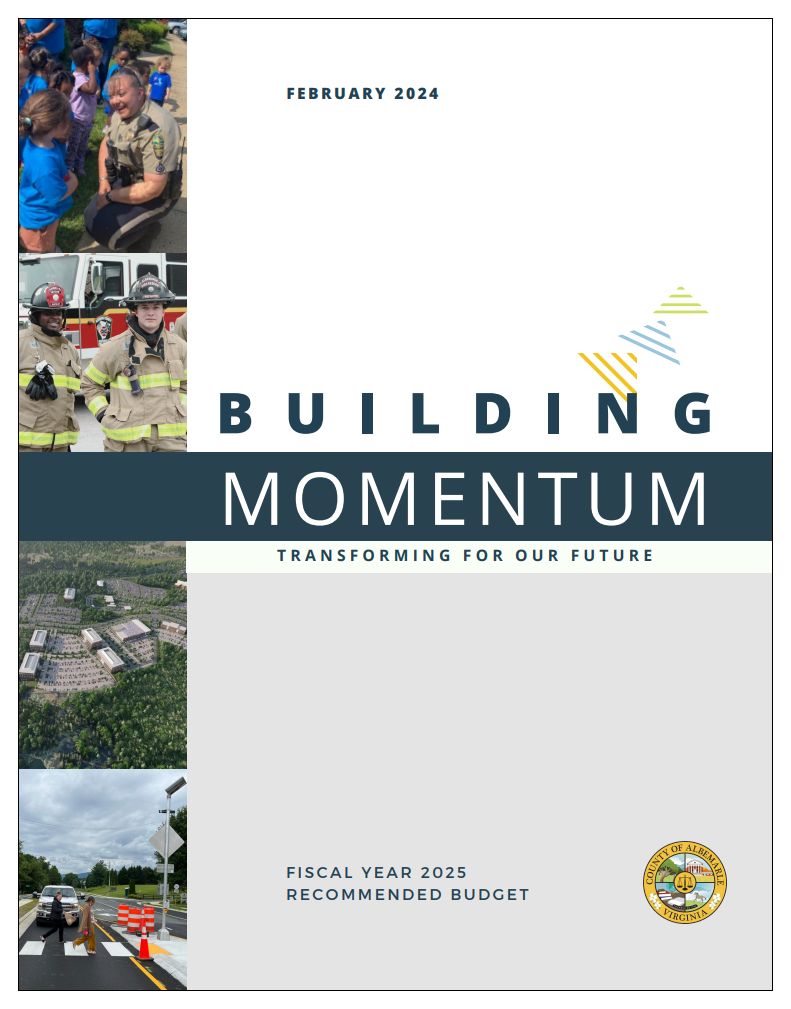
Albemarle County Executive Jeffrey Richardson has presented the Board of Supervisors with a recommended operating and capital budget of $629,054,446, an increase of about $74.4 million over the current fiscal year. (download the recommended budget here)
“I’m proud to say that this recommended budget that’s before you today is balanced on the same tax rates as the current year,” Richardson said at the Board meeting on February 21, 2024.
Those tax rates are a real property tax rate of $0.854 per $100 of assessed value and a personal property tax rate of $3.42 per $100 of assessed value.

Richardson’s direction for the budget comes from the strategic plan, a document last adopted by the Board of Supervisors in October 2022. That plan guides budget development over multiple years.
This year’s budget title is “Building Momentum: Transforming Our Future” carrying on from the title of this year’s budget which is “Activating The Strategic Plan to Strengthen Our Foundation.”
“It is building momentum,” Richardson said. “Year two of this five-year strategic plan, if you look inside this budget, you will see a lot of things that we are doing, a lot of things that we’re going to finish this year, and a lot of things we’re going to open this year.”
The document itself reflects more spending on public safety. Part of the county’s new court facilities will come online in late 2025 and the county also has to pay more of the share for firefighters hired through grants from the Federal Emergency Management Agency.
“In FY25, we’re beginning to pick up some costs that previous policy and funding decisions require,” Richardson said. “The new courts were a capital expense but now require for revenue and staffing and operating the new building and the expanded square footage.”
Richardson said federal COVID-19 relief funds are now receding.
“We use these funds to do exactly what we thought we could do,” Richardson said. “One-time money that we quickly spun into programs that would make a meaningful impact.”
Richardson said Albemarle will also be paying more for transit to make up for reduced federal and state revenue that went to transit agencies to help keep them afloat as ridership dropped in the early pandemic.
Recommended expenditures also equal $629,054,446 with 39 percent going to local government and 58 percent going to Albemarle County Public Schools. Superintendent Matt Haas unveiled his budget request on Thursday, February 22. (view the presentation)
Three percent of county expenditures will go to the City of Charlottesville per the revenue sharing agreement. The payment will increase from $15.7 million in FY24 to $17.76 million in FY25, a 13 percent increase.
There is no new funding in the recommended budget for climate action funding. A total of $421,604 was allocated to that pool in FY24.

An overview of the total county expenditures. (download the recommended budget here)(Credit: Albemarle County)
Some highlights of what’s in the budget:
- The budget adds additional funding to continue the MicroCAT program and adds additional funds for Charlottesville Area Transit. The FY24 budget approved $1.3 million for CAT and that will increase to $1.859 million, a 43 percent increase. The amount of local funds allocated for MicroCAT in FY24 was $175,000, but that will increase to $1.742 million in FY25. (read a story about MicroCAT’s launch in late October)
- There’s an additional $2 million going to Albemarle’s Housing Fund
- The budget anticipates the first phase of Biscuit Run being complete in FY25 with over four miles of trails
- Revenue collected through the disposable plastic bag tax will go toward litter cleanups on county roadways
- The recommended budget anticipates the hiring of 36.87 additional “full-time equivalenst” for a total of 957.22 county employees. You can read the details on page 84 of the recommended budget.
A look at the capital budget
Materials in the capital improvement program begin on page 261 of the recommended budget. The total amount for FY25 is $104,886,161 and the five year CIP is under $335.7 million
“For this next year, we’re looking at a total capital for schools of $206.8 million,” Richardson said. “I’d highlight that High School Center Two and Elementary One, which is the southern feeder pattern school, both have checkmarks for fiscal year 25. I believe that the schools have indicated that they are also struggling with increased construction costs.I want to think that’s about $11 million of additional costs for both of those schools together and I’m pleased to say that in the FY25 budget we have those costs.”
That elementary school has a cost estimate of $45,537,452 in FY25. A northern elementary school is planned for funding in FY27 and FY28.

Some highlights from the capital budget:
- There is funding in the out years for the renovation of the Central Library in downtown Charlottesville. That consists of $857,109 in FY27 and $9,676,141 in FY29.
- There is $150,000 in funding in FY25 for an urban pocket park with $1.5 million slated to be spent in FY26.
- There is $635,000 in funding to bring a trailhead at Woolen Mills up to compliance with the Americans with Disabilities Act
- A capital request from the Blue Ridge Area Food Bank is slated for $165,000 in FY25.
- Construction of a Northern Convenience Center has been delayed one year to FY27 but design will proceed in FY25
- There is $5.1 million slated in the capital improvement program in FY25 for transportation projects for the purpose of matching state and federal funds. Another $11.3 million is anticipated in FY26 and another $13.6 million in FY27.
- There is $300,000 to replace voting machines
Some other items in the operating budget are worth noting such as the funding for the Human Services Alternative Response Team which has begun as a pilot program.
“Here we are with a group of people from Human Services, police, and fire,” Richardson said. “In the first six months that this team has been together, they’ve provided support for 149 9-1-1 calls in our community.”
There’s also funding in the fiscal year for another public safety experiment that takes advantage of enabling authority that allows a certain technology.
“This budget supports a photo speed camera pilot on Hydraulic Road,” Richardson said. “It’s going to be installed this summer before the start of the fall semester for our public schools beside the Lambs Lane Campus,” Richardson said.
Another trend over the last several years is the hiring of professional fire and EMS personnel to combat declining participation of volunteers. In December, Chief Dan Eggleston briefed Supervisors on the systemic issue and the county’s investment to date. Richardson had this refresher.
“Over the past three budgets, Board, we have hired 50 professional, paid firefighters in Albemarle County,” Richardson said. “We’ve done that using federal grant money and we’ve planned ahead as this grant money is retired to be able to take this obligation on locally. We’re prepared to do that.”
To give a sense of the scale of the investment, the actual amount spent on “System-Wide Fire Rescue Services” was $19,381,839. That’s increased to a budgeted amount of $27,991,243 in FY25. (page 78)
Richardson said staff will also continue to prepare the 462 acres of land near Rivanna Station that the county purchased for $58.9 million.
“We’ll be working in fiscal year 2025 to do master planning, rezoning, to bring durable partners to the table to support the funding of the site’s future,” Richardson said.
The county will also take over funding for the on-demand MicroCAT pilot as state funding for the pilot expires. Richardson said the service has been successful.
“Since its launch at the end of October, more than 8,500 rides have been requested through this service,” Richardson said.
After Richardson’s presentation, Supervisors had the opportunity to ask questions and make comments but many said they would reserve that for the work sessions. Rio District Supervisor Ned Gallaway had this question and observation about MicroCAT.
“Does MicroCAT in the analysis of the pilot going to give us information or not on whether all of the fixed routes that are still in place are still needed?” Gallaway asked. “Or if MicroCAT could replace some of those because there are potential cost savings. If you have a fixed route alone Rio Road that MicroCAT could serve and you don’t need the fixed route any longer, that could be a way to finagle some dollars around.”
Gallaway said he has heard great feedback about MicroCAT and is glad to see the program continue.
The public hearing will be on Wednesday, February 28, 2024 at 6 p.m. in Lane Auditorium.
Before you go: The time to write and research of this article is covered by paid subscribers to Charlottesville Community Engagement. In fact, this particular article comes from both the February 20, 2024 and the February 21, 2024 edition of the newsletter and podcast. To ensure this research can be sustained, please consider becoming a paid subscriber or contributing monthly through Patreon.
Discover more from Information Charlottesville
Subscribe to get the latest posts sent to your email.
2 thoughts on “Richardson presents FY25 Albemarle budget of $629M that anticipates no change to tax rates”