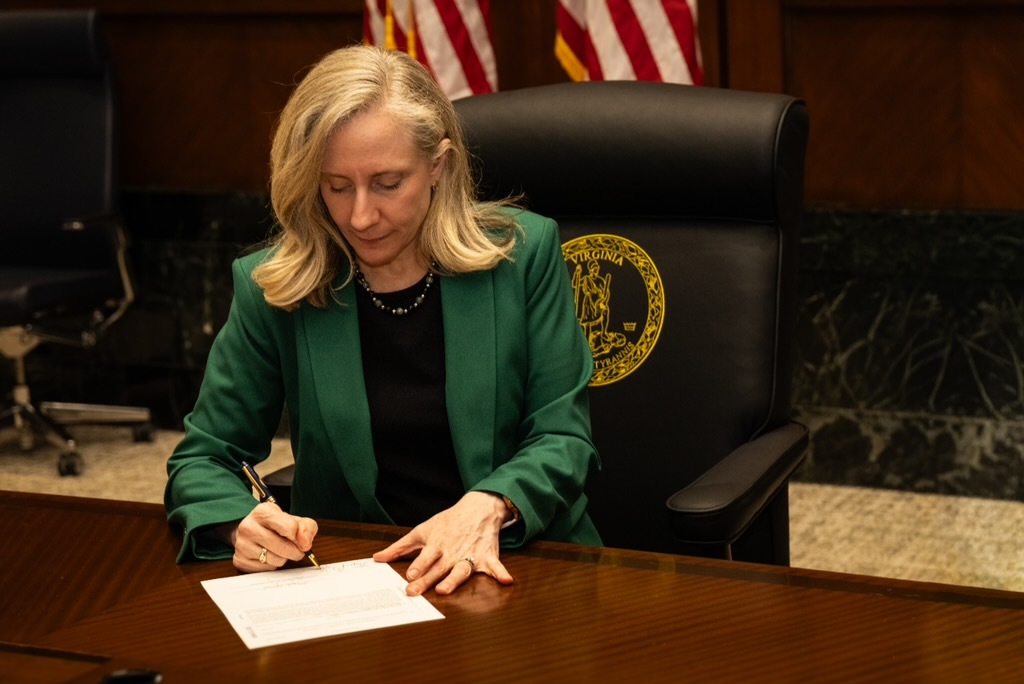
Virginia Governor Abigail Spanberger has made a very small dent in a task to sign or amend hundreds of pieces of legislation that have made it out of the 2026 General Assembly. Several dozens received her signature at a ceremony today.
“We are holding pharmacy benefit managers accountable for hiking up drug costs, cutting red tape so more Virginians can find housing that fits their budget, and tackling the high energy costs Virginians are facing across the Commonwealth,” Spanberger said in an information release posted on March 31.
HB1227 and SB729 will increase the number of private activity bonds that are used to finance affordable housing projects. Sunshine Mathon, executive director of the Piedmont Housing Alliance, said the legislation addresses a relatively new challenge.
“Starting a couple of years ago, for the first time, the bonding capacity by agencies focused on housing capped out,” Mathon said in a March 16 email. “We use these bonds for 4 percent [low-income housing tax credits] (LIHTC) financing.”
Here are some of the bills signed on March 31, 2026:
- HB655 and SB346 eliminates some of the powers that localities have to restrict the location of manufactured homes
- SB628 will formally establish the Eviction Reduction Program in the Department of Housing and Community Development
- SB390 eliminates the Apple Board and the Apple Fund effective July 1, 2028. Someone’s going to write a really good story about this one, and perhaps they can use the most recent annual report as a start.
- SB407 will allow Dominion Energy and Appalachian Power Company to apply for a tariff through the State Corporation Commission for electric vehicle charging stations.
- HB562 authorizes electric cooperatives to establish “virtual power plant programs” from an aggregation of distributed energy resources.
- SB497 directs the Virginia Department of Transportation to develop a policy on electric transmission lines that would prioritize existing corridors over new ones.
- HB1180 and SB591 will require the Tax Commissioner to develop and offer a free tax-filing program for individual state income tax. This will need to be in place by the 2028 year.
- SB669 will require health insurance carriers to use a “pass-through pricing model” and eliminates discretion currently held by “pharmacy benefits management services.”
- HB220 and SB630 will eliminate the ability of health insurance providers to charge a variable rate based on tobacco use.
There are still 1,569 pieces of pending legislation according to the Virginia Legislative Information System. Spanberger has to take action on all of them before April 13. The General Assembly will return on April 22 to respond to any amendments or vetoes she might make. A special session to complete the budget will take place the next day.
Before you go: The goal of Town Crier Productions is to increase awareness about what is happening at the local, regional, state, and federal government levels. Please share the work with others if you want people to know things. Paid subscribers cover the cost of conducting research for this article which was originally published in the March 31, 2026 edition of Charlottesville Community Engagement. You can either subscribe through Substack or make a charitable contribution.
Discover more from Information Charlottesville
Subscribe to get the latest posts sent to your email.