


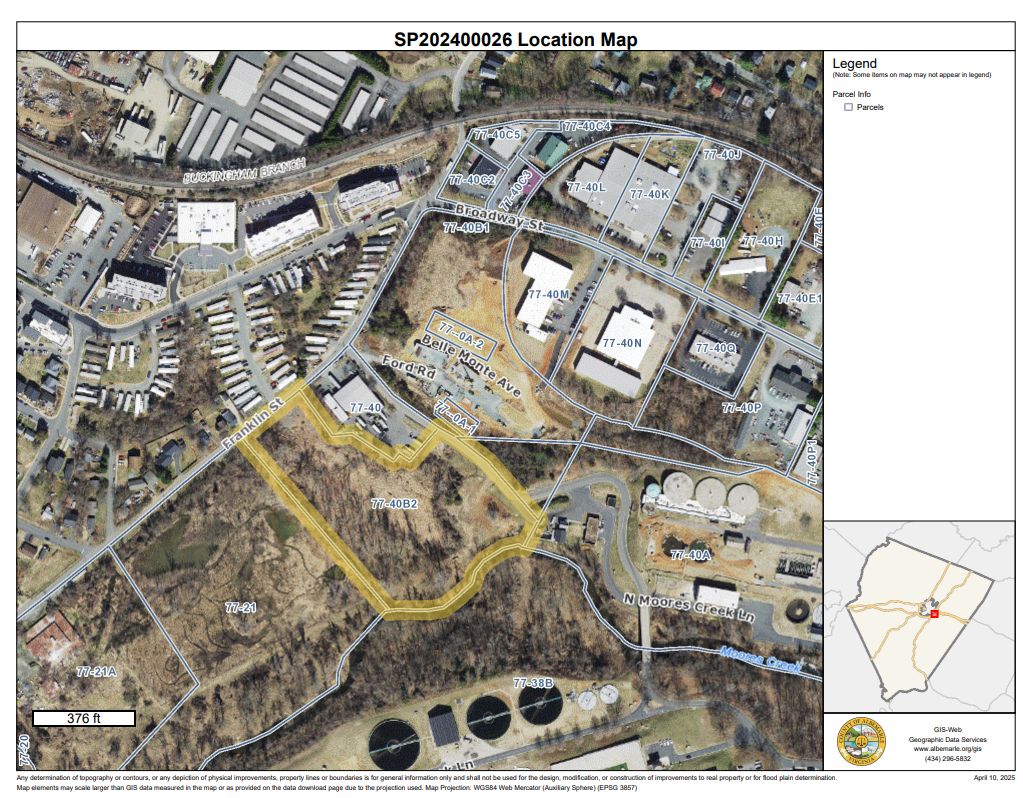
The Albemarle Board of Supervisors spent three hours on June 4, 2025 considering a request from a developer to fill in a portion of the floodplain to build an industrial park. In April, the Planning Commission recommended approval of a special use permit on a 4-3 vote. (my story in C-Ville Weekly) (link to meeting items)
“This is a request that you don’t see that often,” said Rebecca Ragsdale, a planning manager in Albemarle County. “So we want to spend some time this evening going over the particulars of the floodplain characteristics in the location where the fill is requested.”
The property in question is seven acres and is already zoned for light industrial uses but the request is fill-in an acre and a half. The developer is seeking a flood map revision from the Federal Emergency Management Agency but needs the county to sign off as well to unlock the site’s potential.
“That fill would need to occur or be approved and need to occur before any of the light industrial uses of the existing zoning could be developed,” Ragsdale said. “So that would include things like manufacturing and processing, storage, warehousing, laboratory [research and development].”
There is no building proposed at this time. The developer is proffering a dedication of some of the land for a future greenway trail, but Ragsdale noted that there are no plans for one in the location shown.
Tony Edwards, Albemarle’s deputy county engineer, provided a background on some terminology related to the area’s hydrology beginning with the place where you can absolutely not build structures.
“The floodway itself is the channel that the river needs to carry the capacity needed for in in the adjacent area that would be in reserve to handle the discharge from a base flood elevator event,” Edwards said.
Land considered to be in the “floodway fringe” allows for extra water storage capacity and he said granting the permit would not make flood conditions worse.
“Adding fill to this area doesn’t significantly alter the main channel’s capacity to convey the flood waters. So the floodplain water elevations remain unaffected,” Edwards said.
FEMA has issued a conditional approval to change the floodplain map, but that won’t become permanent until after something is built and verified.
The applicant was represented by Tim Miller of Meridian Civil Survey. He said the owner, Chris Donaldson, is aware that Albemarle County’s economic development strategy has called for more places where industrial buildings can be built. The property is within the footprint of the Office of Economic Development’s Broadway Blueprint. Last year, Supervisors said they would prefer industrial uses rather than residential.
“Chris is currently constructing the Woolen Mills industrial site and because of that has determined the need for the light industrial because of the interest in that property,” Miller said.
Donaldson has also hired the Timmons Group to work on the floodplain review for FEMA and Albemarle County.
At the public hearing, several people who live nearby asked the Board of Supervisors to deny the request. The first to speak is Bill Emory, a resident of East Market Street.
“You know this project will cause substantial damage to quality of life in adjacent parcels,” Emory said. “It will damage the character of adjacent or the character of adjacent parcels will be changed by proposed special use. Public health, safety and welfare will not be improved.”
Other nearby residents also expressed concern about flooding and the cumulative effects of development upstream. One person brought up an environmental justice concern.
“As a licensed clinical social worker and someone who is trained to understand how environmental stressors impact the well being of communities, especially those who are low income and underserved, I want to raise concerns about this proposal in regards to the social injustices to our vulnerable community that have been overlooked in this planning process,” said Alanah Horning.
Horning said the additional truck traffic to carry the fill dirt would have a negative effect on the people who live in the Carlton Mobile Home Park.
Last year, the Habitat for Humanity of Greater Charlottesville and the Piedmont Housing Alliance purchased the park and will be redeveloping it. City Council has agreed to contribute at least $8.7 million to the effort in the form of a forgivable loan.
Peggy Gilges, a resident of the Jack Jouett District, said she understood that Albemarle is seeking to diversify its revenue through attracting more industrial development.
“While I understand that industrial development may contribute more taxes to county coffers with fewer service costs than residential development, open space also has significantly fewer service costs than residential development,” Gilges said.
About a dozen speakers gave comments, all seeking denial.
When it came time for the Board to discuss the matter, Supervisor Diantha McKeel said this was a complicated decision given a lot of moving parts.
“We’ve been talking about this area, the Board of Supervisors have been for years, and looking to how we might best utilize this piece of property,” McKeel said, adding she was inclined to support the request given the reputation of the Timmons Group.
Supervisor Ann Mallek was inclined to vote against the request in part because she had not been convinced. She also expressed concern about the impact of trucks carrying fill dirt to the site.
“I will tell you that even 100 trucks is a lot of trucks,” Mallek said. “It’s the damage to the city streets and the neighborhood streets is going to be.”
Supervisor Bea LaPisto-Kirtley said this site was one that has been identified for light industrial use and she was confident in staff’s recommendation to approve.
“Anytime you have any kind of building, whether it’s residential, commercial, industrial, you’re going to have movement,” said LaPisto-Kirtley. “You’re going to have trucks back and forth.”
Supervisor Ned Gallaway pointed out that the county has been studying the Broadway corridor as a light industrial area for many years. He said that process had involved community input and resulted in elected officials saying they do not want residential uses in the area.
“We want to protect the current character of the [light industrial] that exists because it is the most affordable area for that commercial activity we have in the entire county,” Galway said. “That folks that work and employ and exist there now have no other option in our county so we must preserve it.”
Supervisor Mike Pruitt said it would be a tough vote and said he lives in a location next to light industrial uses.
“It seems like the universal opinion of staff and of engineering reports is that the impact is negligible to the point of being non-existent,” Pruitt said. “And it is not lost on me that the applicant has done the absolute best that they can with the site that they own to prepare a proposal that affects that zero impact standard. That being said, there are still key elements of this that give me pause.”
Supervisor Jim Andrews said he trusted the engineers, but also had to weigh the concerns expressed by neighbors.
“We can do it,” Andrews said. “‘Should we?’ is really the question.”
For Mallek the answer was no, and she rejected the idea that this would send a message the county is closed for business.
“We have hundreds of acres of light industrial land around the county that do not have the constraints of potential flooding and impacts to city neighbors,” Mallek said. “And I think we need to give a whole lot more credibility to the ecosystem services that the open space provides and the health services, the environment, human environment as well, because places where they have neglected to do those things have really suffered for it.”
McKeel pushed back on that notion and said the county pursued the Broadway Blueprint for a reason.
“I understand that people have that some of you all in the audience live there and you have jobs,” McKeel said. “What we’re talking about is having a place that we can provide more jobs for folks that they can actually walk to their jobs and have a life that really is affordable.”
The vote was 3 to 3 and Albemarle has no provision for a tie-breaker. The deadlocked vote results in a denial. Pruitt, Andrews, and Mallek said no. Gallaway, McKeel, and LaPisto-Kirtley voted in favor.
Halifax County also has an even number of Supervisors but there is also a person elected to serve as tie-breaker. That happened earlier this week in relation to a solar permit. What happened? Go take a look at Miranda Baines’ reporting the Gazette-Virginian!
Before you go: This story was first published in the June 6, 2025 edition of Charlottesville Community Engagement. It was posted to this site later in the day. If you’d like to learn more about how you can help keep this work going, visit this Town Crier Productions page.
Discover more from Information Charlottesville
Subscribe to get the latest posts sent to your email.


This story originally listed the incorrect mobile home park. The request was for a property across from the Carlton Mobile Home Park. I regret the error.