

Sam Sanders has been Charlottesville’s City Manager for 22 months which for this community in recent times is an epoch. Sanders was first hired in 2021 by former City Manager Chip Boyles who resigned in the fall of 2021 shortly after his role in firing a former police chief.
Boyles had been hired in early 2021 after a long stint as executive director of the Thomas Jefferson Planning District Commission. He succeeded interim City Manager John Blair, who succeeded City Manager Tarron Richardson who had been hired in May 2019.
At the City Council meeting on June 2, 2025, Sanders discussed several current matters of this moment including a guerilla crosswalk marking that has attracted international attention.
On May 21, pedestrian activist Kevin Cox was arrested and charged with defacement of public property for chalking a crosswalk on Elliott Avenue four days earlier. There’s a hearing for the misdemeanor charge in Charlottesville General District Court on July 14.
On June 2, Charlottesville City Manager Sam Sanders was asked by Council to explain why the public should not take matters into their own hands when it comes to public infrastructure.
“I’m not speaking about any specific individual, but when we have infrastructure placed in the public right of way without permission, that is a violation,” Sanders said. “That is not something that we can accept. It does interfere with public safety in more ways than one.”

Sanders said advocacy is important but markings on streets made by members of the public is not defensible as an act of free speech.
“When it does pose a threat, I do have a responsibility and others within this organization have the same responsibility to make sure that the public remains safe at all times,” Sanders said.
Last October, a 64-year-old woman was killed while within a crosswalk at Elliott Avenue and 1st Street South around dark, prompting calls for improved infrastructure. Here are a series of stories:
- Charlottesville to make plans to improve pedestrian safety on Elliott Avenue, November 7, 2024
- City Council discusses pedestrian safety in wake of pedestrian death on Elliott Avenue, October 11, 2024
- Residents call for Council to take action on speeding on Lankford, May 9, 2025
A petition was circulated last fall to implore the city to build a crosswalk at Elliott Avenue and 2nd Street SE. So far that project has not made the list of what the city is called “Quick Build” projects.
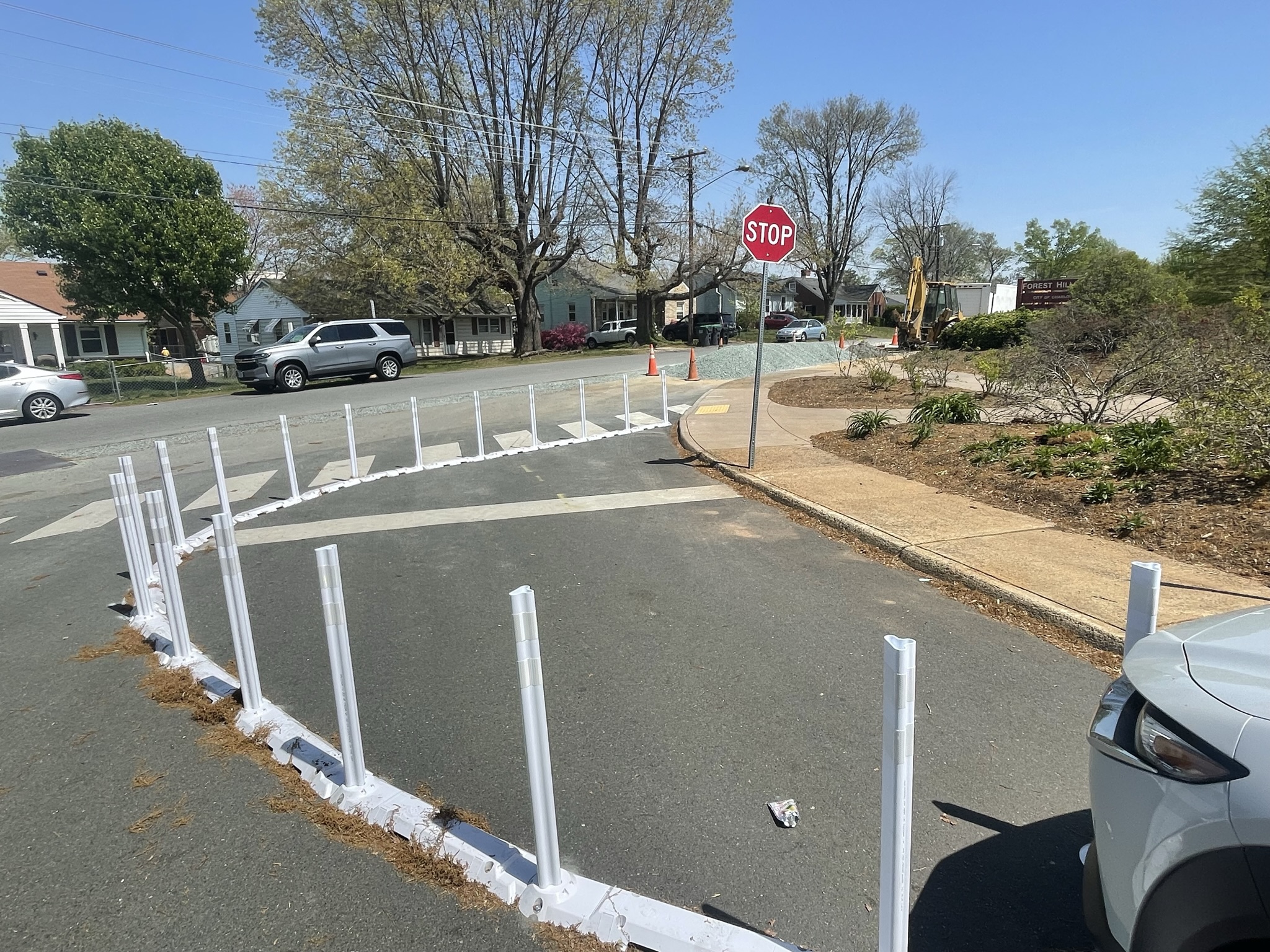
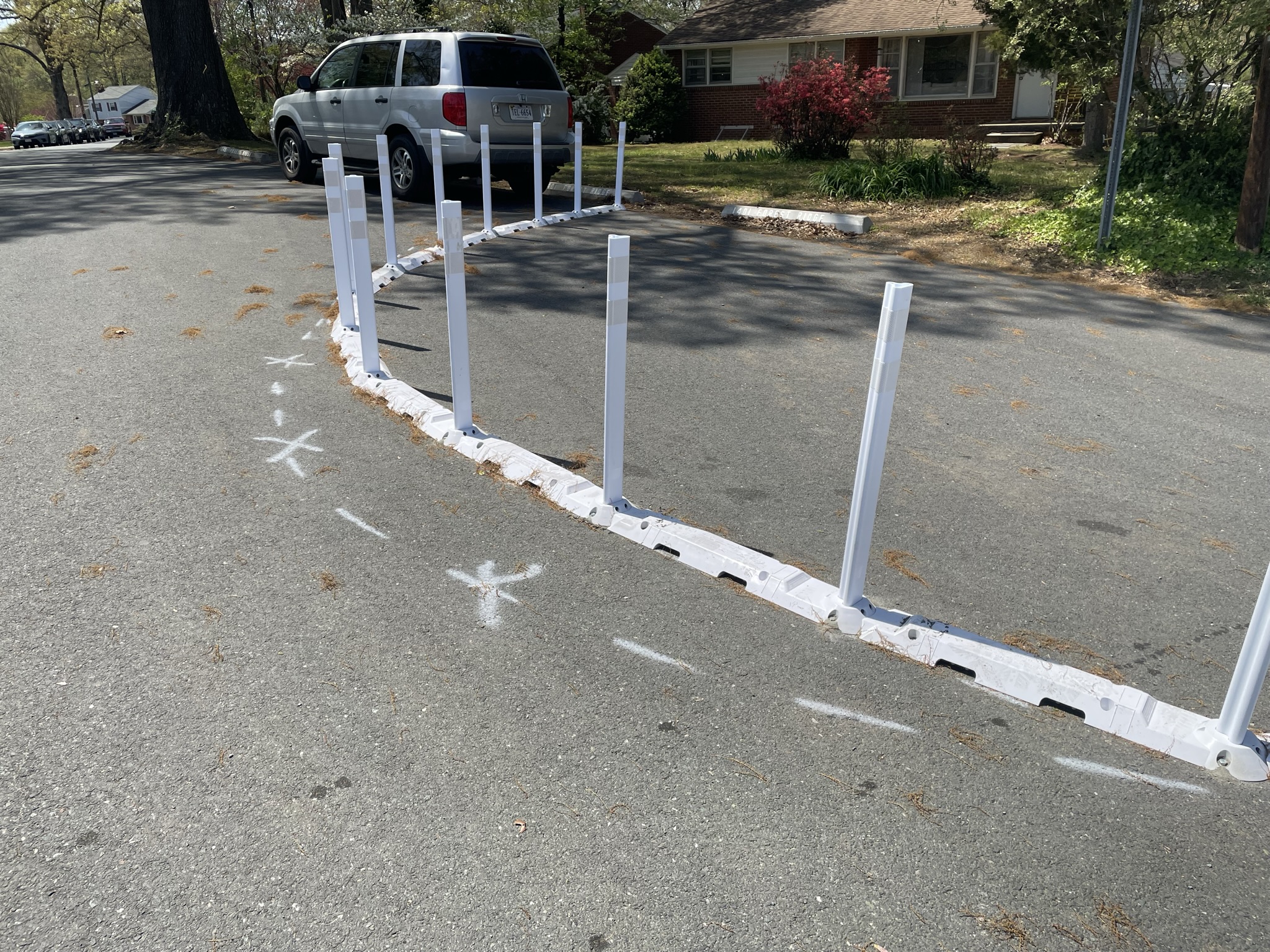
“Following a pedestrian fatality in October 2024, City staff used lessons learned from the Safe Routes to School program to deploy a quick response solution to safety concerns identified at the location of the crash, Elliott Avenue at South 1st Street,” reads a new website the city published on May 27. “Strategies like upgraded signage, rapid flashing crossing beacons, narrowed lanes, and protective reflector posts along bike lanes were used to improve the pedestrian crosswalk on Elliott Avenue.”
The full list can be seen here.
On Wednesday, Cox said he is still investigating the communication record related to his arrest. He added he has not reviewed the “quick build” list but has concerns about what the city has installed at Elliott and 1st.
“It’s my understanding that all involve ‘plastic and paint’,” Cox said when asked for a response to Sanders’ comments. “I am concerned about the excessive use of plastic pylons and thermoplastic markings. All of those things cost money, don’t last forever and require regular maintenance and frequent replacement.”
In his email to me this afternoon, Cox also said he has questions about the Americans with Disabilities Act transition plan and has continued concerns about the city’s contract with VEO for e-bikes and scooters. He told me to watch the Charlottesville Bike and Pedestrian Advocacy Committee, but there was no way to do so remotely. I’m out of town this week.
At their meeting on June 2, Council was asked to support $500,000 to complete 34 of the quick-build projects by the end of the year as part of the vote on the use of the Capital Improvement Plan contingency plan. That spending made the cut after Sanders made some reductions as I reported this week.
Sanders also addressed continuing requests in public comment to end the city’s participation in the FLOCK camera system. He said the project was approved for a one-year pilot that expires in October. However, he defended its use.
“We have solved multiple crimes in this community as a result of the Flock System,” Sanders said. “If that system did not exist, some of those crimes could still be unsolved today.”
For background:
- Charlottesville police considering use of license plate recognition system, September 19, 2023
- Police Chief Kochis gives an update on FLOCK license plate readers, February 7, 2025
Sanders also addressed Charlottesville’s inclusion on a United States Department of Homeland Security list of localities that were “sanctuary cities.” The list was later deleted.
“No one knows what a Sanctuary City is because people have debated about that for a long time all over this country,” Sanders said.
Sanders said the list will likely resurface and Charlottesville will likely be on the list. He said not following federal law is not an option because of the risk that will mean for funding that residents depend on.
“There is a fine line that has to be walked as it relates to managing these situations,” Sanders said. “I carry the burden of having the responsibility in many instances for making certain decisions. I will do my best.”
Sanders said he wants to remain city manager because he loves doing the work, but there will be people who disagree with some actions.
“Because I do hear people say, please stay, don’t leave,” Sanders said. “While others are now asking me to leave because of decisions that I’ve made. I will continue to do what I think is best for this larger community at all times.”
For this next bit, some stories for reference:
- Trump Administration orders elimination of Charlottesville-based federal training center, February 14, 2025
- Charlottesville City Schools and UVA are both seeking to acquire Federal Executive Institute, April 27, 2025
- Charlottesville City Schools selected to proceed with acquisition of Federal Executive Institute, May 2, 2025
- UVA responds to federal government’s withdrawal of offer of surplus property to Charlottesville City Schools, May 15, 2025
Sanders also said he is deeply disappointed that the federal government changed its mind regarding the disposition of federal property deemed to be surplus. One of the early executive actions of the second presidency of Donald Trump was to close the Federal Executive Institute. In late April, the property was contingently approved to be granted to Charlottesville City Schools, but the federal government opted several days later to give the 14.5 acre property to the University of Virginia instead.
“We have tried to have conversations with the federal government,” Sanders said. “As you might expect, they’re not taking our calls right now.”
Sanders said he is focused on trying to come up with a Plan B to move forward with a plan to build an early childhood education center at the site of what is now Walker Upper Elementary School.
Before you go: I try to make an attempt to cover as much as I can, and the main thrust of what I do comes from government meetings. This reporting is not the work of an advocate, but an archivist. A journalist? I’m not sure anymore. In any case, this one comes from the June 3, 2025 edition of Charlottesville Community Engagement and posted here two days later with edits to make it ready for the Saturday radio edition of the podcast. What’s the point of this? I don’t know, but I like doing it. If you want to support it, here’s a place to look at options.
Discover more from Information Charlottesville
Subscribe to get the latest posts sent to your email.