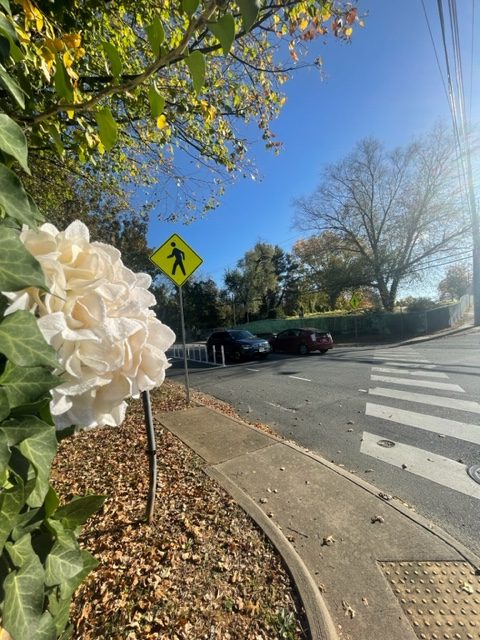
On November 4, Charlottesville City Council heard an earful from several speakers about the lack of infrastructure to make it safer for people to cross Elliott Avenue.
“I am here today because bad design kills and it has killed people on Elliot Avenue, and it will continue to kill people on Elliot Avenue,” said Renee Byrd, the creator of a petition made in the wake of the death of 64-year-old Mamawa Samai on October 3.
Byrd’s petition calls for a second crosswalk to be built at Elliott Avenue and 2nd Street and said the hundreds of people who have signed digital and paper versions of the petition expect a fix to be made.
“We all know that this is a very dangerous crossing and it’s a legal crossing, which hopefully most people know,” Byrd said, “But without actually having a marked crosswalk there, we are so much more endangered by cars who don’t realize people are crossing because they cannot see people crossing at this space for a lot of different reasons.”

Several other people spoke to the issue including Belmont resident Chelsea Braun whose husband was once hit on a bicycle while in a crosswalk. She said this was a public health issue.
“I’m a professor of medicine at UVA,” said Dr. Braun. “I used to bike commute to work. It became too stressful and too dangerous for me to ride my bicycle from Belmont to UVA because of hostile, aggressive drivers and lack of infrastructure.”
James Freas, Charlottesville’s Deputy City Manager of Operations, said the city quickly installed plastic bollards at the intersection where Samai was fatally struck in order to draw more attention to the crossing.
“I want to acknowledge that those were the solutions that we could do quickly,” Freas said “Those are what we could do within a matter of days. But that doesn’t mean we are done with that work at this point in time.”
Freas said his staff is working to identify more permanent solutions that can be constructed within a year.
“The city manager has identified what we’re referring to as urgent infrastructure dollars that can be put towards these deployments very quickly,” Freas said.
Earlier in the meeting, Council got a briefing from city transportation staff on the status of several projects in the planning stages and on the city’s ability to build projects. I’ll have that story in a future edition of the newsletter. For previous stories on transportation in the area, visit this link to Information Charlottesville.
Before you go: The time to write and research of this article is covered by paid subscribers to Charlottesville Community Engagement. In fact, this particular installment is from the November 5, 2024 edition of the newsletter. To ensure this research can be sustained, please consider becoming a paid subscriber or contributing monthly through Patreon.
Discover more from Information Charlottesville
Subscribe to get the latest posts sent to your email.