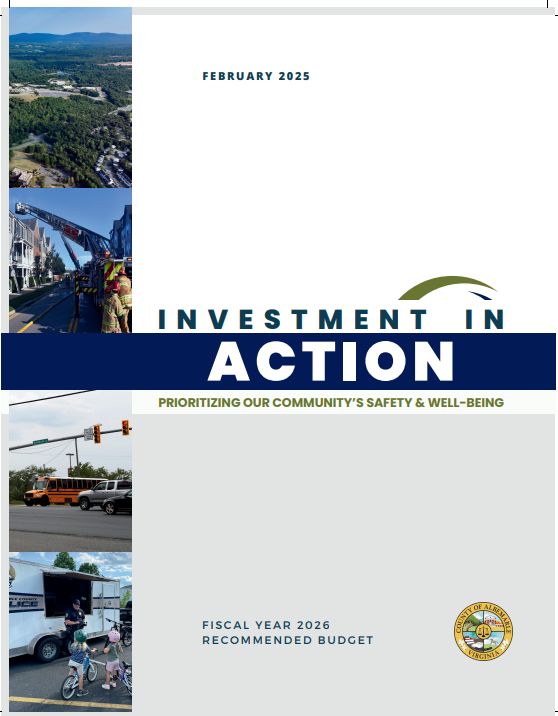
The public hearing on Albemarle County’s proposed budget for fiscal year 2026 is not for another three weeks on April 23 so there is plenty of time to go through it.
One of the main stories in County Executive Jeffrey Richardson’s proposed $642,386,163 is that it is based on a four cent increase on Albemarle County’s real property tax rate. Eighty percent of that revenue will go to public safety purposes and at the March 10 work session, Albemarle’s fire chief and police chief explained why they needed more funds.
At the March 12 work session, Albemarle Supervisors were told again where half of the remaining 20 percent would go.
“The current budget recommends dedicating 0.4 cents of real estate equaling about $1.2 million to get towards affordable housing,” said Ryan Davidson, deputy chief of budget for Albemarle County.
That $1.2 million is expected to remain in place in future budget years. The budget for FY26 also envisions an infusion of $3 million from a carryover from the FY25 budget. All of that funding goes into what the county refers to as the Albemarle County Housing Investment Fund and others refer to as the housing trust fund.
“The purpose of the housing investment fund is to support housing initiatives with that are one time costs and serve to support the county’s strategic and housing goals which change over time,” said Kaki Dimock, Albemarle’s chief human services officer.
Dimock said Albemarle has spent $17 million over the last five years. One project funded during that time was Virginia Supportive Housing’s Premier Circle, though both names have since changed. SupportWorksHousing’s Vista29 Project would perhaps be more current.

For the past several years, Albemarle has used a metric of a need to create 10,000 affordable units that is based off a 2019 study commissioned by the Thomas Jefferson Planning District Commission. A new study is currently underway that may provide an updated number.
“That 10,000 unit number is a reasonable target for us to continue to pursue,” Dimock said. “Right now there are 2,255 affordable housing units that are already online.”
Dimock said there are another 2,500 in the development pipeline, but that that’s a best case scenario based on full-build out of what the county has already approved.
Another topic at the March 12 work session was on economic development. Department director Emily Kilroy was on hand to explain why there has been a requested to add an additional $1 million to the economic development fund.
“The purpose is to have funds available much like the housing fund to leverage and catalyze investments in the community and you know, all with a goal for creating jobs, attracting capital investment and contributing to the overall thriving economy,” Kilroy said.
Kilroy said there has not been a transfer to the fund for many years, and this would bring it to $4.3 million in unallocated money.
Recent uses of the fund include $61,000 to provide a ten percent match for a larger $631,000 grant to build infrastructure for the Rivanna Futures project, $20,000 to contribute toward a regional study on assisting the wine industry increase business, $540,000 to assist Afton Scientific in their expansion, and $15,000 for an innovation roadmap.
And that takes us to the end of the March 12 work session. I also reviewed the March 17 work session and won’t be writing up anything from that. By the end of this week I’ll go through the March 19 work session at which Supervisors decided to advertise the four cent increase on the property tax.
Before you go: This story was posted in the March 31, 2025 edition of Charlottesville Community Engagement. It’s the final story from a three-hour work session the Albemarle County Board of Supervisors held on March 12, 2025. This took a while to go through but I got through it eventually. The audio of this is also in a podcast version that went out on March 28, 2025.
Discover more from Information Charlottesville
Subscribe to get the latest posts sent to your email.