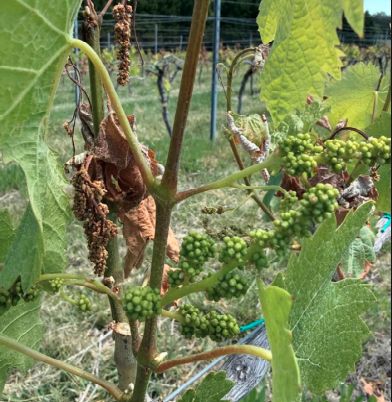
In the early hours of Tuesday, April 21, the temperature as recorded at the Charlottesville Albemarle Regional Airport hung below freezing for several hours. The cold snap as well as two others in the month caused significant damage to newly-budded grapes.
“That major frost caused some significant vineyard damage to our winery customers,” said Ashley Hernandorena, Business Development Manager in Albemarle County’s Office of Economic Development. “It is making this year’s pruning critical to protect the long term vine health and productivity of the sector.”

On July 21, 2026, representatives from the Monticello Wine Trail appeared before the Albemarle Economic Development Authority to ask for $20,000 to hire pruning experts Simonit & Sirch to teach staff at area wineries what to do to repair vines at a three-day intensive workshop to be this December.
Corry Craighill of Septenary Winery said the instruction would not just be about education but a workforce investment.
“So no matter how much those big or small wineries invested in site selection or frost protection measures, pruning is something that we all need to do every single year,” Craighill said. “And with the freeze event that happened in April, we’re looking at decision making that is not going to affect just 2027, but 2027, 28, 29, 30 for the next 30 plus years.”
Craighill said efforts need to be made to repair the damage to what she called one of the worst frost events ever. Sometimes vines can take up to five years to bear fruit. This year, she lost all of her crop.
“Not only did we lose 100 percent of our crop in some areas in our vineyard, we lost 30 percent of our permanent structure due to the freeze,” Craigill said. “And what that means actually is the vine will crack. And when it cracks, it damages the lymphatic system of the structure and it will die off or the entire system will die off.”
The Virginia wine industry brings in $1.73 billion a year according to Tracey Love, the executive director of the Monticello Wine Trail. Members of her organization are responsible for about 30 percent of that number.
“We’re the largest vineyard growing area in the state and have the largest population of wineries driving people here not only for wine experience, but for restaurants and lodging and all sorts of tourism and activities,” Love said. “We have 40 plus wineries and $48.5 million in local tourism tax revenue.”
The specific classes to be taught by Simonit & Sirch are intended for Virginia’s humid climate which can lead to something called trunk disease. One class would be taught in English and the other in Spanish.
Love said a survey revealed wineries would pay up to $200 total for each class but it costs $1,000 for each. They sought help from the EDA to help subsidize the instruction so each winery could send a representative.
Learn mor
“It benefits the entire region,” Love said. “Because if you have 32 people that now know how to prune this way, then they can teach.”
Craighill said the class is intended to teach methods that are different from the way pruning has been done.
“They’re not afraid to let the vine grow up and up enough as long as they’re keeping their cuts as small as possible,” Craighill said. “They would teach the way to make a correct cut in order to limit the trunk limit in order to make the plant the most efficient at closing itself off from trunk disease. So looking at the long term and also improving the efficiency of the plant for the current year’s growth.”
Emily Kilroy, Albemarle’s Economic Development Director, said the request was brought to the EDA due to the Economic Development Strategic Plan. The EDA Board of Directors voted unanimously to proceed.

Before you go: The goal of Town Crier Productions is to increase awareness about what is happening at the local, regional, state, and federal government levels. Please share the work with others if you want people to know things. Paid subscribers cover the cost of conducting research for this article which was originally published in the August 3, 2026 edition of Charlottesville Community Engagement. You can either subscribe through Substack or make a charitable contribution.
Discover more from Information Charlottesville
Subscribe to get the latest posts sent to your email.