

In late October, the planning commissions for both Albemarle and Charlottesville got details about the Resilient Together project at their first joint meeting in nearly eight years. That’s a city and county initiative with the University of Virginia to prepare adaptation and mitigation plans for a more volatile climate.
On November 7, 2024, the members of the Thomas Jefferson Planning District Commission heard about that agency’s work to identify potential hazards that may one day require assistance from the Federal Emergency Management Agency.
“In 2001, the Disaster Mitigation Act mandated that local governments develop and adopt hazard mitigation plans to receive FEMA funding,” said Isabella O’Brien, a planner with the TJPDC. “These plans must be updated every five years.”
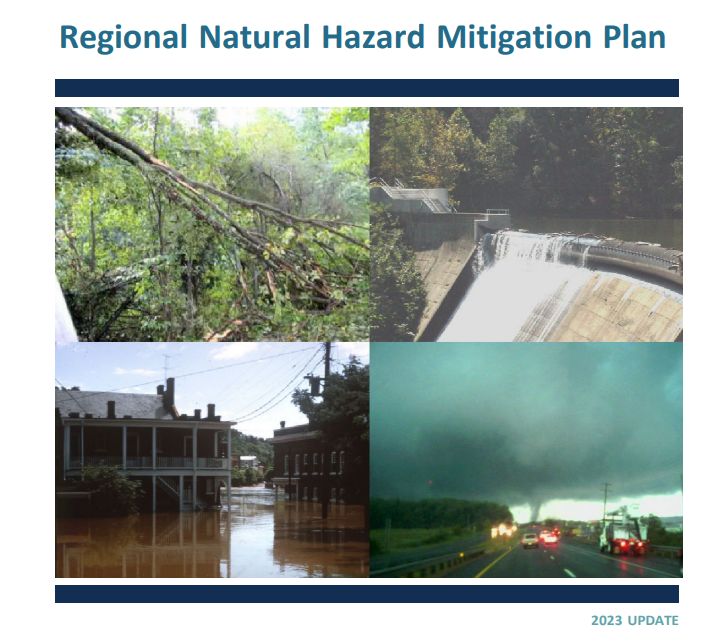
The TJPDC adopted their first plan in 2006 and the last update was approved by the TJPDC in 2023.
The Federal Emergency Management Agency was created by President Jimmy Carter in 1979 and is now part of the Department of Homeland Security. O’Brien said the TJPDC is seeking funding to cover the cost of planning for the next cycle which must be completed by February 2028.
Unless rules change. President-elect Donald Trump is in the midst of making Cabinet selections that include people who have stated they will shut down federal programs.
Extreme w eather will happen in any case.
“The risk assessment identifies potential hazards, assesses their likelihood of severity and evaluates the community’s unique vulnerabilities to such hazards,” O’Brien said.

The 2023 plan identified hurricanes, flooding, and winter weather as the top three threats with all three ranked as being a “certain possibility.”
O’Brien said under the existing rules, localities need plans in place in order to be eligible for federal funding for projects to mitigate such hazards. These could include generators, public warning systems, or other critical facilities.
“Once adopted, the region staff and stakeholders continue to implement the mitigation strategy and we maintain this plan by coordinating annual working group meetings and tracking the progress of the specific mitigation actions,” O’Brien said.
As an example, Nelson County is currently awaiting to see if FEMA will approve a $300,000 grant to replace generators at volunteer fire departments.
“These outdated generators are hindering or can hinder emergency response during power outages and limit the use of these buildings as emergency shelter,” O’Brien said. “When they initially sent in the grant application it was deemed ineligible because this project wasn’t included in the mitigation action strategy and we worked with Nelson, the [Virginia Department of Emergency Management] and FEMA to update the plan.
It is still early days for the 2028 update and right now TJPDC will apply for a grant from the Virginia Department of Emergency Management to cover the costs of going through a public process for all six localities. The kickoff will be next October.
To get a sense of how the planning went last time, take a look at some stories written here on Charlottesville Community Engagement.
- Louisa Supervisors briefed on Regional Hazardous Mitigation Plan, push back on incomplete data, July 11, 2022
- Planning for heat for near-term, long-term, July 20, 2022
- Council seeks more information on Regional Hazard Mitigation plan before approval, April 6, 2023
- Albemarle Supervisors endorse Regional Hazard Mitigation Plan, May 10, 2023
Before you go: The time to write and research of this article is covered by paid subscribers to Charlottesville Community Engagement. In fact, this particular installment is from the November 12, 2024 edition of the newsletter. To ensure this research can be sustained, please consider becoming a paid subscriber or contributing monthly through Patreon.
Discover more from Information Charlottesville
Subscribe to get the latest posts sent to your email.