One way that localities organize what their municipal government will do is through the adoption of a strategic plan. This is different from a Comprehensive Plan which lays out the broad direction elected officials want their jurisdiction to head toward.
The Albemarle Board of Supervisors last adopted a strategic plan in October 2022 and got an update at their meeting on August 21.
“What I really hope to get out of this afternoon is hearing from our board about, are we on the right track?” asked Kristy Shifflett, who now has the title of chief operating officer for Albemarle County.
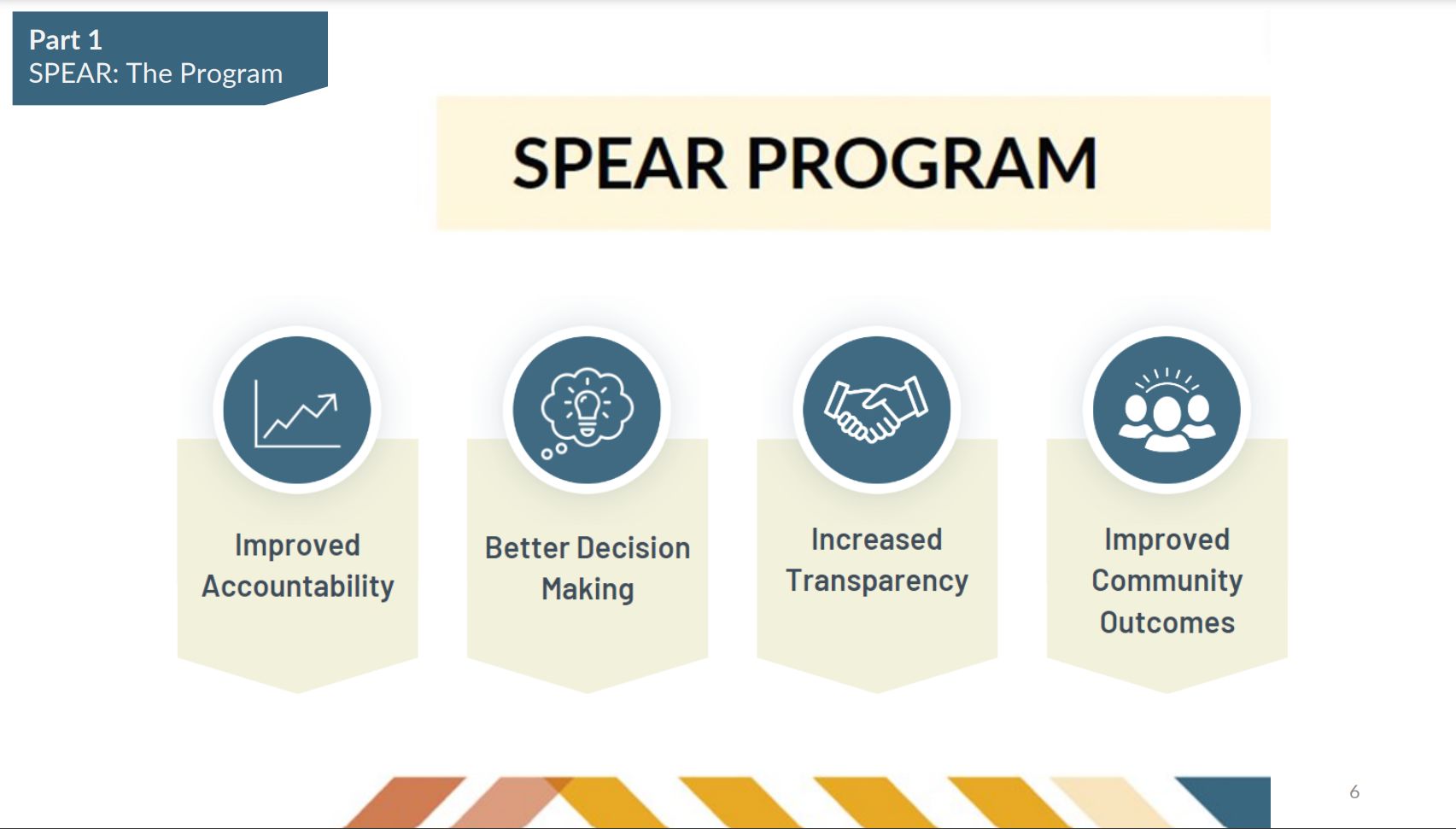
For the first time, Albemarle has developed a series of metrics to evaluate how progress toward each objective in the plan is going. This goes by the acronym SPEAR which stands for Strategic Plan Execution Analysis and Reporting (SPEAR). (final report)

“Several of our departments and our functions have been at performance measurement for a very long time,” Shifflett said. “They have state reporting, they have mandates, they have calls for service. And so it is something that they’ve been measuring for a very long time.”
All departments across Albemarle County government participated in coming up with metrics. Staff has been looking at the data and evaluating what the various targets would be.
“We spent some time with each department talking about the kind of rules of the road about metrics, and we wanted to ask them, where are we succeeding?” Shifflett asked. “We want to make sure that we look at this work, and from this work, we say, where are we stopped, paused? Where are we not making headway? And are we in trouble somewhere?”
Shifflett said paying attention to the direction of a policy can help staff change direction. She said the data itself is not the answer and often leads to more questions. And by putting it out for the public to review, the county increases its transparency.
“Trust in government often comes into play by setting the right and fair expectations,” Shifflett said.
For now, they’ve settled on 220 metrics which are designed to check in on the strategic plan. Gabriel Giacalone, a Senior Performance Management Analyst at Albemarle County, said there are metrics for each goal.
“Our goals are broad areas of focus. In the strategic plan, we have six of them, and underneath each of these we have objectives and these objectives,” Giacalone said.
For instance, Goal 1 is Safety & Well-Being which Giacalone said represents public safety agencies.
- A target was set for Fire/Rescue to conduct 1,800 code inspections of businesses within the county, and they attained 1,685, or 94 percent
- Another target determined that 90 percent of Fire Rescue calls for service in the rural area should arrive with 21 minutes, and the actual number was 95 percent
- Police sought to reduce their response time to priority 1 calls by three percent, and they achieved 4.5 percent
Goal 2 is Resilient, Equitable, and Engaged Community.
- There was a FY24 target to clean and assess 40 percent of the county’s urban drainage infrastructure, and the actual number was 29 percent
- The county also surpassed a goal to reduce greenhouse gas emissions from municipal buildings by five percent and the actual number was 6.4 percent
Take a look at the rest of the report to see the other four goals but note that the report for Goal 5 does not have any metrics but is just a timeline of events.
“You’ll see here that we’ve identified the funding that we provide to the public school system and the capital plan, such as the design of High School Center II, the Southern Feeder and Pattern elementary school,” Shifflett said.
For more information on those projects, I’ve got a recent story from the Places29-North Community Advisory Committee.
After the presentation, Supervisor Ned Gallaway said the county should make sure that taxpayers are aware of the metrics.
“This is about why what we’ve done connects to the tax bill you received and the people you elected to make it, you know, to get up there and try to drive policy,” Gallaway said. “So drawing those threads from strategic plan to the budget, that is critical. And you can’t do it without having a good analytic or a good report.”
Supervisor Michael Pruitt said he hoped the SPEAR report and other uses of the 220 metrics could help engage the community.
“I remember we had a citizen who came to a public comment earlier in the year who came up and asked myself and chair Andrews very simply, hey, what are you all doing?,” Pruitt said. “What are the things you’re doing? I would like to know what you’re doing. Can you tell me? This is going to be a really great way to do that.”
County Executive Jeffrey Richardson asked Supervisors to provide feedback on the metrics and reminded them this is just the first year of reporting. He said the overall goal is to tell the story of how the county is functioning.
“We don’t produce a product in this organization,” Richardson said. “We don’t build widgets. We are a people heavy organization that provides services to the community and our community looks at us in many ways to determine how we’re doing.”
Richardson also said the report is a good item for Supervisors to consider as they think about their performance review of his tenure as well as the people in his administration.
“We really do want to meet the expectations of this board and, more importantly, of the community,” Richardson said.
For more information, take a look at the SPEAR page on the county’s website. And what do you think? What do you want to know about Albemarle County?

Take a listen to the story:
Before you go: The time to write and research of this article is covered by paid subscribers to Charlottesville Community Engagement. In fact, this particular installment is from the September 21, 2024 edition of the newsletter. To ensure this research can be sustained, please consider becoming a paid subscriber or contributing monthly through Patreon.
Discover more from Information Charlottesville
Subscribe to get the latest posts sent to your email.