The Albemarle County Planning Commission has recommended denial of a request to rezone a residential property on Rio Road to commercial to allow for a sandwich shop and motel.
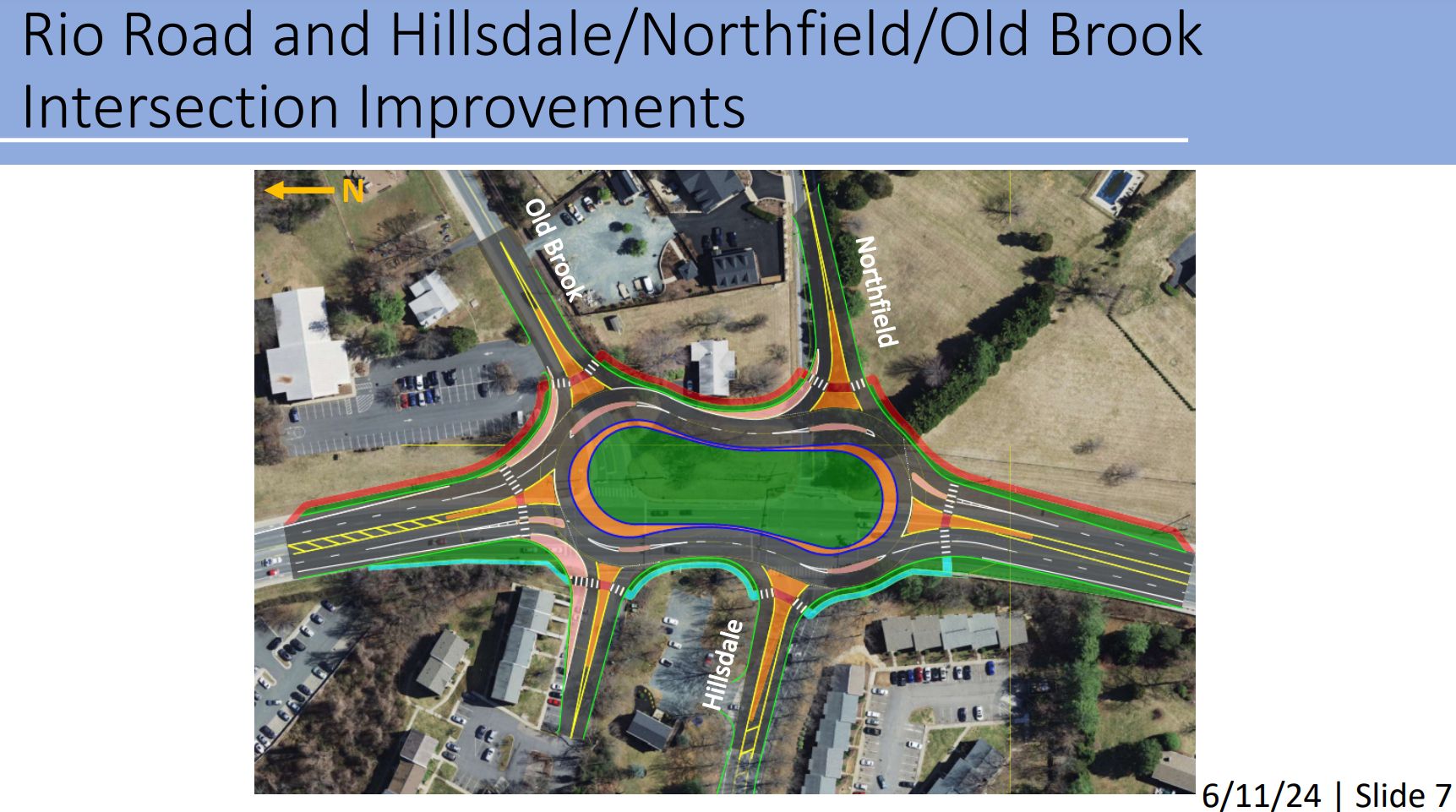
“It’s at the two closely-separated intersections of Rio and Northfield at Hillsdale, and Rio and Old Brook Road,” said Kevin McCollum, a senior planner with the Albemarle County Community Development Department.
The owner of the 1.2 acre property wanted the rezoning and special use permit to be able to add more rooms for short-term rentals to the existing single house, which already has an existing homestay permit. They also want to build a 1,200 square foot sandwich shop on the property.
McCollum said staff and the Virginia Department of Transportation already have concerns about the two intersections.
“In 2024, there have already been six crashes at this location,” McCollum said. “VDOT traffic volume data shows that approximately 30,000 vehicles pass through these intersections each day.”

A recent corridor study of Rio Road called for specific improvements at the intersection and Albemarle has applied for funds through VDOT’s Smart Scale program in the current cycle.
“The rates of crashes at these intersections combined is much higher of what we would ever expect at a similar type intersection, so much so that it was ranked the 4th worst intersection in the Culpeper District in the 2014 to 2018 five-year period,” said Kevin McDermott, the deputy director of planning for Albemarle County.
McDermott added there has been one fatality at the intersection this year as well as another in 2022. He said one reason is that the two traffic signals are too close together. The Smart Scale rankings will be known in January.
In their application, the applicant did not guarantee the plan that was shown to the Planning Commission but a representative said the concept is what would get built.
“The business owner’s commitment is that no change whatsoever to the business,” said a person named Pham. “Gas station? No. Something manufacturing? We should stick to a small business, food and drink only.”
Tim Miller of Meridian Planning Group, also representing the applicant, said the owner is not opposed to proffering the concept plan. The chair of the Planning Commission explained why they might be desirable to the county.
“There’s a concern that you may just tear down everything that’s there,” said Fred Missel, the Scottsville District representative. “A proffered plan would limit the ability to… to what’s there, basically.”
There were many speakers from the Raintree neighborhood who asked the Planning Commission to recommend denial of the plan. The first mentioned many have legal concerns with the case, including a recent case tried by the Virginia Supreme Court.
“I think when you fully read these materials as well as review it with Mr. Herrick, the county attorney, it will demonstrate that if this rezoning moves forward you would be going against and contrary to the rule of law in Virginia in this particular case,” said David Corbin.
Corbin said both the Raintree and the Carrsbrook neighborhoods were both created by Dr. Charles Hurt in 1959 and there were a number of restrictive covenants that would stop commercial uses. He said they were upheld in 1999 when another developer wanted to commercialize lots in Carrsbrook that front on U.S. 29. That case is River Heights Limited Partnership Association v. Batten and you can read it on FindLaw.
Herrick is currently serving as the interim county attorney and he addressed the case.
“I think it’s worth noting that private restrictive covenants and the zoning ordinance are separate tracks,” Herrick said. “It’s up to the county to enforce the zoning ordinance but the county is not in a position to enforce private restrictive covenants. To the extent that there is an alleged violation of a private restrictive covenant, it would be up to the neighborhood to enforce the terms of its own restrictive covenant.”
A half-dozen other speakers also argued against the rezoning due to traffic concerns.
Rio District Commissioner Nathan Moore said he makes decisions based on whether it’s something the community needs.
“We do need a lot more housing, so I am supportive of those,” Moore said. “But on this one, do we need to convert a non-compliant homestay to an inn? It’s not that compelling.”
Moore also said he is not often persuaded by neighborhood complaints and traffic, but this is the exception given the tough intersection and future plans to reconfigure it.
“When it comes to the neighborhood character argument, I would say that twenty times out of twenty I don’t find that particularly compelling,” Moore said.
Moore said he would support small-scale commercial uses in residential neighborhoods. Samuel Miller District Commissioner Karen Firehock had a different view.
“The neighbor has a residential home and has an expectation they are not buying a home next to a convenience store or a sandwich shop where people are coming and going, slamming car doors,” Firehock said.
The Commission voted unanimously to recommend denial of both the rezoning and the special use permit.
Before you go: The time to write and research of this article is covered by paid subscribers to Charlottesville Community Engagement. In fact, this particular installment is from the September 3, 2024 edition of the newsletter. To ensure this research can be sustained, please consider becoming a paid subscriber or contributing monthly through Patreon.
Discover more from Information Charlottesville
Subscribe to get the latest posts sent to your email.