


For the past several months, a political campaign turned newsletter company called Crozet United has raised concerns about the way Albemarle County is seeking to build a piece of infrastructure seen as a crucial transportation component for planned residential growth in Crozet. (Exclusive Report: Albemarle County’s Project Heron: A Questionable Public Private Partnership, May 31, 2024)
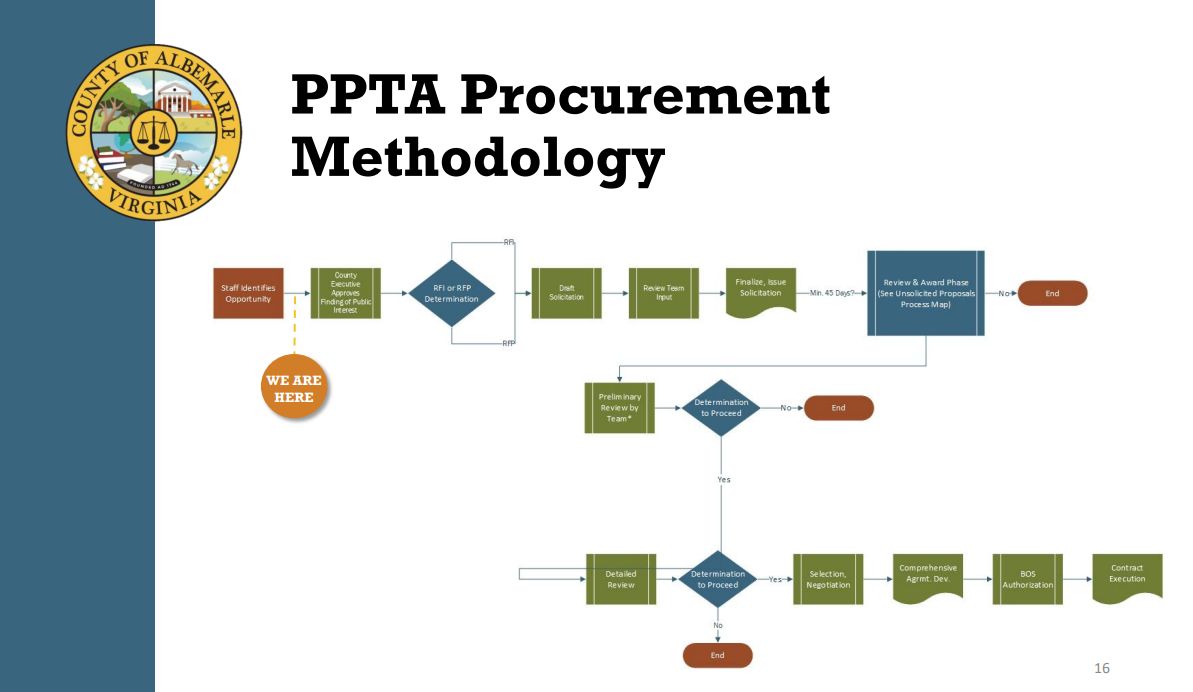
On Wednesday, August 7 Supervisors heard more details about how Albemarle County staff are planning to use a public private partnership to build the southern extension of Eastern Avenue.
“This project has been a very important piece of our transportation plans for the development of the Crozet area since we began planning for the growth of that area so as early as 2004 it was in the initial Crozet Master Plan and also the extension of Eastern Avenue,” said Lance Stewart, the director of Facilities and Environmental Services in Albemarle County.
As part of the process to update the Crozet Master Plan, Stewart said the county hired the firm Kimley-Horn in 2020 to study alignments for the road and the bridge. The route selected would cross Lickinghole Creek and connect to Cory Farms Road.

The major issue that has prevented the project from moving forward is a cost estimate that increased way beyond what was likely for the county and the Virginia Department of Transportation to save for construction. At the time a “basis of design” was completed the cost was $17.4 million, a figure that has grown to $23 million.
Albemarle’s strategy has been to use a combination of local funds and money from the Virginia Department of Transportation’s revenue-sharing program. As of the fiscal year that just began on July 1, VDOT has contributed $8,242,000 matched by an equivalent from the county.
However, VDOT’s official cost estimate for the project increased last summer to $39,475,000 leaving a substantial gap. That number is based on an assumption the project would be built in 2031.

At a Board of Supervisors meeting last August when the news was broken, Supervisor Ann Mallek suggested the county explore a public-private partnership. To enable that, the Board had to enact guidelines for the use of that mechanism, which they did.
- Albemarle Supervisors briefed on transportation projects including cost escalation for Eastern Avenue South in Crozet, August 10, 2023
- Albemarle Supervisors briefed on alternate transportation funding mechanism, April 11, 2024
Stewart said projects undertaken through Virginia’s Public Private Transportation Act of 1995 (PPTA) are complicated and Albemarle so far lacks experience in this process.
“Luckily, Kimley-Horn has done this before,” Stewart said. “They’ve worked on a number of VDOT PPTA projects.”
Stewart said Kimley-Horn is playing the role of “owner’s representative” where they work on behalf of a government agency by developing both the “finding of interest” and developing a “request for proposals” for contractors to bid on. (view the Finding of Interest)
The selected alignment is about 3,000 feet long and includes a bridge, according to Brian McPeters with Kimley-Horn. The connector would feature two travel lanes for vehicles, five foot wide sidewalks on each side, and bike lanes for a total width of 62 feet. McPeters said the analysis also did preliminary work toward meeting federal floodplain regulations.
“We’ve established the typical section, we’ve established what the alignment looks like, we have estimates of quantities,” McPeters said. “We even conducted environmental analyses including wetland and stream delineations. We know where the jurisdictional wetlands and streams are which means we know where the jurisdictional wetland impacts are likely to be.”
One unknown is whether the Federal Emergency Management Agency (FEMA) will agree to an adjustment of the official floodplain map.
“And we actually did conduct a floodplain analysis,” McPeters said. “Whenever you cross a floodplain on a bridge you have to deal with the floodplain. The question becomes, is the bridge X-hundred feet long or Y-hundred feet long.”
McPeters said state code establishes that a “finding of interest” must address six items including a description of benefits, an analysis of how much funding a locality can put up, and a reason why other procurement mechanisms are not being used.
“We have to do a risk assessment and understand,” McPeters said. “This is where you hire engineers because we like to look at problems and we like to come up with solutions to problems and understand how they work.”
The fifth item in the finding of interest is a determination of whether a risk is high, medium, or low. The final item is to explain why the state should allow the locality to proceed with a process that does not automatically award the work to the lowest bidder.
“If we want to choose best value, meaning we come up with a scoring system in the [request for proposals] that offerers are aware of, and may not be the low bidder but technically could be a better proposal in the advantage of the county, we’d have to explain why we would select that process,” McPeters said.
The four-page finding of interest goes over all six of these items.
Albemarle’s finding of Interest for Eastern Avenue
In terms of project benefits, McPeters said a completed Eastern Avenue would provide increased emergency access and would also remove traffic from Crozet Avenue to the west.
McPeters said private entities would have up to $17.3 million in public funding for the total project, but that doesn’t account for money for consultants. He also said VDOT’s estimate of $39.5 million is based on an assumption the project will go to bid in 2031. If the project were bid in 2028, the estimate would be closer to $28.3 million.
Traditional procurement methods for infrastructure projects are design-build and design-bid-build, both of which require Albemarle to have saved up all of the necessary funding before bids can be advertised. (view the Finding of Interest)
“Option 3, what we’re really here to talk about today, the P3, the public-private partnership, we now can close that gap potentially with private funds,” McPeters said. “We don’t have to have 100 percent of the public funds available for the total cost of the job. It brings with it the same benefits of a design-bid-build. We are now hiring the contracting team to do the design work, to do the permitting work, and the contractor to build it. They’re all working on one team.”

Another benefit to a public-private partnership is the possibility of beginning the project faster, which would avoid or reduce the inflation factor.
For this project, Kimley-Horn conducted a risk assessment exercise on May 24 with county staff and VDOT personnel that sought to list all of the various factors that could go wrong. This results in a risk matrix that will help with the writing of the request for proposals.
“If we have a risk event on that risk matrix, we’re going to write something into the RFP in the requirements to establish that sandbox or that corral in which the P3 offerer team is going to have to live and play and the things that they’ll have to hold up to,” McPeters said.
McPeters said there would be a higher risk to this project because it would be the first one conducted by the county. That’s the only reason why the Eastern Avenue project is considered “medium risk” rather than a low one.
“This project has all of the same project risks that any transportation project would typically have [because] it is crossing a stream, building a bridge, having to deal with FEMA,” McPeters said. “There’s really not anything unusual about that. In fact, it’s a new alignment project which from a roadway transportation project is actually easier because I don’t have to maintain traffic and work alongside you while you’re driving through my work zone.”
Stewart said developing the RFP will take some time but he is hoping it will be completed and then issued in the fall.
Supervisor Ned Gallaway said the Board has been asking for public-private partnerships for various initiatives such as one with Habitat for Humanity of Greater Charlottesville for affordable units at the Southwood Mobile Home Park.
“I was thrilled months ago to find that we could get into that PPTA for transportation projects because it’s an alternative tool available to us to try to get more done in a county that is behind in trying to get transportation projects done,” Gallaway said.
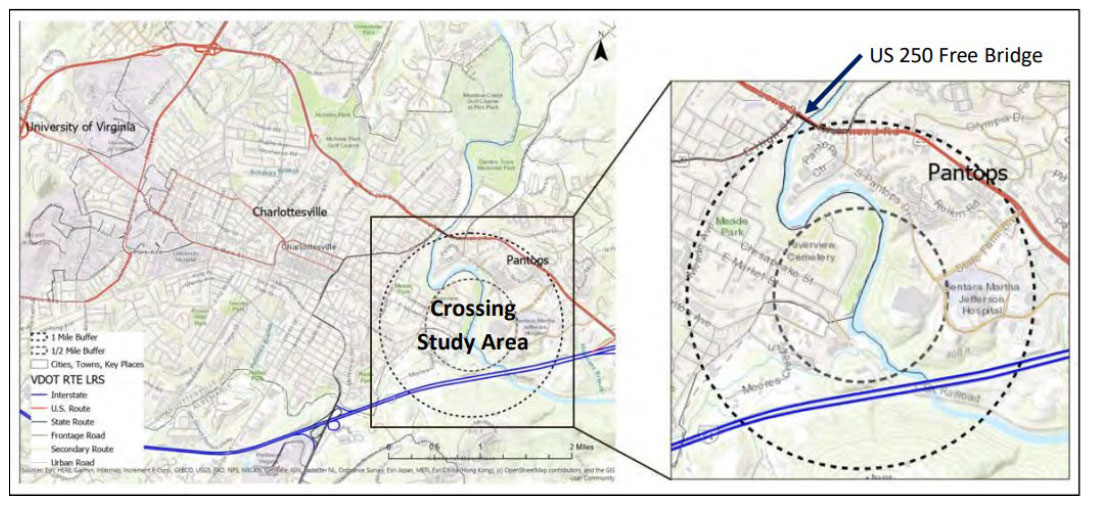
Gallaway said VDOT contingencies can kill projects, pointing to the project to build a pedestrian bridge over the Rivanna River at Pantops that also had a cost estimate that sky-rocketed.
Concerns from nearby residents
Before the presentation, three people from Crozet addressed the Board of Supervisors to offer their concerns about the public private partnership.
“I really want to believe that Eastern [Avenue] will be extended to 250 in Crozet but I can’t shake the feeling that the proposed partnership is really about checking a box to justify the development of Oak Bluff,” said Janie Holbrook, a Westlake Hills resident who is the second person to own a home that was built in 2020.
Oak Bluff is the working name of a proposed development along the right of way of Eastern Avenue for which Riverbend Development seeks a rezoning that has not gone before the Board of Supervisors. The maximum request is for 134 units in a mix of single-family houses and townhomes. The property is within the county’s designated growth area and the scope of the Crozet Master Plan.
According to the narrative for the rezoning, the project would dedicate 1.55 acres of right of way for the roadway. The application plan describes how the roadway would fit into the overall development.
Holbrook said the risk assessment should be considered high given what she said was the high likelihood that Riverbend would be the only respondent to the RFP.
“There’s no ongoing revenue stream to fill that gap or to repay financing,” Holbrook said. “No rational road construction will bid on a project requiring a huge subsidy. So we’re back to Riverbend being the only potential partner with something to gain. Can Riverbend increase the cost of homes at Oak Bluff by an average of $50,000 to cover the funding gap? Of course not.”
Holbrook also said she was concerned the rest of the Board of Supervisors would not be willing to spend over $8.2 million in local funding on the project to bring down the equivalent in VDOT revenue sharing funds.
Three nearby residents filed suit in Albemarle County Circuit Court on February 1 against two subsidiaries of Riverbend (Oak Bluff LLC and Lickinghole Creek LLC) as well as Stanley Martin Homes. The lawsuit argues that one of the parcels is still subject to a restrictive covenant and that Stanley Martin failed to meet the terms of a declaration by not holding annual meetings.
One of the plaintiffs is Carol Fairborn of Westhall Drive, a resident of a home built in 2017. She didn’t believe the expansion would ever be built due to what she also sees as high risk.
“I worry that the connector may remain more of an empty promise rather than a reality because many questions exist regarding its cost estimates, funding, and environmental issues,” Fairborn said.
Another of the plaintiffs in the lawsuit also spoke and dismissed the “finding of interest” included in the meeting packet.
“This just looks like a hope-filled plan signed off by Mr. Richardson and the community is going to be left with more homes approved, more density, more traffic, without a connector and more safety issues,” said William O’Malley, a resident of Westhall Drive since 2017.
“The public will be watching along with the details of the RFP,” O’Malley said. “Crozet citizens, we want the Eastern Avenue connector, we badly need that connector. We just don’t need it at all costs.”
O’Malley said there appears to be a quid pro quo behind the scenes with the rezoning with Riverbend’s name being all over documents made available through the Freedom of Information Act.
Gallaway addressed that accusation head on.
“I think I even heard the phrase quid pro quo thrown out today,” Gallaway said. “I don’t know how to get away from that thought because of the way negotiations happen. It’s just how it is but I know with Southwood that people thought it was just a quid pro quo to get the rezoning they needed even though we were talking about to make the partnership and make the project work.”
In that case, Habitat and the Albemarle Economic Development Authority have a performance agreement in place that governs how tax incentives and other payments will be granted in exchange for the provision of units guaranteed to be rented at certain levels.
See also:
- Habitat provides Southwood details to Albemarle Supervisors, September 23, 2021
- Albemarle Supervisors briefed on Southwood Redevelopment, April 26, 2022
- Redevelopment work continues at Southwood, August 19, 2022
Gallaway said the county is working ethically and legally and will continue to do so. He had this to say about anyone who might be contemplating a lawsuit.
“I can’t control litigation,” Gallaway said. “Litigation in this society and at this time can come for any reason and I simply offer my previous response on the view or the presence of folks who think we’re doing something improper, I offer the same response here. And if folks here and they have to litigate, then okay. But I’m going to feel confident going into it that we’ve done what is legal and ethical.”
One of the speakers had asked what would happen if the Federal Emergency Management Agency denied what’s known as a “letter of map revision” that would need to show impacts of the bridge. Brian McPeters had an answer.
“If for some reason FEMA was to say no and an increase in the floodplain is not available than likely that leads you to a potentially longer and taller bridge,” McPeters said.
McPeters said the timeline for a letter of map revision would be about a year and that would be assigned to whoever is awarded a contract through the RFP process.
A request for proposals will be ready in the fall. There will be more questions about this novel process at that time.
Before you go: The time to write and research of this article is covered by paid subscribers to Charlottesville Community Engagement. In fact, this particular installment is from the August 9, 2024 edition of the newsletter. To ensure this research can be sustained, please consider becoming a paid subscriber or contributing monthly through Patreon.
Discover more from Information Charlottesville
Subscribe to get the latest posts sent to your email.


One thought on “Albemarle Supervisors briefed on procurement mechanism for Eastern Avenue”