Since Albemarle County began offering an on-demand ride service for residents of two of the designated growth areas, the experience for the user has been free. During a budget work session in March, the Board of Supervisors asked for more information on what the effect of instituting a nominal charge would be.
On September 2, 2026, the six elected officials were briefed on the matter which began with a history of the service from Deputy Budget Chief Ryan Davidson.
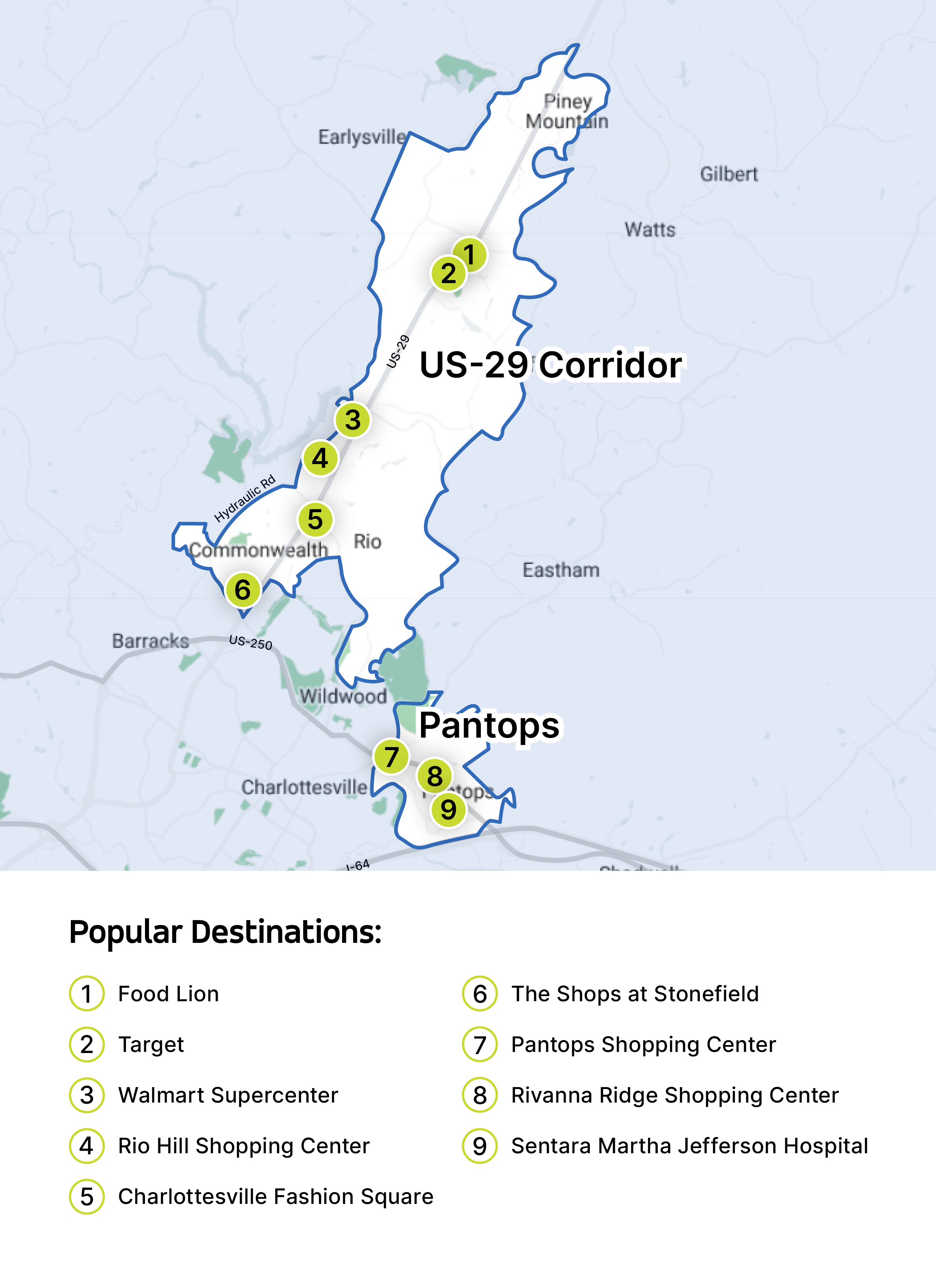
“In 2022, Albemarle County conducted a transit expansion study,” Davidson said. “One of the main recommendations coming from this study was around the utilization of microtransit, and more specifically for having that service in the Pantops and 29 North corridors or zones of the county. At that time, it was estimated the county could see approximately 100 rides per day for this service.”

Resources for the story:
- Staff report for the September 2, 2026 discussion
- Resolution to proceed to authorize collection of fares
- Presentation
Albemarle obtained a $1.9 million grant through the Virginia Department of Transportation to operate a pilot project and Charlottesville Area Transit won the contract to operate the service.
The county put up a $390,000 match but the terms of the grant required that no fare be charged to the user. Charlottesville Area Transit itself has been fare free since the beginning of the pandemic.
Since October 2023, the MicroCAT service has operated in the desired areas and a fleet of eight vehicles has been taking people around the areas to their destinations. There have been over 184,000 rides which has worked out to double the anticipated volume.
“In terms of current annual cost, the adopted budget for this service for FY27 was just over $1.4 million,” Davidson said. “Seventy-nine percent of the riders are repeat users of the service, and within— and those customers with an average of 8 rides per month for the return users of that service.”
As demand increases, the capacity is not enough to keep up which means a statistic of “unmet demand” is declining.
Now that the DRPT grant has run out, staff is proposing a general fee of $2 a ride for an individual passenger with an additional $1 for each rider. Discounts would be applied for eligible demographics such as those over the age of 65 and those with incomes lower than 60 percent of the area median income.
The proposal would see this starting on January 1, 2027 and would be expected to bring in $80,000 for the rest of the fiscal year, and $160,000 for every year going forward. Transactions would be done inside of the app and not via cash.
“It should be noted that the intent of these fees is not to be a source of revenue to fully offset the cost, but rather a source to help cover some of the cost while incentivizing users to utilize this service to supplement fixed route, not instead as a replacement for fixed route,” Davidson said. “Fixed route service is still the most efficient and cost-effective means of public transportation.”

Supervisor Ann Mallek of the White Hall District supported efforts to make sure the service was being used by people who needed it.
“I think it’s really important that there be accountability,” Mallek said. “I’ve been concerned about just giving free taxi rides to everybody, especially people who are certainly able to contribute something. But I also really appreciate the benefits to these people who are able to get to work or get to the hospital or get the child to school.”
Supervisor Sally Duncan of the Jack Jouett District said she had been skeptical of charging a fare but reconsidered after the presentation.
“It makes sense to me, especially if you’re trying to get people to do group rides and not just have single rides,” Duncan said. “So I actually think this is a great thing to try and, you know, see what happens.”
Supervisor Mike Pruitt of the Scottsville District said he remains skeptical of the MicroCAT system but said he appreciated charging a fare might help integrate the initiative into other multimodal programs.
“To kind of pithily capture the various concerns I have about MicroCAT generally is that it feels like a kind of curious nice-to-have, like a fun thing we do, and feels less part of an integrated transit system,” Pruitt said. “And I feel like this is a step toward that.”
Supervisor Bea LaPisto-Kirtley of the Rivanna District said MicroCAT has been a big success for the county and said charging fares will work well especially if no money changes hands between rider and driver.
“I was at first worried before it was answered that it’s not going to be cash,” LaPisto-Kirtley said. “So otherwise I thought, oh my gosh, they’re going to be held up.”
Supervisor Ned Gallaway of the Rio District disagreed with Pruitt and gave a specific example.
“Rio District residents are using this as their transit service,” Gallaway said. “It’s, it’s just happening. And I always use the Woodbrook to Kroger. It’s not that far. There’ll never be a fixed route that runs from Woodbrook to Kroger. And if there is one, it’ll have to be circuitous and go around where the MicroCAT’s always going to be the faster way. And I don’t want them walking across this, across 29.”
Supervisors voted 6 to 0 to authorize staff to begin making the steps necessary to put the charge in place as of January 1, 2027.
Before you go: The goal of Town Crier Productions is to increase awareness about what is happening at the local, regional, state, and federal government levels. Please share the work with others if you want people to know things. Paid subscribers cover the cost of conducting research for this article which was originally published in the September 4, 2026 edition of Charlottesville Community Engagement. You can either subscribe through Substack or make a charitable contribution.
Discover more from Information Charlottesville
Subscribe to get the latest posts sent to your email.