As Albemarle County has grown over the decades, so too has the local government that provides services to its residents. The Board of Supervisors adopted a $727,690,282 budget for the current fiscal year and the summary explains what guides how that money is spent.
“Our decisions are guided by the Strategic Plan, AC44, the Economic Development Strategic Plan, staffing studies, and our financial policies,” wrote County Executive Jeffrey Richardson in a letter that introduces the FY27 budget. “They are the guardrails that help us manage uncertainty, prepare for changing economic conditions, and protect taxpayers over time.”
AC44 is what Albemarle calls its Comprehensive Plan and the current document was adopted by the Board in October 2025, as I reported at the time.
The Economic Development Strategic Plan had been adopted two months before and you can read my account here.
The Strategic Plan refers to a set of high-level goals adopted by the Board of Supervisors in October 2022 which I also covered in the moment. Each year a report is produced by county staff that measures how well these goals are being implemented and this report is part of the process of preparing the next budget.
Kristy Shifflett, Albemarle’s Chief Operating Officer, presented the latest information to the Board of Supervisors on August 19, 2026.
“It’s important for the public to understand why we do this work and why we in Albemarle believe that the measurement is so important,” Shifflett said. “And so we talk about where are we succeeding, where should we pause or stop, or where are we not making headway? Is it about our staff, our structure, our systems, the lack of resources? And where are we in trouble? What areas do we need to refocus or redeploy something or re-engineer?”
- Strategic Plan Execution Analysis and Reporting (SPEAR)
- August 19, 2026 presentation to Albemarle Board of Supervisors
Goal 1 covers Safety and Well-Being, an area where the Board of Supervisors has approved significant investments in recent years. Eighty percent of the proceeds from a four-cent increase in the real property tax rate levied in 2025 goes to pay for public safety officers. (read a story)
Albemarle set a target to have at least 90 percent of fire rescue calls to rural areas responded to within 21 minutes and met that goal 96 percent of the time.
For the development areas, the target is to respond within eight minutes 90 percent of the time. The actual number for FY2026 is 81 percent.
“While fire rescue’s development area response isn’t quite where we want it yet, this 81 percent is a significant increase from last year’s 72 percent,” said Gabriel Giacalone, Albemarle’s Performance Measurement Program Manager. “And this is a direct result from investments made in the FY25 budget, and it’s a great success story to get to share today.”
Albemarle has two targets related to police response times for priority 1 calls with a goal to have officers on scene within ten minutes in the rural areas calls 100 percent of the time and five minutes in the development area. Actual numbers for FY2026 were 51 percent in the rural area and 73 percent in urban areas.

Goal 2 is Resilient, Equitable, and Engaged Community and one of the reported metrics is that Albemarle achieved 95 percent of its target related to greenhouse gas reductions and 100 percent of its goals to reduce pollution that makes its way into the Chesapeake Bay Watershed.
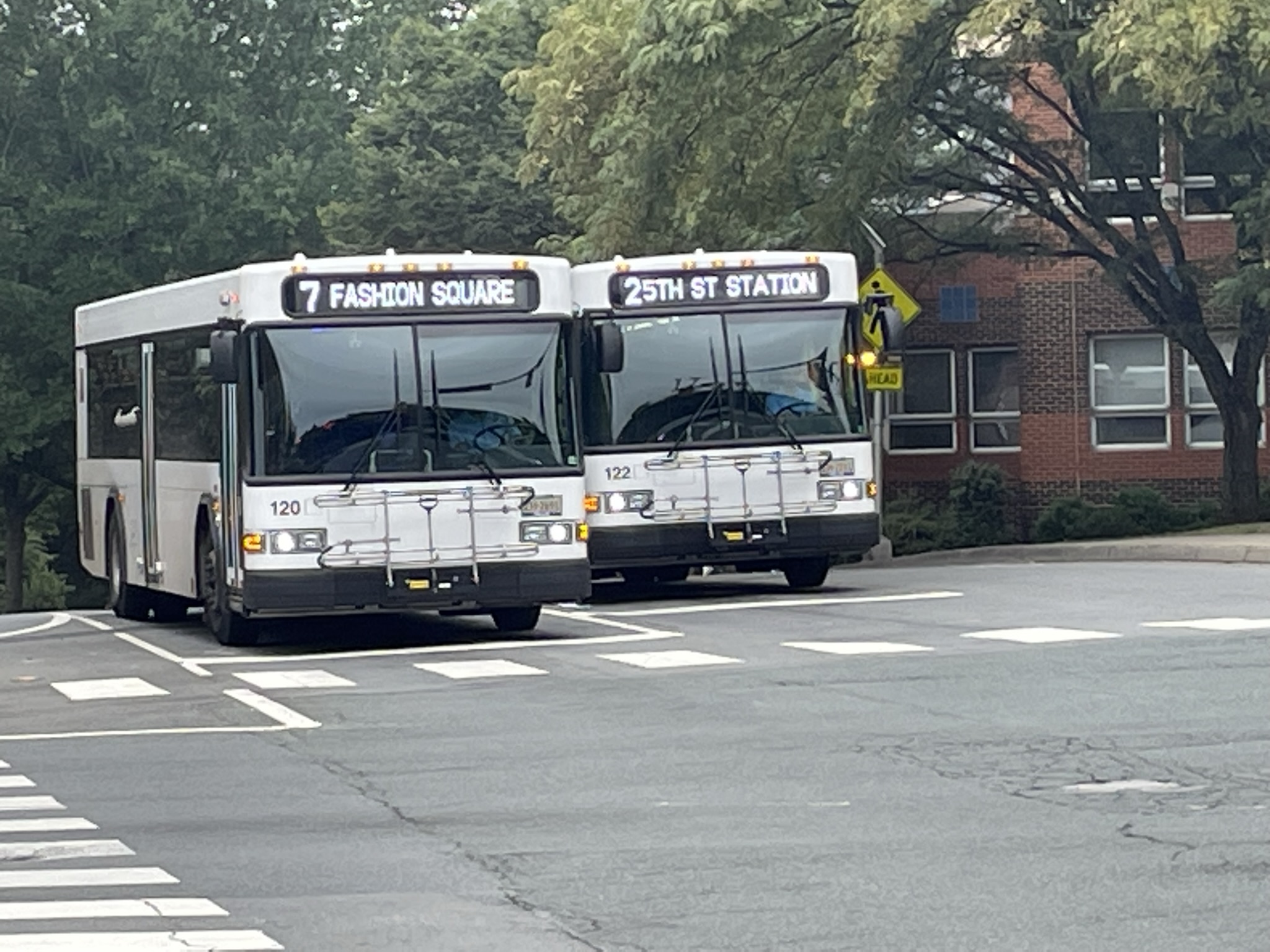
Goal 3 is Infrastructure and Placemaking and targets include ADA compliance on the county’s website as well as specific goals to build at least 6,000 linear feet of new sidewalks and provide at least 6,000 rides a month on MicroCAT. Other metrics include what another transit provider has been able to do.
“In FY26, Jaunt’s Connect services For 29 North and Crozet areas saw ridership increases of 4.8 percent and 22.6 percent respectively, collectively representing over 50,000 riders,” Giacalone said. “Jaunt demand response saw a modest 2.1 percent increase over 28,500 riders, and local funding of $3.5 million was leveraged with $4.9 million of federal and state dollars to provide these services.”
Goal 4 is Quality of Life and reflects the strong emphasis that economic development plays in driving policy in Albemarle County. A key metric over the long term is to have 15 percent of the county’s tax base come from commercial sources but the goal for FY2026 was 11.3 percent. The actual amount is 10.9 percent.
“The percent did drop here a bit, but given the incredible work of [the Office of Economic Development] and many big wins they supported in the past year, we are still optimistic that this value will meet our longer-term 15 percent goal, especially when AstraZeneca is operational,” Giacalone said.
In October 2025, AstraZeneca announced the investment of $4.5 billion to build two pharmaceutical plants at the county-owned Rivanna Futures business park. Giacalone called this a landmark accomplishment.
“The project is expected to create roughly 600 high-quality jobs and strengthen the local biotech supply chain,” Giacalone said.
Another milestone was the ribbon-cutting of Agrospheres, a biotech start up with ties to the University of Virginia.

Goal 5 covers Education and Learning and accomplishments in FY2026 include near completion of what used to be called High School Center II but is now referred to as the Albemarle Career Exploration Academy.
“The new facility will house eight scholar studios and serve up to 400 students daily from Albemarle, Monticello and Western Albemarle High Schools with specialized career-focused learning opportunities.
Mountain View Upper Elementary School was also completed and serves grades three to five in the southern feeder pattern.
Goal 6 focuses on Workforce and Customer Service which includes skills training for employees, payroll optimization and investments in the county’s GIS system. That system had been knocked offline in a cyberattack on the county in June 2025 but has been brought back with improvements.
“The county modernized its GIS services with improved search and parcel tools, new sketch and measurement features, and expanded data export capabilities,” Giacalone said. “These upgrades make accurate spatial information more accessible, supporting greater operational efficiency, data-driven decision-making, and a better experience for staff, partners, and the public.”
Supervisor Mike Pruitt of the Scottsville District said he was not sure if the SPEAR report was meant to be a way to evaluate Albemarle’s programs but instead a way for staff to tell stories about what gets accomplished.
“We need both of these things, but I think it will be better at whatever it is when it is very firmly one of those things,” Pruitt said.
Shifflett agreed that SPEAR does serve both purposes.
“It is to try to meet our constituents where they are,” Shifflett said. “Some people do not love data like we love data, and some people just want to hear about impact. And so we have done both, but I would tell you that behind the scenes, it’s a lot of program evaluation. We just don’t publish that in this report, but it is published online.”
That information can be found here.
Before you go: The goal of Town Crier Productions is to increase awareness about what is happening at the local, regional, state, and federal government levels. Please share the work with others if you want people to know things. Paid subscribers cover the cost of conducting research for this article which was originally published in the September 2, 2026 edition of Charlottesville Community Engagement. You can either subscribe through Substack or make a charitable contribution.
Discover more from Information Charlottesville
Subscribe to get the latest posts sent to your email.