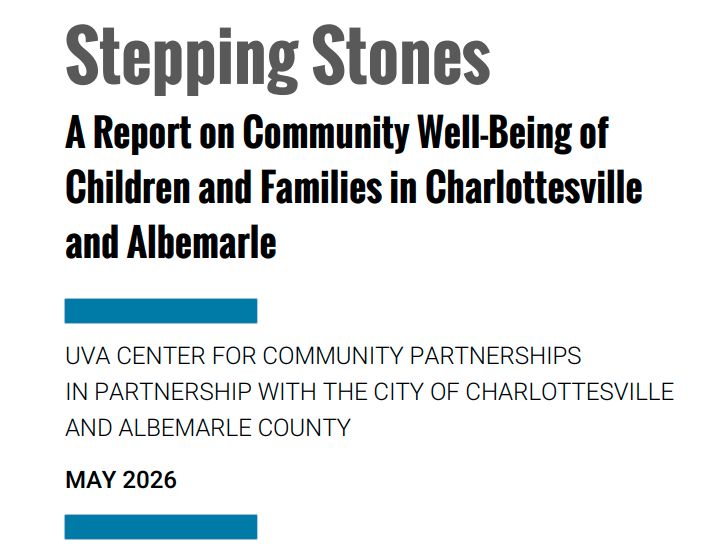
A research group at the University of Virginia created in 2019 has published the latest report on the well-being of children and families in Albemarle County and Charlottesville. The UVA Center for Community Partnerships reviewed more than thirty datasets to describe the state of youth development.
“The goal is to create a data-informed understanding of our collective trajectory, encourage dialogue, and promote action to improve the lives of all who reside in our community,” reads the executive summary of the 54-page Stepping Stones Report.
There are four categories of measurements and they are; Education; Economic and Family Stability; Health; and School and Community Disciplinary Actions.
This work dates back to 2000 when the now-defunct Charlottesville/Albemarle Commission on Children and Families published the first one. The city’s Department of Human Services took over the research and in 2023 the UVA center joined the partnership with Charlottesville and Albemarle County.
The first education metric listed is Kindergarten Readiness as measured by benchmarks in social skills, literacy, self-regulation, and mathematics.
“In the most recent fall assessment, 59 percent of Albemarle kindergartners and 58 percent of Charlottesville kindergartners met the overall readiness benchmark,” reads page 6 of the report.
The report also traces Standards of Learning scores over time. These were not administered in 2020 due to the COVID shutdown and the data for math scores dropped sharply in the gap year. For instance, 83 percent of Virginia students in 5th grade passed the math SOL in 2018-2019 and that dropped to 50 percent statewide in 2020-2021.
Albemarle students were at the statewide average in 2018-2019 but dropped to 63 percent in the first after testing resumed. The number has climbed higher to 74 percent in the 2024-2025 year.
Only 40 percent of 5th grade students in Charlottesville schools passed the math SOL in 2018-2019 and that dropped to 32 percent in 2020-2021. That number rebounded to 60 percent in 2024-2025.

The report also tracks absenteeism.
“In the years following the initial onset of the COVID-19 pandemic, rates of chronic absenteeism in schools throughout the U.S. have skyrocketed: national-level data shows that rates of chronic absenteeism in U.S. schools increased from 15 percent in 2019 to 26 percent in 2023,” reads page 10 of the report.
Albemarle County Public Schools have followed that trend but have made efforts. In 2022-2023 18 percent of students were considered chronically absent but the figure dropped to 12 percent in 2024-2025. That same year, 21 percent of Charlottesville students met the description.
The Economic and Family Stability section begins on page 16 and the first metric regards income for families with children.
“According to United for ALICE the amount an average family needs to meet basic needs in 2023 was $75,124 in Albemarle and $68,703 in Charlottesville,” reads the report.
Data comes from the Census Bureau’s American Community Service and the report notes this has a degree of uncertainty to it. Data from 2024 shows that the median income with families with children was nearly $140,000 in Albemarle and $113,000 in Charlottesville.
Another metric is the number of children living in poverty. In 2024 that is defined federally as having an income of $31,200 for a family of four.
“In Charlottesville in 2024, the percent of children in poverty was the lowest it has been in the last decade, at 15 percent, but still remained higher than in Virginia overall,” reads the report. “The child poverty rate in Albemarle is consistently lower than that in the state, and has remained near its lowest rate in recent years, at 7 percent in 2024.”
Other metrics under this section include investigations by Child Protective Services, children in foster care, and students experiencing homelessness.

The Health section includes metrics on prenatal care, low birth-weight babies, teen pregnancy and infant mortality.
“The infant mortality rate has risen in Albemarle since 2016, growing to a high for the period of around 6 infant deaths per 1,000 live births in 2022, the most recent year with an available 3 year average value,” reads page 31 of the report. “In Charlottesville, the infant mortality rate has fluctuated over the period, with a high average in 2016 of 7 infant deaths per 1,000 live births. In the most recent year with an available 3 year average, the rate was around 5 infant deaths per 1,000 live births.”
The School and Community Disciplinary Actions tracks in-school suspensions, out-of-school suspensions, children in need of supervision, juvenile delinquency judgements for youths, and arrests for violent crimes.
“Arrest rates in both Albemarle and Charlottesville have seen a mostly downward trend since 2010,” reads page 43 of the report. “In Charlottesville the arrest rate was 5 per 1,000 youth in 2011 and has gone down to 0 recorded in 2024.”
There’s a separate metric for arrests for crimes involving firearms.
All of the data can be found on GitHub.

Before you go: The goal of Town Crier Productions is to increase awareness about what is happening at the local, regional, state, and federal government levels. Please share the work with others if you want people to know things. Paid subscribers cover the cost of conducting research for this article which was originally published in the June 16, 2026 edition of Charlottesville Community Engagement. You can either subscribe through Substack or make a charitable contribution.
Discover more from Information Charlottesville
Subscribe to get the latest posts sent to your email.