


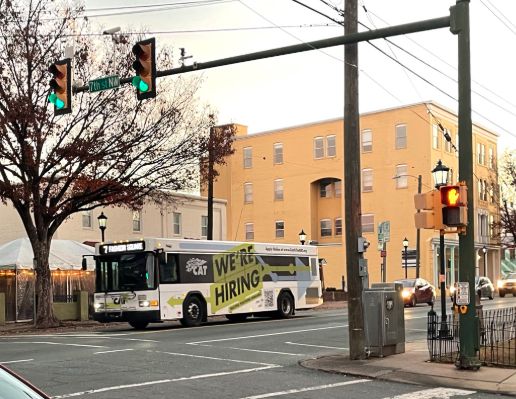
In March 2024, the Charlottesville City Council agreed to a plan where Charlottesville Area Transit would pilot two alternate fuel sources for its vehicles as a replacement for diesel.
Two months later some of its members visited Champaign-Urbana, Illinois, to see how that community’s Mass Transit District generates its own hydrogen. So far there’s no clear path for CAT to pursue this route as the Planning Commission learned on May 12.
Piloting the other alternative will move forward this summer as CAT receives the first two battery-electric vehicles from manufacturer Gillig. Director Garland Williams told the Charlottesville Albemarle Regional Transit Authority on May 28 that they there were under construction that day.
“Our two battery electric buses have been built,” Williams said. “They’re actually on property at Gillig. They’re waiting on seats. The technology is going in this week.”
The next step was to have been testing followed by shipment to Charlottesville.

As of May 28, work was also underway on a charging station at CAT’s facilities on Avon Street Extended in Albemarle County.
A few days later, Williams was on hand at the June 1 City Council meeting as part of the first reading of $16,846,224 in federal and state grants for capital spending intended for both FY25 and FY26.
“The awards from the Federal Transit Administration equal $4,716,943 and from the Virginia Department of Rail Public Transportation is $11,455,432 with a local match requirement of $673,849,” Williams said.
Some of the money will go toward making it easier for people to find the buses. There’s a $1.5 million line item for Automatic Vehicle Location (AVL) software.
“That allows individuals, when we put it into the app, to know where they are and also hopefully move us closer towards real time recognition when you look at your app,” Williams said.
The federal and state grants include $2.6 million to pay for the first two electric buses. Williams said this appropriation will allow them to cover the costs when they arrive. Another $2.75 million goes toward infrastructure to support the battery electric vehicles which Williams said are considered expansions to the fleet and not replacements.
This tranche of funding also includes around $6.3 million for eleven diesel bus replacements. At least two Councilors asked why these would not be hybrid models.
Williams said CAT needs a significant amount of capital investment for a maintenance facility to support an expanded fleet of alternative fuel buses and the federal and state government will be asked to help cover that cost.
“We’re looking at in the range of 35 to 40 million dollars, so that’s a significant ask,” Williams said. “And then we’re going to be coupling that with asking for much more funding associated with the vehicles themselves.”
Another two battery electric vehicles are expected to arrive next March.
Even when the first two arrive, the infrastructure will likely not yet be in place.
Before then, CAT needs Dominion Energy to perform work to connect the chargers. Williams did not have a firm date for that at either the CARTA or the Council meeting. He said the company has marked lines on the property but are not cleared to do the work.
“I believe there is an agreement that needs to be done to allow them on our property that has not gone to legal,” Williams said. “We have not seen it yet. So that will be the first indication that they’re ready to start their process.”
Williams said he is hopeful that work will be done before the end of September. He also said he would provide information to Councilors about diesel-hybrids in two-by-two meetings. When two Councilors get together, conversations are not subject to Virginia’s open meeting laws.
Follow-up questions sent to CAT and the city were not responded to by publication time of either the newsletter nor this article to this website.
Previous stories:
- Area delegation travels to Illinois to tour hydrogen production used by Champaign-Urbana Mass Transit District to power a dozen buses, June 14, 2024
- City pursuing federal grant for maintenance facility, June 24, 2025
- Procurement update: CAT seeking firms to install chargers for battery electric buses, March 11, 2026

Before you go: The goal of Town Crier Productions is to increase awareness about what is happening at the local, regional, state, and federal government levels. Please share the work with others if you want people to know things. Paid subscribers cover the cost of conducting research for this article which was originally published in the June 4, 2026 of Charlottesville Community Engagement. You can either subscribe through Substack or make a charitable contribution.
Discover more from Information Charlottesville
Subscribe to get the latest posts sent to your email.


