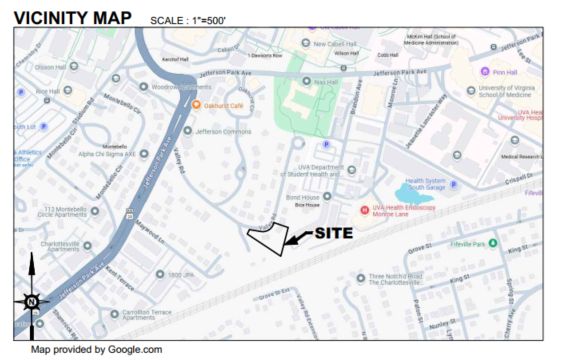
In less than a month, the City of Charlottesville intends to relocate willing residents of the Rivanna River encampments to a vacant office building the city purchased in October 2025 for $6.2 million.
“Although the city has taken the lead as it relates to emergency shelter operations, our goal really remains the same and that is to collaborate with our partners, our providers and other folks to ensure that we open Holiday Drive as close to September 1st as possible and with a viable shelter operating plan,” said Assistant City Manager Sam Roman at an August 3rd briefing to City Council held in the afternoon.
Several hours later, City Council agreed to spend $4 million from the city’s Capital Improvement Program contingency fund “for homeless intervention services to include emergency sheltering and direct to housing supports.”
Specific amounts to specific agencies were not specified at the meeting because negotiations are still underway. Council learned in the evening that a group called Central Arizona Shelter Strategies (CASS) is in line to operate 2000 Holiday Drive in the short-term.
Council also voted 4 to 0 to waive a second reading that would allow City Manager Sam Sanders to complete negotiations. Charlottesville Mayor Juandiego Wade was absent from the work session and the rest of the meeting.
Another group that will be hired is the Clutch Consulting Group. Further details from the evening discussion in the next edition of this newsletter. A press release was sent out this morning that confirmed CASS but not the Clutch Consulting Group.
“CASS brings decades of experience operating emergency shelters and, if finalized, this agreement would enhance our ability to provide immediate shelter while connecting people with housing, healthcare, behavioral health services, and other supports,” Sanders is quoted in the release.

Roman on Holiday
Roman began his update at around 4:30 p.m. with an initial assessment of people living at the encampments conducted concurrently with a Point in Time count held in late July.
“That consisted primarily of UVA clinicians and our local providers to include PACEM, to maintain a presence at the riverfront where they set up two tables, two kiosks, one of them on the 0 East High side and the other on the Free Bridge side, using the data from the assessment and PIT count to interact with the folks down in the encampment,” Roman said.
Roman said that intake led to assistance of 54 people, using the phrase “documented connections.”
“Those connections include SNAP benefits and applications, healthcare coordination, employment and education opportunities, case management, intake scheduling, follow up appointments, identification and vital records, behavioral health and recovery support and reentry support through Home to Hope as well,” Roman said.

City staff have begun to identify items at the encampments that appear to have been abandoned and will soon have a contractor come out to remove them. The city’s Parks and Recreation Department has been collecting trash in the area on a daily basis.
Roman said the city is close to an agreement with an entity to provide services at 2000 Holiday Drive but did not initially give a name. He also said there will be an engagement plan to communicate what will be happening with businesses near 2000 Holiday Drive. Last week, the Virginia Restaurant, Lodging and Travel Association sent a letter to Council seeking answers to ten questions as reported by CBS19 News. (read the letter)
Roman said he and the police chief visited the area on Monday along with other city officials including economic development.
“We spent about an hour and a half in the area just talking with the different businesses and really just kind of filling in some of the gaps as we know them now, some of the informational gaps that existed,” Roman said.

Back in May, Executive Director Shayla Washington of the Blue Ridge Area Coalition for the Homeless said the nonprofit had received a quote from the Clutch Consulting Group to help get people into homes for up to a year and a half. The company was created in 2018 by two people who helped rebuild the homelessness response system in Houston, Texas.
Roman said the company was here last week.
“After spending time in Charlottesville, they have offered their technical assistance to us that will partner with us to utilize the resources available to connect with landlords and housing opportunities with current individuals in the encampment that were a part of the assessment,” Roman said.
Roman said this will include training city staff on case management so they can continue doing the processing work.
“They will also continue to advise us on technical matters pertaining to the encampment, the encampment closure as we request,” Roman said.
A price was not initially mentioned.
City launches Connect Charlottesville page with one month until “transition”
On Monday, the city’s new Connect Charlottesville community engagement platform got a new section.
“Charlottesville is taking a coordinated and compassionate approach to support people who are experiencing homelessness,” reads the Charlottesville Homelessness Response and Riverfront Transition page.
The page is intended to inform the public how they can assist with the transition. It also informs the public that temporary cameras have been set up to “support public safety for individuals staying in the encampment, trail users, volunteers, and staff.”

According to the website, these cameras record video but not audio and no facial recognition technology is used.
Roman told Council the cameras are part of the increased presence by Charlottesville Police and the Charlottesville Fire Department.
“Following the most recent incident, CPD increased patrols and maintained an enhanced public safety presence in the area, including overnight areas,” Roman said. “Enhanced public safety presence is ongoing and likely to last throughout the closure of the encampment.”
City Councilor Lloyd Snook said the number of people who have been assessed so far is lower than the number of people believed to be at the encampments.
“We’ve had estimates at one point, but 115 and 80 and so on,” Snook said. “And now we’re finding 38 or maybe 30 that we’re actually making contact with. Do we have a sense, even just a working hypothesis vaguely of what’s going on?”
Roman said the city’s Chief Strategy Officer is working with nonprofits in the “Continuum of Care” to get that information ready to share.
“In some cases it’s difficult to analyze that information,” Roman said. “However, we do endeavor to do the very best that we can with that.”
Last June, City Council authorized $425,000 from the surplus fund for two homelessness outreach specialists. Human Services Director Misty Graves said those jobs will be posted soon plus a third.
“That’s going to include one program manager and also two homelessness outreach specialists,” Graves said. “What we hope that these positions will be able to do is to also help support accurate data collection. These folks will actually be in the field, not just at the 0 East High or the Free Bridge encampments, but in other areas and where folks may be sleeping outdoors to ask questions like where did you last sleep?”
An elected official’s perspective
City Councilor Jen Fleisher has been working closely with the many groups trying to provide assistance such as the Haven’s work to take people to the Department of Motor Vehicles to get an ID.
“PACEM’s team has been remarkable from leading the assessments in a trauma enforced, trauma informed way, but also making these connections that are critical to that trust building and that kind of walking the walk that we have wanted to do,” Fleisher said. “UVA Health med students and nursing, bringing all kinds of expertise and connections for, you know, from general wound care to mental health support.”
Fleisher also provided some demographics on the people at the encampment with an average age of 37. She said there are couples there as well as people who are trying to reunite with family. She said a consistent presence has helped earn trust for the transition effort.
“The teams have really worked hard to not only be consistent, we’ve been there every day for at least four hours a day, but double days for a lot of the first week and a few times last week as well,” Fleisher said.
Emergency shelter or permanent?
City Councilor Natalie Oschrin asked about the plans that had been presented by the three Continuum of Care nonprofits back in March. The firm Mitchell Matthews Architects Planners had been hired to prepare an initial schematic but that has not been publicly updated.
“What are the features that are going to be there?,” Oschrin asked. “What is it actually going to look like? How much of that has been conceptualized and how much does it differ from those plans?”
Roman said the goal is to make the existing footprint work in the short term with one change being physical alterations making sure people can get in and out of the building safely. Another is to have places to store the belongings of those who will stay there.
Whatever is done will have to pass inspection.
“For now, the emergency shelter, what we’re working on is making sure that, you know, building code, the building official is happy with the plans that we have for the building,” Roman said.
The plan for now is to be able to use 2000 Holiday Drive as an emergency shelter while the greater renovations are also taking place. There is no public price tag for how much that will cost.

City Manager Sanders details uses of $7 million in state funding
The Virginia General Assembly finalized a biennial budget in late June, very close to the beginning of the fiscal year. That included a budget amendment to provide additional funds to tackle this issue.
“Out of the amounts in this paragraph, $7,000,000 the first year is provided to the City of Charlottesville for the development of a transitional housing and life skills training facility to increase capacity to serve individuals and families experiencing homelessness in the community,” is the exact wording of the amendment.
It will be up to the City Council to decide how that money should be used. City staff are recommending using a portion for the Salvation Army’s expansion project. Council has already contributed $3 million to this project.
“The recommendation that is coming to you all on your August 17th agenda is for $3 million to be provided to the Salvation Army, basically framing it as a match to the city’s contribution to the Center of Hope Capital campaign,” Sanders said.
Sanders said the other $4 million will be used for transitional housing services but not the emergency shelter planned for 2000 Holiday Drive because it does not match the language in the budget amendment.
“The transitional housing component is that it becomes a place that people get to live in for an extended period of time,” Sanders said. “And there are minimal conditions that have to be met. An example would be that they would have independence in that space. So an ability to cook, an ability to clean, and the ability to take care of themselves. In a congregate shelter. That is not the case. Th
The Vista29 project under construction on U.S. 29 is an example of transitional housing as is the Crossings at Fourth Street. Both are managed by a nonprofit called Support Works Housing.
More details in the August 5, 2026 edition of Charlottesville Community Engagement.
Before you go: The goal of Town Crier Productions is to increase awareness about what is happening at the local, regional, state, and federal government levels. Please share the work with others if you want people to know things. Paid subscribers cover the cost of conducting research for this article which was originally published in the August 4, 2026 edition of Charlottesville Community Engagement. You can either subscribe through Substack or make a charitable contribution.
Discover more from Information Charlottesville
Subscribe to get the latest posts sent to your email.