For many years, the City of Charlottesville struggled to deliver on transportation projects with long delays for undertakings such as the replacement of the Belmont Bridge. In recent years, the Virginia Department of Transportation has declared the city “deficient” at implementation.
On March 24, the Planning Commission learned that for the first time in many years, VDOT is allowing the city to apply for money to change a major downtown intersection.
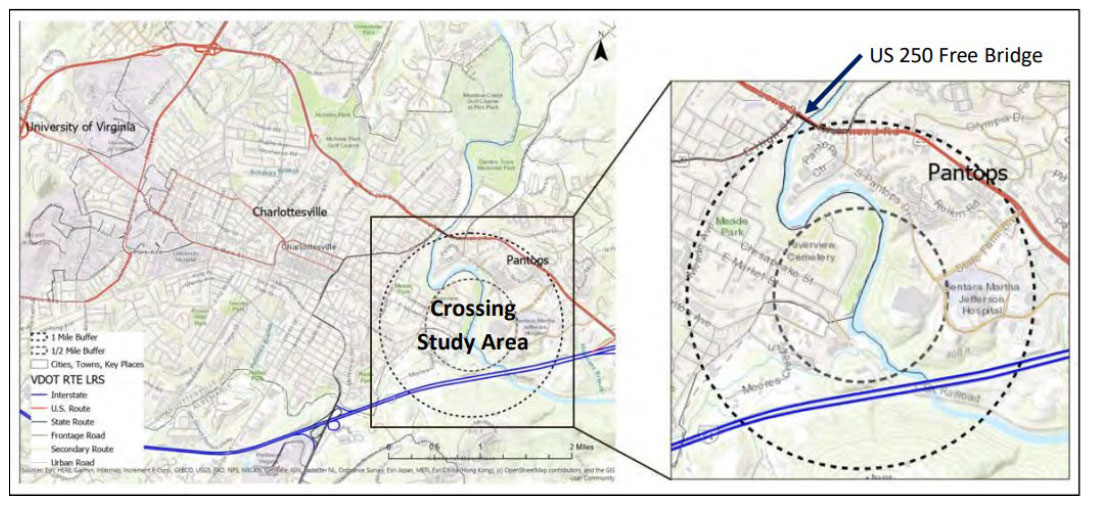
“We’ve got a STARS study with VDOT that we’re doing right now for the intersection in the middle of town at West Main and Ridge,” said Ben Chambers, the city’s transportation planning manager. “That will turn into the city’s first Smart Scale application in four years if it’s endorsed by City Council in July.”
STARS stands for “Strategically Targeted Affordable Roadway Solutions” and you can learn more about this project at VDOT’s website. Charlottesville City Council had a briefing on those plans on March 16.
Chambers usually only appears before the Planning Commission once a year during a presentation on the capital improvement program but he wanted to brief members on what his staff is working on. That includes coordination with Charlottesville Area Transit to realign routes and coordinate infrastructure for new bus stops.
“We’re doing that with the Route 2,” Chambers said. “That is an expansion out into [Albemarle] County which will allow city residents to connect to such glamorous locations as the jail, but also to the Mill Creek Shopping Center and Piedmont Virginia Community College.

View the rest of the CAT Transit Strategic Plan here (Credit: Charlottesville Area Transit)
According to CAT’s Transit Strategic Plan, the idea is to split the existing Route 2 into two segments. Chambers also said that an inventory of all of the bus stops has been made so their conditions can be tracked over time now that a baseline has been created of what is on the ground.
“Kind of surprisingly, we didn’t already know the answer to that, but now we do,” Chambers said.
Another ongoing initiative is planning for restriping on Rose Hill Drive after infrastructure work is done in 2027. Chambers said there is an opportunity to slow down traffic and that has included working with the Rose Hill neighborhood.
“We kicked off this project with the neighborhood at the beginning of this month with a walk audit up and down the corridor,” Chambers said. “We’ll be returning to them in April with some design options and hopefully moving to council with a referral alternative that’s been vetted and discussed with the community in June.”
More information about that project is also on the city’s website.

Toward the end of his presentation, Chambers updated the Planning Commission on a new mobility plan, something called for in the 2021 Comprehensive Plan.
“It says secure funding for a transportation master plan as part of its goal number one for ‘complete streets’,” Chambers said. “I can say that we have achieved that goal already. Council has already set aside funding for this effort.”
In October, Council approved the use of $1.5 million from surplus funds to pay for the mobility plan as well as a review of the city’s environmental regulations.
That month they also agreed to settle a lawsuit that alleged that the city’s 2023 Development Code was not valid because the city did not sufficiently coordinate with VDOT to measure the effects increased density might have on the road network.
The mobility plan will involve coordination between previous plans such as the 2015 Bike and Pedestrian Plan, the 2024 Americans with Disabilities Act update, and the 2019 Standards and Design Manual. (all can be found here)
“And part of the reason that we identified this as a need last year was we were trying to turn to our existing plans and figure out what we were supposed to do next and finding a lot of conflicts,” Chambers said. “We were finding that they weren’t coherent amongst themselves.”
Chambers said the goal is to have a plan with actions that can measure how well the city is living up to the ideals in the Comprehensive Plan to have multimodal access, sustainability, and healthy communities. The next step is for the Planning Commission and the public to see a report on existing conditions.

Before you go: The goal of Town Crier Productions is to increase awareness about what is happening at the local, regional, state, and federal government levels. Please share the work with others if you want people to know things. Paid subscribers cover the cost of conducting research for this article which was originally published in the April 1, 2026 edition of Charlottesville Community Engagement. You can either subscribe through Substack or make a charitable contribution.
Discover more from Information Charlottesville
Subscribe to get the latest posts sent to your email.