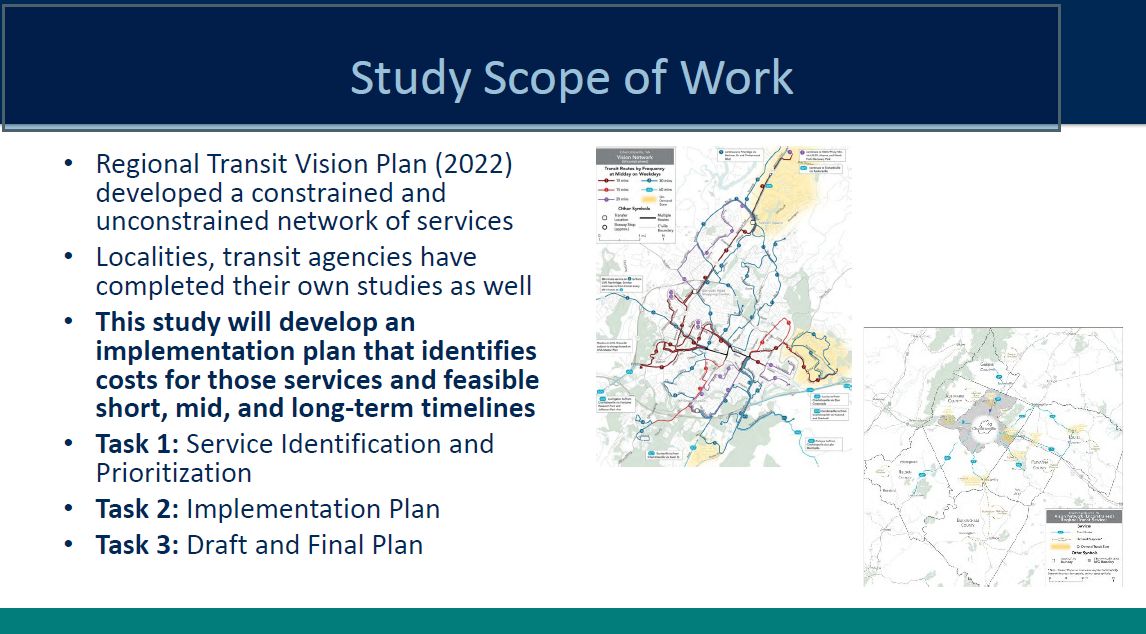
As the Charlottesville-Albemarle Regional Transit Authority continues its existence, one of its purposes is to prioritize what activities it should be pursuing. To that end, a study is underway intended to guide the search for additional funding for additional bus service as called for in a 2022 study known as the Regional Transit Vision Plan.
“This Transit Vision Plan is a collaborative effort to evaluate transit service in the City of Charlottesville and the Counties of Albemarle, Greene, Louisa, Fluvanna, Buckingham, and Nelson and to establish a clear, long-term vision for efficient, equitable and effective transit service in the region,” reads the executive summary for that plan.
The Virginia Department of Rail and Public Transportation is overseeing the prioritization study which will also look at the Regional Transit Governance Study from 2023.
“There are actually over 20 studies that we’re pulling recommendations from, pulling all that information together, identifying cost in a common year for those services and then coming up with some feasible short and mid and long term timelines and strategies for implementation,” said Jennifer DeBruhl of DRPT.
CARTA replaces the Regional Transit Partnership which ended last year as I reported at the time.
DeBruhl said the recommendations will be ready in time to influence the next General Assembly but the work of stakeholder engagement is just getting underway with focus groups.
“ We’re targeting late February for a larger group session to talk about potential elements of prioritization with those folks in those original interviews, but a much broader group of stakeholders really brainstorming what, what is possible before we bring that to the CARTA Transit workgroup in early March and to you for your March.
None of the current providers are members of CARTA but space has been put on their agendas to allow them the chance to present information.
Mike Murphy, the CEO of Jaunt, said he believes having three transit organizations is a strength for the community. His agency was created in 1975 and is now a public service organization that provides both paratransit and fixed-route commuter services from outlying communities.
“We’ve been engaged with the University of Virginia because we’ve really grown the ridership of our Connect routes about additional financial support for FY27,” Murphy said.
Murphy said Jaunt has recently hired someone to step up their communications efforts.
“We’ll be doing a lot more marketing because the biggest thing that keeps people from riding Jaunt is understanding how to and when they can,” Murphy said.
Murphy gave a similar presentation to City Council in November 2025 as I reported at the time.

The CARTA Board also heard from Scott Sillsdorf of the University of Virginia’s Parking and Transportation office. The office is considered an auxiliary business service unit that uses bus routes as a way of managing parking spaces around Grounds.
“There’s about 20,000 parking spaces at UVA and 18 structures and over about 100 surface lots,” Sillsdorf said.
The bus routes began in the early 70’s as a student effort to alleviate parking and congestion but has since grown to be a major part of how UVA functions. Sillsdorf said just under half of the agency’s $12.2 million budget comes from student fees with another 41 percent coming from the UVA Health Service. There is no federal component. Frequency and service depends on the time of year.

Garland Williams is the director of Charlottesville Area Transit. He told CARTA his staff were putting together their final budget request for FY2027. One consideration is whether the city will buy two more additional battery-electric vehicles for a total of four.
“We have two that will be here in May of this year,” Williams said. “Two more, we just got the quote from Gillig. So we’re anticipating being able to get a PO out the door by February 1,” Williams said.
City Council made a decision in March 2024 to experiment with both battery-electric and hydrogen fuel cell propulsion systems as a replacement for ones that burn diesel. In May of that year, I traveled along with a delegation from the area that went to Champaign-Urbana, Illinois to see a hydrogen system at work. Read or listen to that story here!
Before you go: Paid subscribers cover the cost of conducting research for this article which was originally published in the January 27, 2026 edition of Charlottesville Community Engagement. You can either subscribe through Substack, make a monthly contribution through Patreon, or consider becoming a sponsor. The goal of Town Crier Productions is to increase awareness about what is happening at the local, regional, state, and federal government levels. Please share the work with others if you want people to know things.
Discover more from Information Charlottesville
Subscribe to get the latest posts sent to your email.