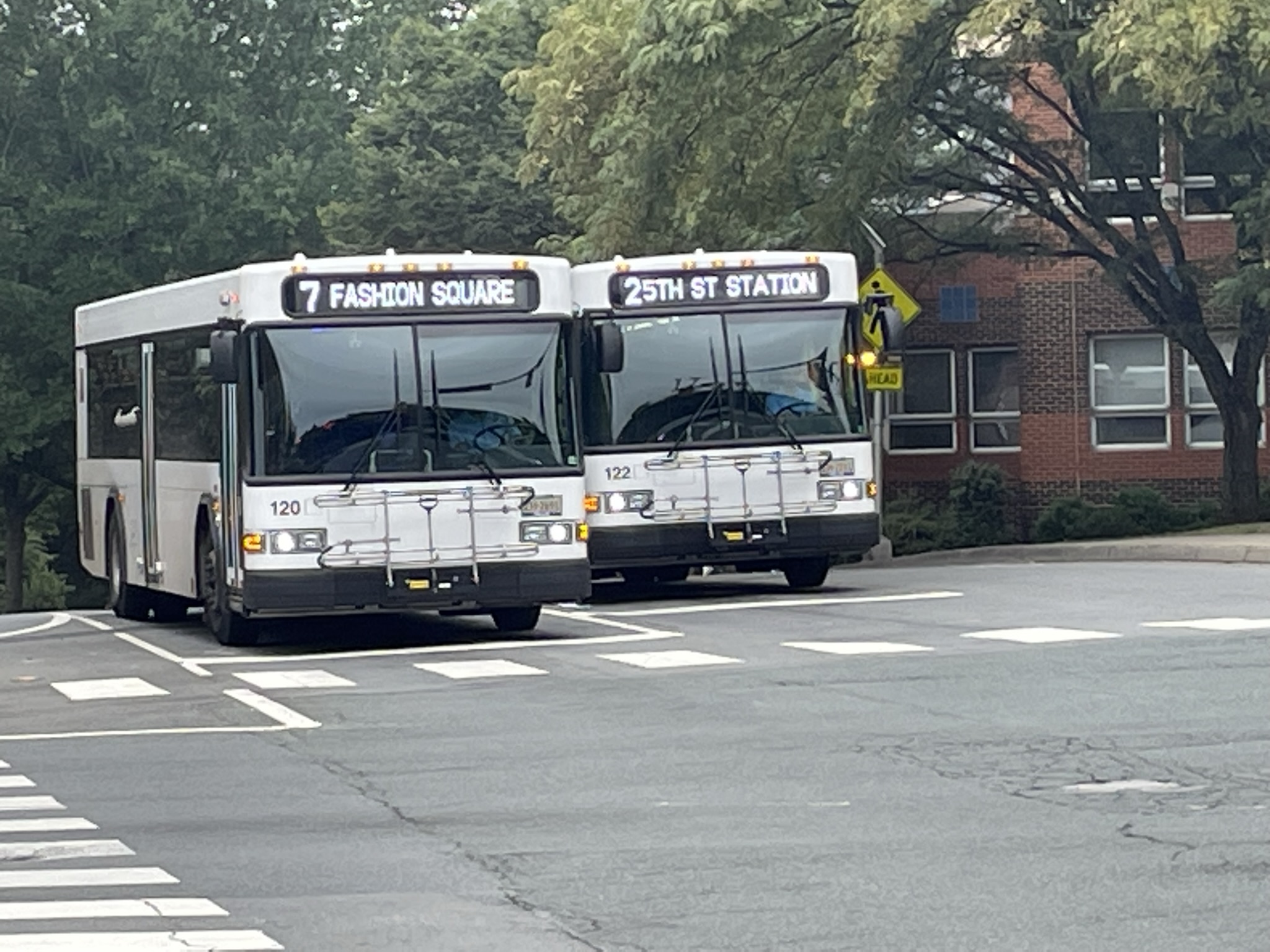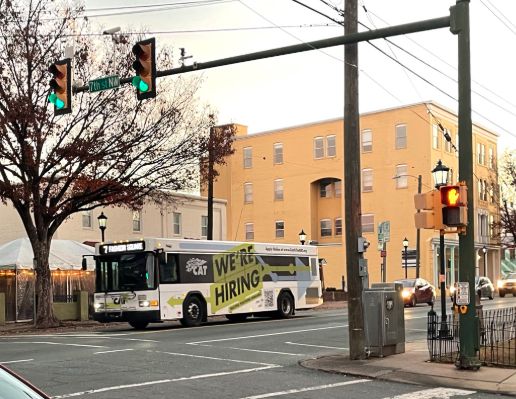
Tracking local and regional government is all about knowing what acronym stands for what organization. As 2025 comes to an end, there’s one less to worry about now that the Regional Transit Partnership (RTP) has been discontinued. That happened at the November 18 meeting of the new Charlottesville Albemarle Regional Transit Authority (CARTA).
“Today we honor and celebrate the extensive work that this region has done to get to this point,” said Christine Jacobs, the executive director of the Thomas Jefferson Planning District Commission. “In our region, discussion around coordinated transit has been a cornerstone for over two decades.”
The TJPDC is home to the Charlottesville-Albemarle Metropolitan Planning Organization (CAMPO), a federally-mandated body that makes decisions about transportation funding. In July 2006, the MPO Policy Board adopted a resolution of intent to create a regional transit authority as reported by Charlottesville Tomorrow at the time.
Both Albemarle County and Charlottesville agreed to pursue the idea after a joint meeting of the Board of Supervisors and City Council in February 2008. Legislation passed the General Assembly in 2009 to allow the creation of an authority but another bill failed that would have allowed a referendum on a sales tax increase to pay for enhanced service. Albemarle pulled back in 2010 after the elected body sought to cut spending.
“For many years following the adoption of the legislation, the region continued to operate without a forum for the City of Charlottesville, Albemarle County, University of Virginia, transit agencies and other regional partners to routinely sit together, identify shared challenges and coordinate solutions,” Jacobs said.
The TJPDC resumed the idea a few years later, briefing the now defunct Planning and Coordination Council in May 2016. A Regional Transit Coordination study was published soon afterward.
“While a Regional Transit Authority (RTA) would be the most direct and comprehensive way to coordinate transit, establishing an authority would be an enormous and difficult process,” reads the executive summary.

The study recommended establishing the RTP as a way to improve coordination between Charlottesville Area Transit, Jaunt, and the University Transit Service as a way of easing tensions over funding. Supervisors and Council approved creation of the partnership at a joint meeting in September 2017 as I reported at the time.
Jacobs said the eight years of the partnership have strengthened community relationships.
“With the start of the RTP, the region had for the first time a forum for all transit providers, all major stakeholders, to regularly gather to collectively plan for the future of transit in our region,” Jacobs said. “Over time, the region has built a shared understanding of the collective challenges and opportunities.”
Work has included several studies such as a Regional Transit Vision Plan and a Regional Transit Governance Study. The latter recommended establishment of the authority.
Jacobs said there are still many questions awaiting CARTA as it takes up the mantle of being a regional clearinghouse for transit while also searching for new sources of funding.
However, other than providing opportunities for public comment at its meetings, CARTA will currently not be the place for community members to go with feedback for how existing transit systems work. TJPDC transportation director Taylor Jenkins explains there are two reasons why.
“One, because CARTA doesn’t directly operate any transit service currently, so it makes sense that local governments would be the key conduit for communicating any feedback that the residents have,” Jenkins said. “And then the second reason is that it really maintains the connection between the work that CARTA is doing for planning, for revenue generation and for funding and the actual work that’s happening at the local level with its local jurisdictions.”
A next step is to amend the working documents for CARTA to reflect an interest in making sure rural area transit needs are also taken into consideration.
Supervisor Diantha McKeel has chaired the RTP for eight years and at her final meeting before retiring from office, she wanted to make sure that the University of Virginia remains part of the discussion as a major employer and not just as a transit provider.
“The recommendation, the main recommendation that came from the Transit Government study [was] ‘engage UVA leadership at a level where there is a decision making authority and efforts towards establishing transit authority,’” McKeel read from the study. “ I think this is a really critical point. We need UVA at the table.”
The CARTA by-laws do not currently have any reference to UVA but does offer a pathway for other local governments to join in the future.

Before you go: Paid subscribers cover the cost of conducting research for this article which was originally published in the November 25, 2025 edition of Charlottesville Community Engagement. You can either subscribe through Substack, make a monthly contribution through Patreon, or consider becoming a sponsor. The goal of Town Crier Productions is to increase awareness about what is happening at the local, regional, state, and federal government levels. Please share the work with others if you want people to know things.
Discover more from Information Charlottesville
Subscribe to get the latest posts sent to your email.