


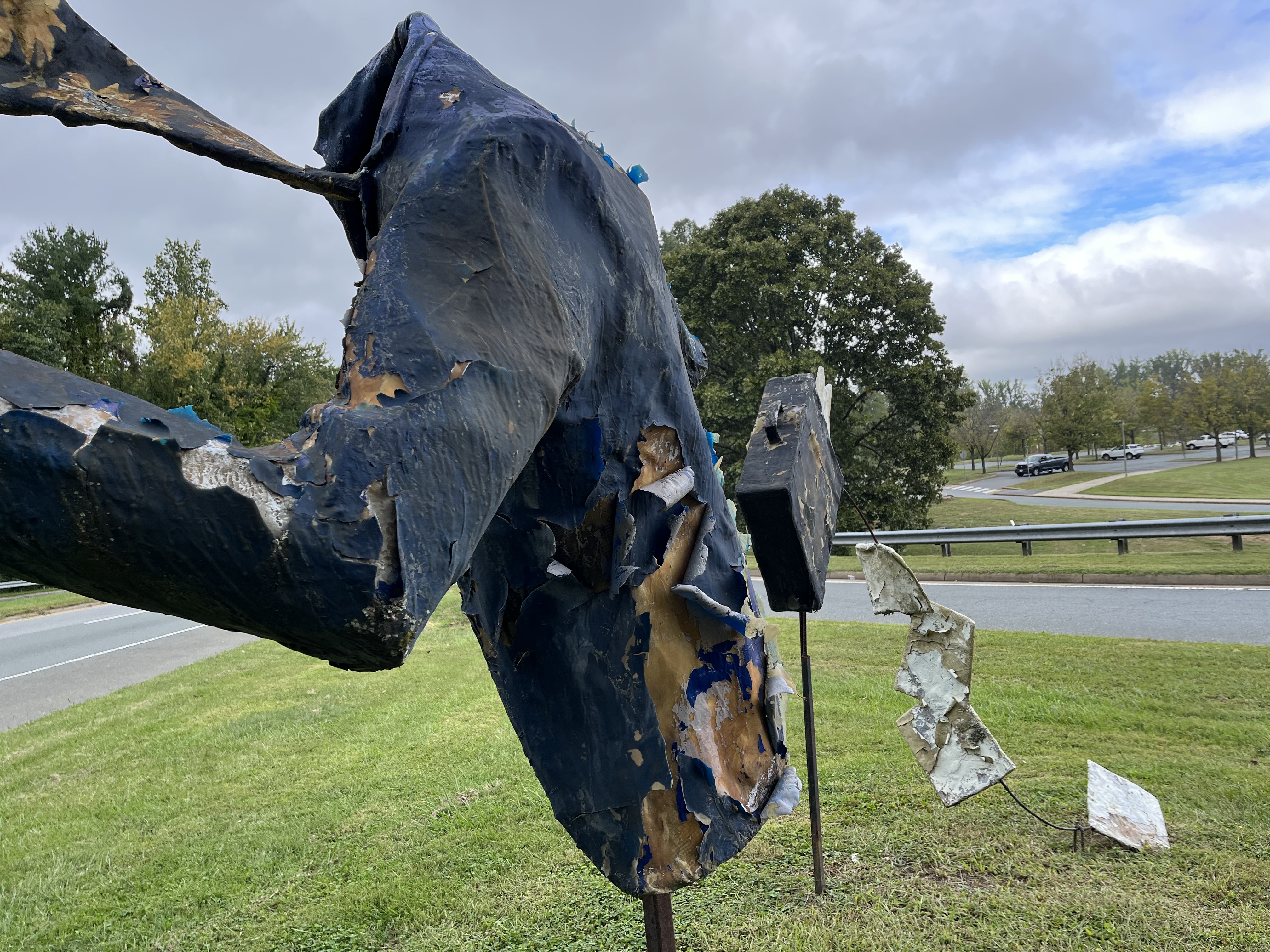
For many years, an organization called Art in Place commissioned public artwork to be placed in the public right of way. The program transitioned to the Piedmont Council for the Arts, an entity that went out of business in 2017.
“Having a vital public art program says so much that is positive and exciting about a city,” said Deborah McCleod, who used to run the Art-in-Place program. “It elevates it.”
Charlottesville hasn’t had such a program but one is in the works.
The New City Arts Collective is overseeing an initiative to create a new arts group. Deputy City James Freas is one of the members of a steering committee announced in September. He briefed City Council on the potential for a new public arts program at their meeting on November 3, 2025.
“The promotion of the arts in Charlottesville has been a longstanding priority for the city and is reflected in your strategic outcomes and within the comprehensive plan,” Freas said. “In the past, the city has invested in public art, mostly through partnerships with public or with arts organizations of various types.”
Freas said the city is working on an ordinance to once again begin a program for artwork in the public realm. This time around, the city itself would commission and maintain the work.
“That also would ensure that maintenance of public art is carried out consistently with our city objectives and carried out so that the materials and the makeup of this art is within the capacity of the city to do so when we choose new art pieces,” Freas said.
Freas said another recommendation would be the creation of a new public art committee that would come up with criteria for installation and removal of pieces.
A third recommendation is that memorials would be a subcategory of public art.
The actual ordinance will come back before City Council at a work session early in 2026 but Freas wanted to know if the elected officials had any questions.
City Councilor Lloyd Snook said there were reasons in the past why non-profit organizations ran the program.
“One of the reasons why that sort of dichotomy was created… 20 or 30 years, was out of a sort of constitutional concern about public speech, so to speak,” Snoko said. “And the extent to which the decision about which artworks get placed, being vested in some public body, poses some potential risks.”
City Attorney John Maddux, who has now been on the job for nearly six months, wasn’t entirely prepared to give a full briefing but said he felt comfortable the city could craft an appropriate ordinance.
“When the government speaks how it chooses to speak, we’re not getting into a matter really of First Amendment rights,” Maddux said. “The government can speak as it likes, as the Council wants to speak, and it can put up art that speaks to that. If somebody wants to put up art, the Council can choose to reject it.”
This ordinance would not apply to artwork on private buildings which would continue to go through the Board of Architectural Review or the Entrance Corridor Review Board if within a design control district.
City Councilor Michael Payne said the ordinance to create a public art program would be a step forward.
“The city could obviously do a lot, lot more to support our arts community,” Payne said. “I think even cities like Buena Vista seem to be more proactive about having city supported murals than we have been in recent years.”
When Payne asked Freas if he envisioned the hiring of a city employee to manage the program, Freas responded that that and other questions remain to be answered but at least a part-time position is used by cities with similar programs.
“There’s a whole set of processes and procedures that have to be established and criteria,” Freas said. “That kind of buildup period of time is going to be completely different than kind of running the program in the future where it’s really going to be more of an administrative task.”
Mayor Juandiego Wade said he looks forward to learning more at the work session next year.
McLeod said she hopes the program can be successful and urged the city to think about Baltimore, a city with many urban problems but one that is beloved.
“Because Baltimore, for all its gristle and grit, has long been committed to its arts and its artists, to creativity and expression,” McLeod said. “I wish that for Charlottesville. All the creative energy and ingredients are here. Just need a little political commitment.”
Before you go: Paid subscribers cover the cost of conducting research for this article which was originally published in the November 6, 2025 edition edition of Charlottesville Community Engagement. You can either subscribe through Substack, make a monthly contribution through Patreon, or consider becoming a sponsor. The goal of Town Crier Productions is to increase awareness about what’s happening in local, regional, state, and federal government. Please share the work with others if you want people to know things.
Discover more from Information Charlottesville
Subscribe to get the latest posts sent to your email.


