Note: This story was written before Election Day. See the end note for a further explanation.
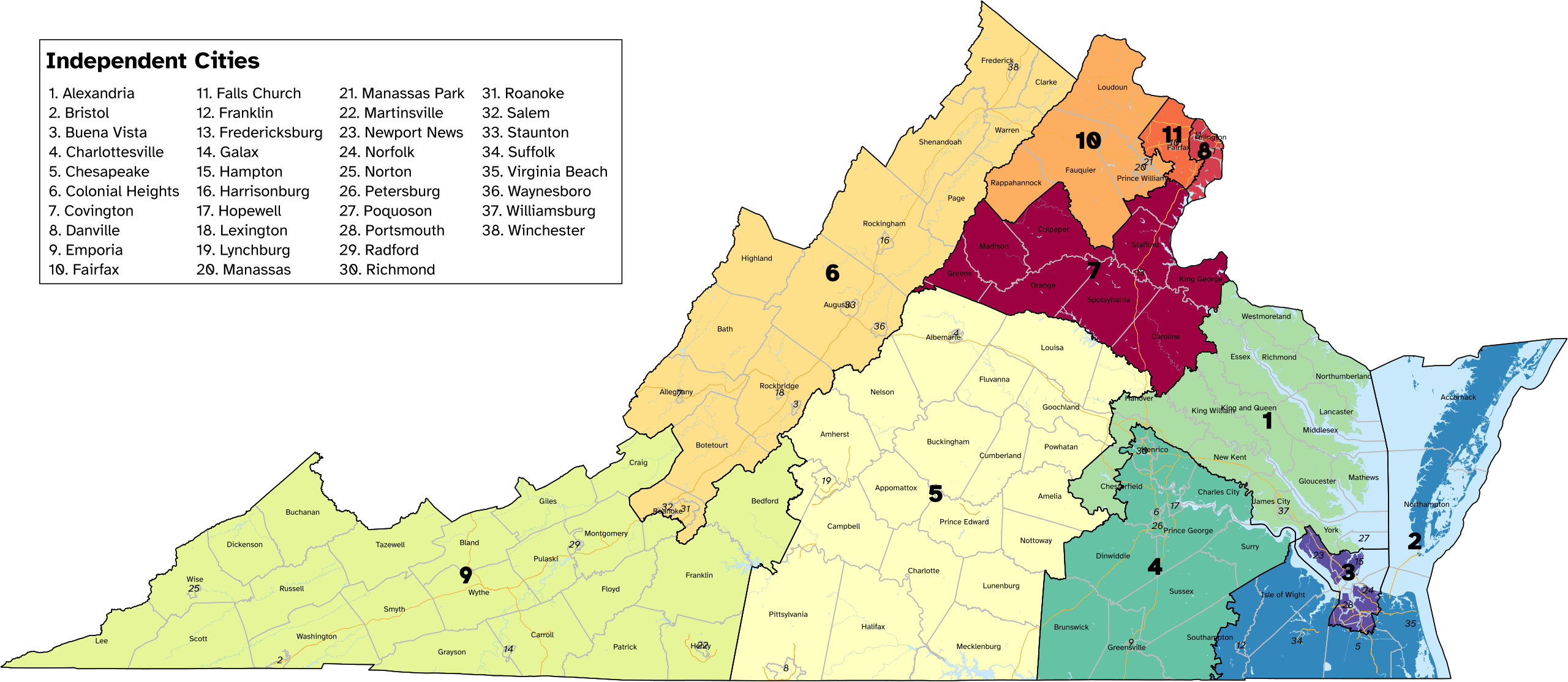
The Virginia General Assembly has taken the first step towards amending the state constitution in order to allow for a one-time redrawing of Congressional boundaries to counter similar moves being made elsewhere.
Before the November 4 election, Democrats held a 51-seat majority in the House of Delegates and a 21-seat majority Virginia Senate. They reconvened a special session from 2024 for the purposes of adopting a first reference of a Constitutional amendment to allow the mid-Census change.
Republicans in both chambers objected to the process, arguing there was not sufficient notice to voters and that at least a million people have already cast their ballots in early voting.
Article XII of the Virginia Constitution describes how that document can be changed. Section 1 explains that both houses of the General Assembly must first adopt a resolution. Then an election has to take place in the House of Delegates. Then the General Assembly has to vote on the resolution a second time before it goes to the voters in a referendum.
Amendments to the Virginia Constitution are fairly common with the last one approved by voters in 2024. Over 92 percent of the electorate approved a proposal to extend tax exemptions to spouses of soldiers killed in the line of duty.

In 2020, two-thirds of the electorate voted to establish an eight member Virginia Redistricting Commission which would take over the process of establishing legislative districts from the General Assembly.
In the final week of October 2025, Republicans argued in committee meetings and from the House and Senate floor that this amendment counters the will of the people. Democrats argued the step is necessary to counter a presidency that is acting beyond its power by asking other states to change their rules.
This story covers the Virginia Senate debate on October 31.
For more background, go back and read these two stories:
- Virginia General Assembly has begun consideration of Congressional redistricting during special session, October 29, 2025
- Constitutional amendment for Virginia redistricting passes House, awaits action in Senate, October 31, 2025
The Senate took up House Joint Resolution 6007 the Friday morning of Halloween. The day before, the Senate Privileges and Elections Committee approved the amendment on an 8 to 6 vote.
Before the full debate, there were three requests to amend the resolution including one from Senator Christoper Head that would have required the mid-Census boundary change to go through the Virginia Redistricting Commission. Those failed on partisan lines, and three Republican members were not present.
A long debate over the resolution kicked off when Senator Aaron Rouse (D-22) made a motion for its adoption. He said the amendment would give Virginians a chance to weigh in with their vote on whether the lines should be redrawn.
“We do see evidence that the system is being rigged by a wannabee dictator out of Washington,” Rouse said. “During this Republican shutdown we’ve seen this dictator be enabled by a coequal but separate branch of government. Virginians may have something to say about that.”
Senator Schuyler VanValkenburg (D-16) was one of the patrons for the Constitutional amendment that set up the Virginia Redistricting Commission. He said Republican claims that the amendment would eliminate the body are false.
“That’s not what this is and that’s not what we’re doing,” VanValkenburg said. “Today we are taking a truly proportional response to an extreme situation. The current outbreak of opportunistic mid-decade redistricting means that we are in a truly unprecedented, Constitutional norm breaking time.”
Senator Glen Sturtevant (R-12) said the resolution is a betrayal of voters in part because over a million people had already voted.
“That’s not reform, that’s reversal,” Sturtevant said. “It’s not transparency, it’s a power grab. It’s been rushed. It’s been secretive. And it is purposely timed to avoid accountability in this election.”
Senator J.D. “Danny” Diggs (R-24) said the Constitution is intended to be updated every ten years to accommodate for population shifts.
“This amendment is being proposed not to protect our citizens or to make our government better,” Diggs said. “This amendment is about increasing the political power of the Democrat party. It has an expiration date so that if the political winds change, the Republican party can’t do the same thing in a few years.”
Senator Luther Cifers (R-10), elected earlier this in a special election to replace John McGuire, took issue with Democrats advancing the process in late October, over a month after early voting had begun. Some voters might have changed vote if they had known the General Assembly would take this action.
“It appears to be well-established that the intent of the intervening election in the Constitutional amendment process is so that voters can respond at the ballot box between the two passages of an amending resolution,” Cifers said.
Senator Christie New Craig (R-19) said the resolution is intended to advance national interests rather than those of Virginia’s.
“The timing of H.J. 6007, positioned as an urgent matter, was not authored based on constituent demands,” New Craig said. “It was authored based on instructions from national leadership.”
Senator Mark Peake (R-22) echoed comments made by Delegate Lee Ware (R-72) during debate in the House of Delegates.
“Texas embarking on a mid-decade redistricting was probably not a good idea but because they have embarked on that endeavor doesn’t mean we have to engage in the endeavor,” Peake said.
One argument made by Republicans is that the resolution does not pass legal muster because it doesn’t follow language in state code that requires court clerks to post a public notice of a pending Constitutional amendment 90 days before an election. Senator Head said that has not been followed.
“There’s no way we can do this,” Head said. “I mean you can do this today. You’re going to do this today. We know that you’re going to do this today. It’s going to get the 21 votes. You’re going to pass it because you’re not paying attention to what people are screaming about out there or any of the arguments that are valid that any of us are going to have made.”
Senator Mamie Locke (D-23) said Republicans making arguments about her party taking national direction were hypocritical and they would be doing something similar if they controlled the General Assembly.
“Be assured if the proverbial shoe was on the other foot, a directive from D.C. to the Governor would have been adhered to, quick, fast, and in a hurry to undo the Constitutional amendment in Virginia mid-stream and not one of you would be talking about the sanctity of the bipartisan redistricting commission or the needs of the voters or respect for the will of the people,” Locke said.
Locke said the federal government has been transformed by executive orders from the White House which have been followed by Virginia’s executive branch.
Senator Barbara Favola (D-40) called the resolution one of hope that would give Virginia voters another opportunity to weigh in on a presidency that is bending the rules of the U.S. Constitution.
“That’s what this is,” Favola said. “We’re not redrawing anything today. We’re not doing anything magical. We’re saying to voters, if this goes through the process we’ve laid out, and we’ve explained that multiple times, should the Constitutional amendment go to the voters, they will have the final say. We are in no way undermining the principles that all of us have stood for.”
Senator Scott Surovell (D-34) said the resolution is necessary to combat an unprecedented attempt to change Congressional boundaries to keep Republicans in power no matter what.
“This is a coordinated national strategy to grab power,” Surovell said. “The fundamental power problem that we are giving ourselves the option to address is that Virginia cannot fight with one hand tied behind its back.”
Surovell said a mid-census redistricting is not ideal but is necessary to have as an option as more Republican-controlled states adjust their boundaries.
“What do you do when one side refuses to play by the rules?” Surovell asked. “Do you maintain principles and accept defeat? Or do you recognize that preserving democracy sometimes requires tools you find distasteful to prevent permanent entrenchment of minority rule? We owe it to our constituents to have this conversation. We owe it to democracy to consider all of the options.”
Soon after, the resolution was adopted 21 to 16. The Senate adjourned about an hour later.
Before you go: Paid subscribers cover the cost of conducting research for this article which was originally published in the podcast edition of Charlottesville Community Engagement that went out on November 3, 2025. I had done a smaller version of the same story the edition before, so I didn’t put out the longer version in the main feed. Why? Time, mostly.
If you want to help keep this going, you can either subscribe through Substack, make a monthly contribution through Patreon, or consider becoming a sponsor. Drop me a line about that last one as I’m still working it out.
Another way you can help is to share this article with people you might be interested. Thank you for reading!
Discover more from Information Charlottesville
Subscribe to get the latest posts sent to your email.