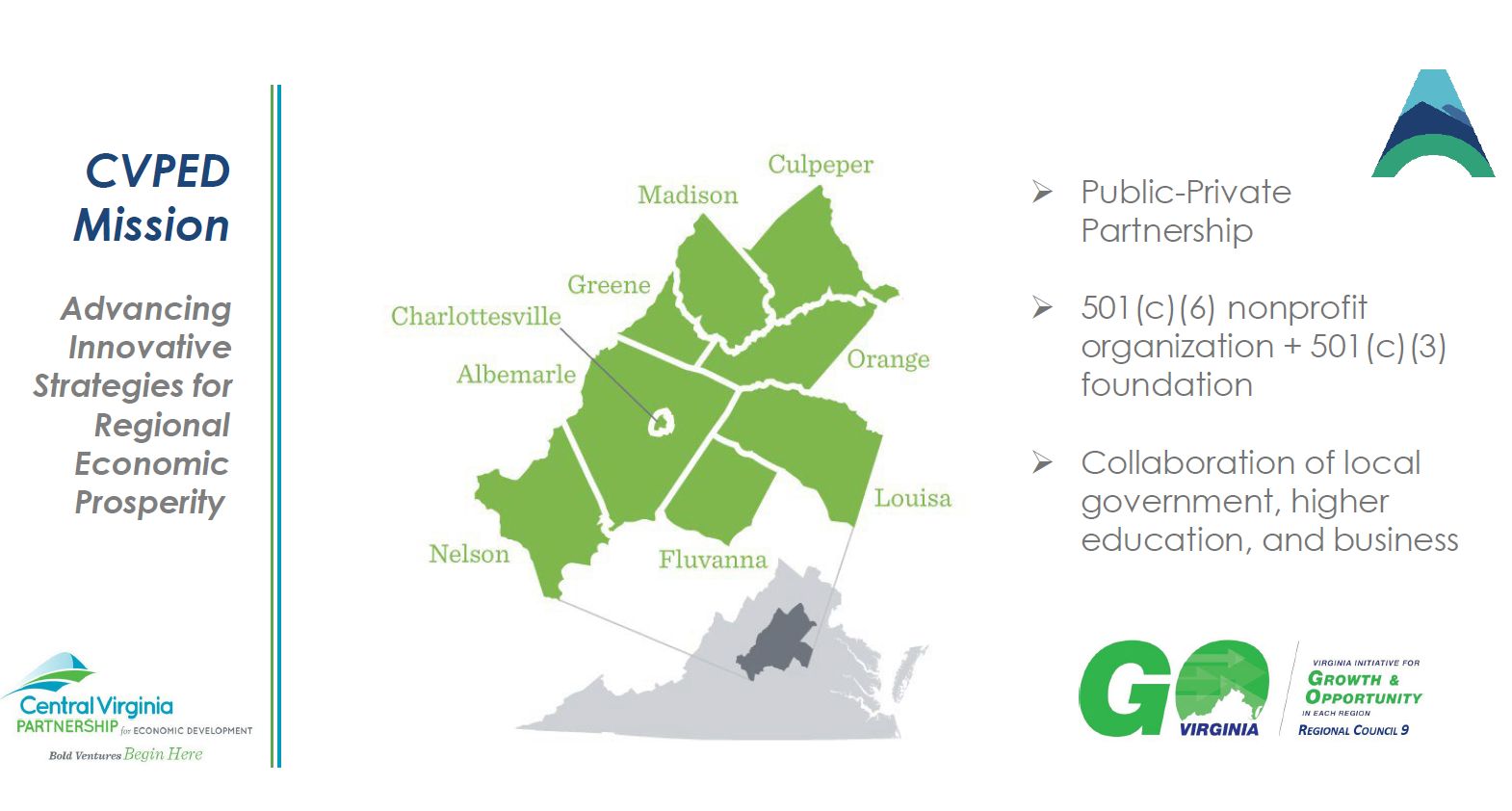
A bold vision put forward by the Central Virginia Partnership for Economic Development and GO Region 9 has resulted in the landing of AstraZeneca’s $4.5 billion investment in two pharmaceutical factories in Albemarle County.
“We believe that our region is poised to be the next significant hub for innovation in biotech, it, data science, digital technologies and national security,” said CVPED President Helen Cauthen.
CVPED was formed in 1995 as a public-private group that worked to advance business interests. In the past three years, Cauthen said nearly $39 billion in expansion announcements have been made in the region.
Other recent milestones include a groundbreaking at Afton Scientific’s new facility on Avon Street Extended and a ribbon cutting for Luna Labs in Charlottesville. Earlier this month, UVA celebrated a major milestone of the construction of the Paul and Diane Manning Institute of Biotechnology with a topping-off ceremony.
“They’re going to hire us 100 researchers and their teams to discover therapies and treatments that improve life,” Cauthen said.

To hone the vision further, the CVPED has hired the firm Teconomy Partners to conduct two studies. One is the Central Virginia Innovation Corridor Strategic Roadmap and the second is called the BioBridge Talent Pathway Initiative.
“They started working on Biobridge in February of this year,” said Katie Dulaney, CVPED’s talent director. “So I’ve been working with them supporting that grant since that point. And they kicked off this Innovation Corridor project in May.”
Previous work by Teconomy Partners includes a geospatial roadmap for St. Louis, Missouri and a ten year innovation plan for the state of Oregon. Dulaney said the work involves a full study of academic work as well as practical logistics.
“They’re measuring that the data points that they’re looking at are by research expenditures, publications, research centers that already exist in commercialization activity and then they’re putting that side by side with the market demand, the market pool,” Dulaney said. “So where is the market already demanding innovation and showing that there’s room for growth here in our region.”
The draft roadmap is expected to be ready by the end of March 2026.
Dulaney and Cauthen’s comments came at the October 14, 2025 joint meeting of the Albemarle and Charlottesville economic development authorities.
There was less information at the meeting about the BioBridge Talent Pathway Initiative.
Steven Johnson, a member of Charlottesville’s Economic Development Authority, said he is concerned that many of the new jobs in life sciences will go to people who move to this community, increasing the potential for displacement of existing residents.
“The Manning Institute as an example, those hundred people are not going to be 100 people that already live here,” Johnson said. “Those researchers are going to be predominantly people moving here, right? And those are well above average paying jobs, which is good from an economic development standpoint, but it’s not necessarily good for the existing residents that are trying to have pathways to careers.”
Cauthen said the BioBridge Talent Pathway Initiative is intended to address that concern and develop programs in local schools to prepare people for careers.
Emily Kilroy, Albemarle’s Economic Development Director, said not all jobs in the life sciences sector are going to require advanced degrees, pointing to the Afton Scientific example.
“They’re about to bring on 200 more jobs and the predominance of those are manufacturing jobs,” Kilroy said. “They do not require a four year degree. And PVCC is stepping up in a major way to work on credentialing opportunities and training opportunities.”
Kilroy said there is more work to be done but the groundwork is being laid for educational training programs.
This is the second annual meeting of the two EDA’s.
Don Long, chair of the Albemarle EDA, said it was good for the two bodies to get together.
“I know cooperation has really increased over the last few years and there’s obviously a lot of things that we can work on together that support both localities,” Long said.
Before you go: The time to write and conduct research for this article is covered by paid subscribers to Charlottesville Community Engagement. In fact, this particular installment comes from the October 16, 2025 edition of the program. To ensure this research can be sustained, please consider becoming a paid subscriber or contributing monthly through Patreon.
Discover more from Information Charlottesville
Subscribe to get the latest posts sent to your email.