


There are less than three weeks until the Albemarle County Board of Supervisors are set to adopt a Comprehensive Plan update and that offers time to catch up with where the process has been.
At the heart of the AC44 update is this theme: How will Albemarle accommodate an estimated 31,000 additional people projected to live in the county by 2050? Paid subscribers and sponsors have kept me paying attention as I can and there are dozens of stories here on Information Charlottesville.
Yesterday’s edition summarized the Albemarle County Planning Commission’s August 26 work session on the overall draft of the document. That body will have a public hearing on September 30.
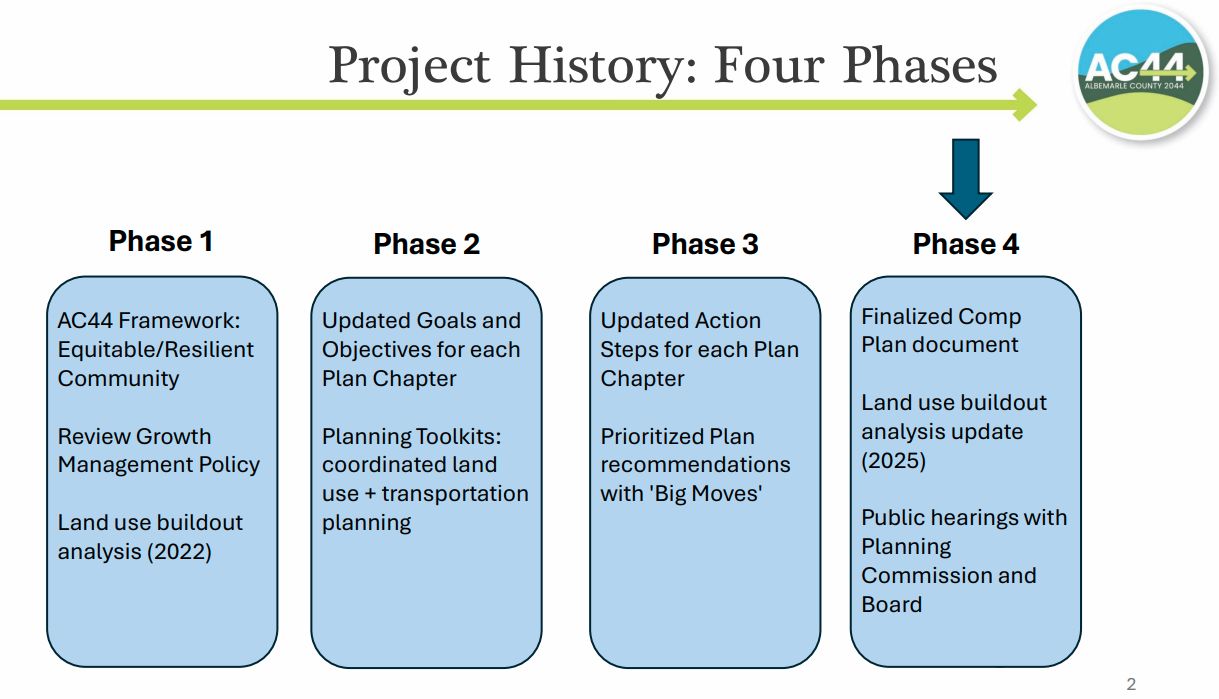
One thing absent from the Planning Commission’s review was an update of a document called a build-out analysis that was conducted in the first of AC44’s four phases.
Albemarle hired the firm Kimley Horn to take a look at recent projects in the growth area to measure how they are meeting development potential. The specific metric is “theoretical maximum buildout.”
The Planning Commission took a look at an earlier version in May 2022 as I wrote at the time.
“That document proved to be very integral to how the AC44 process has moved forward through phases two and three,” said J.T. Newberry, a planner with Albemarle County. “And as the process has gone on, the Board has asked for updated information about what’s happening in our development areas.”
The county hired the firm Line + Grade to update the analysis using the model Kimley-Horn originated and the Board of Supervisors got a briefing on September 3.

The 2022 analysis found that there were 9,377 approved units in the development areas that not had been built with another 5,504 under review. A theoretical maximum of 9,252 units could be built adding up to a total of new 24,133 units.
Three years later, the 2025 analysis found there were 11,230 approved units with another 3,986 under review. The residential theoretical maximum on undeveloped land dropped to 6,428 adding up to a total of 21,644 new units.
“The way we’ve been thinking about it internally is that both the 2022 analysis and the 2025 analysis are really snapshots in time that kind of give us a sense of where we are currently and they help orient us to how far are we from where we want to go in the future,” Newberry said.
Put another way, the 2022 analysis found that developments between 2015 and 2021 on average came in at 58 percent of the potential maximum. The 2025 analysis found that number dropping to 56 percent.
Newberry said there are many constraints such as the high cost of land as well as a mismatch between the Comprehensive Plan and zoning. Another is that many existing parcels have structures on them and would have to be redeveloped. That raises many questions for planning staff.
“How can we support folks that are going to be redeveloping their property in a way that more closely aligns with the comprehensive plan that’s especially true within the activity center areas? Newberry said. “We want to think about how we can make sure that we’re being strategic in investing in public infrastructure in a way that’s going to leverage private investment as efficiently as possible?”
Newberry said the new Economic Development Strategic Plan has many recommendations for how to incentivize new construction in particular areas. He added that going forward, Albemarle staff will be able to update the analysis as new projects are approved and built. The Board of Supervisors will get to see additional tools at a meeting in January 2026.
Supervisor Diantha McKeel will no longer represent the Jack Jouett District on the Board when that happens. She wanted to know what policies might be in place to encourage redevelopment of 20th century commercial properties.
“I mean we have malls that have huge amounts of storefronts that are empty, huge amounts of parking spaces that are just sitting there,” McKeel said. “Will we be seeing eventually recommendations?”
One incentive the county had tried to make is a form-based code for the Rio-29 area where many of those shopping centers exist to encourage the walkable, livable space desired in the Comprehensive Plan.
The Places29-Rio Community Advisory Committee will get an update on a rewrite of those rules that is currently underway.
“I think one of the feedback we heard from a lot of people is that’s probably not a really great space to have sort of that gathering, that community space because of all the traffic,” said Planning Director Michael Barnes. “We’re really trying to create something that is going to be development friendly in the regards of the ease of use, but yet builds the form that we look for in our community.”
Next up in the attempt to catch up with AC44 will be a review of the Board of Supervisors’ work session on September 10.

Before you go: The time to write and conduct research for this article is covered by paid subscribers to Charlottesville Community Engagement. In fact, this particular installment comes from the September 24, 2025 edition of the program. To ensure this research can be sustained, please consider becoming a paid subscriber or contributing monthly through Patreon.
Discover more from Information Charlottesville
Subscribe to get the latest posts sent to your email.




One thought on “How well is Albemarle County using land in its development areas?”