


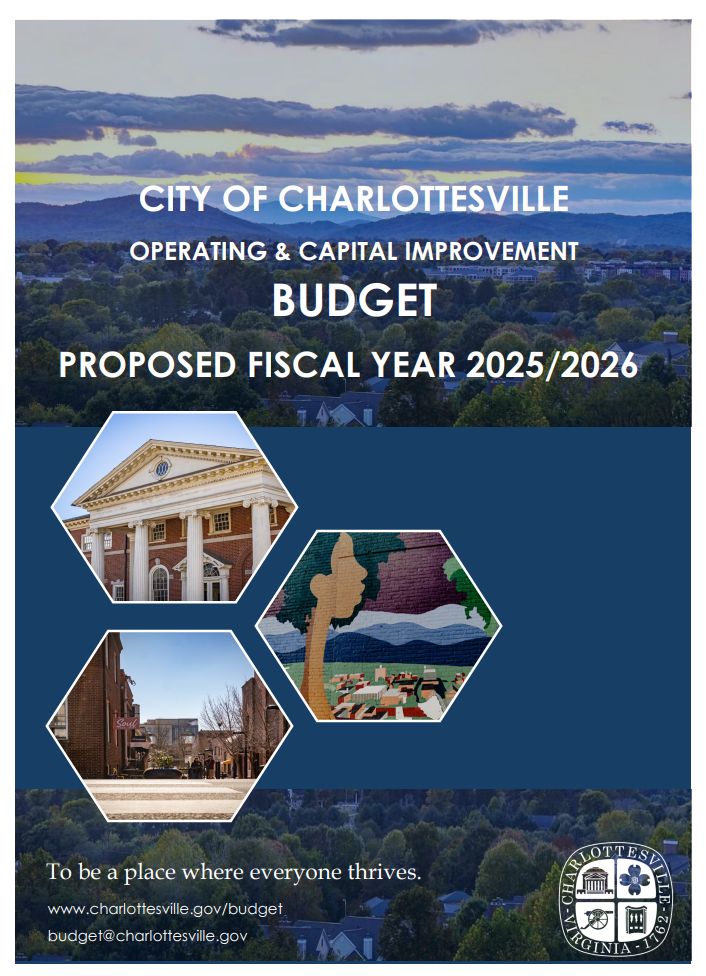
After months of preparation and more than a handful of meetings, Charlottesville City Manager Sam Sanders presented his recommended budget for FY2026 to City Council and the public on March 4, 2025.
The recommended budget totals $264,474,183 and is a 4.97 percent increase over the current year.
“That’s $12.5 million in additional money,” Sanders said.
The city manager has not recommended any changes to tax rates in part because of an average 8.18 percent increase in value for residential property in 2025. Commercial property went up 6.14 percent. The average is 7.74 percent.
“The real estate assessment for Charlottesville reveals our average property value at $527,100, a figure that continues to increase rapidly,” Sanders said.
Sanders said that’s the second highest average of any city in Virginia despite Charlottesville being the 16th largest city in the Commonwealth.
Under Virginia law, localities have to tell property owners what the lowered real property tax rate would be. That is calculated by determining the rate to bring in the same amount of revenue as the current budget. That figure is not included in the recommended budget but was advertised at $0.9128 per $100 of assessed value.
The budget includes a $4.9 million contribution to Charlottesville City School which Sanders said would assist with their first collective bargaining agreement. The city will also increase the amount paid to the school for capital improvements from $1.25 million to $1.4 million a year.
“This budget also ensures that the completion of Charlottesville Middle School and Walker Pre-K Center will happen in this five year [Capital Improvement Program],” Sanders said.

Sanders said the coming year will include further conversations about how the city funds city schools to shore up loose agreements.
The budget includes $12.7 million in spending on efforts to subsidize the cost of specific housing units.
- This includes $1 million for Piedmont Housing Alliance and Woodard Properties’ redevelopment of 501 Cherry Avenue.
- There’s $3 million to close out the city’s initial commitment to help Charlottesville Redevelopment and Housing Authority with redevelopment efforts.
- There’s the first of three $5 million payments to CRHA to redevelop Westhaven.
- Another $1.5 million goes to the Charlottesville Affordable Housing Fund where applications are reviewed by a committee for recommendation to Council.
- There’s $1.3 million in debt service for the purchase of Carlton Mobile Home Park to allow Habitat for Humanity of Greater Charlottesville and Piedmont Housing Alliance to purchase it for redevelopment.
- There’s $900,000 in an existing program to fund more housing choice vouchers.
- There’s $202,000 in rental and tax relief programs.
As promised in November, Sanders’ budget now recognizes the Blue Ridge Coalition for the Homeless as a fundamental agency and that means the $250,000 payment for that entity is non-competitive.
“This budget recommends the designation of a fundamental agency non competitive operating grant of $500,000 annually to support the operations of a low barrier homeless shelter, operator to be determined,” Sanders said. “Also included in this budget is up to $1 million over the five year CIP to replace lost for the Salvation Army should the Cherry Avenue thrift store be adapted to serve as this low barrier shelter.”
That decision is still pending. Other capital items not related to housing:
- There is a total of $5.4 million for sidewalks based on transportation planning manager Ben Chambers’ three-tier system that was presented to Council at their meeting on February 18.
- There is an additional $600,000 in capital funds to allow for the completion of upgrades to Stribling Avenue in the Fry’s Spring neighborhood to allow for a sidewalk to be completed by the fall of 2027.
- There’s an additional $250,000 for planning and design of an upgrade to the parking lot at Riverview Park. According to the budget, “the goal is to coordinate this project with the Rivanna Conservation Alliance project.” Read more about this on their website.
- There is $2 million a year through 2030 for projects to assist the city become compliant with the Americans with Disabilities Act. Sanders said the transition plan will soon be released.
The proposed budget also takes into account the latest collective bargaining agreement to go into effect.
“We recognize the existence of our fourth bargaining unit, the largest of the four, for workers in public works, parks and recreation, utilities and a few in police and fire,” Sanders said. “This activates four of six bargaining units as authorized by your collective bargaining ordinance as passed in 2023.”
That unit is represented by the Teamsters Local 29, as I reported last March. Sanders said the city has budgeted $140,000 to retain legal counsel related to labor administration as well as a labor relations administrator.
There were 66 applications for the Vibrant Community Fund, a name for the pool of money set aside for area nonprofits. There’s an additional $1 million in the Pathways Fund which provides direct aid to people and households in crisis.
Sanders added another $140,000 to Council’s Strategic Initiatives Fund to bring the balance to $500,000. He noted Council has not been spending that money.
“The goal of that is for us to talk more about how I can recommend to you ways to use these funds so that they don’t contribute to the annual surplus,” Sanders said.
In addition, there’s another half million in the city manager’s discretionary fund. Sanders said that was set up by interim City Manager Michael C. Rogers and he is only just now beginning to spend that money.
“The goal would be for it to be a discretionary account for me to work with individuals who are bringing events, quality of life, attracting visitors,” Sanders said. “Different things are truly about enriching this community. So they don’t necessarily have to be big and complicated, but it’s really meant to help those folks that want to help this community, and they really don’t necessarily need to go through what is a competitive process and a complicated process, because sometimes we can have some homegrown things that really add value to what it is about Charlottesville that makes it special.”
Sanders said he has initiated spending on a grant to the Indie Short Film Festival which is coming up later this month. He didn’t provide an amount.
Another loose thread heading into budget season has been a new contract with the Charlottesville-Albemarle Society for the Prevention of Cruelty to Animals. State law requires localities to operate an animal shelter, but they can contract out to an entity to provide the service. The contract expires later this month and negotiations have been underway.
“We hit a roadblock last year,” Sanders said. “It was a bit tenuous at times, but we have successfully negotiated peace and we have a multi-year agreement and that agreement is in coordination with Albemarle County.”
Albemarle Supervisors went into closed session to discuss the contract at their meeting on March 5. The budget document itself contains this line:
“The City and County negotiated a new animal shelter services 3-year agreement tied to per capita calculations that ensure the consistent care and welfare of animals while contributing to the safety of the public,” reads page 16 .
Sanders also turned to federal funding, beginning with a recap on the American Rescue Plan Act funds. He said there’s about $3.3 million that Council has already decided on how it will be spent, but for the first time he mentioned $1.3 million in interest on the cash the city received.
“It is ours to spend and it is flexible,” Sanders said. “So that is another opportunity for us to do something significant in regards to the transformation ideals of what ARP was about during a very difficult time for this country.”
Earlier this year, Sanders recommended Council put the $22.4 million surplus from FY25 into a contingency fund for capital funds. They did so, and Sanders is recommending keeping that money on hand while the effects of the Trump administration’s dismantling of the federal government are known. He’s calling this FedWatch.
“I am going to continue to resist the notion of spending this money, to pause it, continuing to look at it as we need to hold on to it and give our people in D.C. a little more time to work out whatever it is that’s causing us to be in this state that we’re in and see how those changes, proposed changes, actually make impact,” Sanders said.
The first budget work session was held on March 6, 2025. The next one is scheduled for March 13, 2025.
Before you go: This story was originally published in the March 6, 2025 edition of Charlottesville Community Engagement and posted here way too many days later. Usually it’s a good idea to post here as soon as possible, but there are only so many activities that can be accomplished in one day. Town Crier Productions will continue to try to improve.
Discover more from Information Charlottesville
Subscribe to get the latest posts sent to your email.


