

We’re less than a month into the fiscal year for local government, but planning is already underway for the one that will begin on July 1, 2025. Elected bodies in both Albemarle and Charlottesville recently provided direction on one of the processes for funding nonprofits to do some of the work of government.
“The Agency Budget Review Team process serves as a method of evaluating requests for county funding from outside agencies, primarily nonprofits,” said Kaki Dimock, chief of human services in Albemarle County. “Teams of community volunteers and staff, review and score applications against a prescribed rubric.”
Dimock said the number of applications has been increasing each year with 70 in the current fiscal year with 49 organizations seeking a total of $4.7 million. Supervisors ended up awarding just over $2 million in funding. These range from $445,619 for the Albemarle Home Improvement Program to $15,000 for the Women’s Initiative. You can review the full list beginning on page 78 of the budget. (review Albemarle’s presentation)
In this fiscal year, Albemarle created a new category of “emerging needs human services funding” that allowed new areas to get local support. For instance, Dimock said the Blue Ridge Area Coalition for the Homeless received funding to hire a contractor to serve as a coordinator.

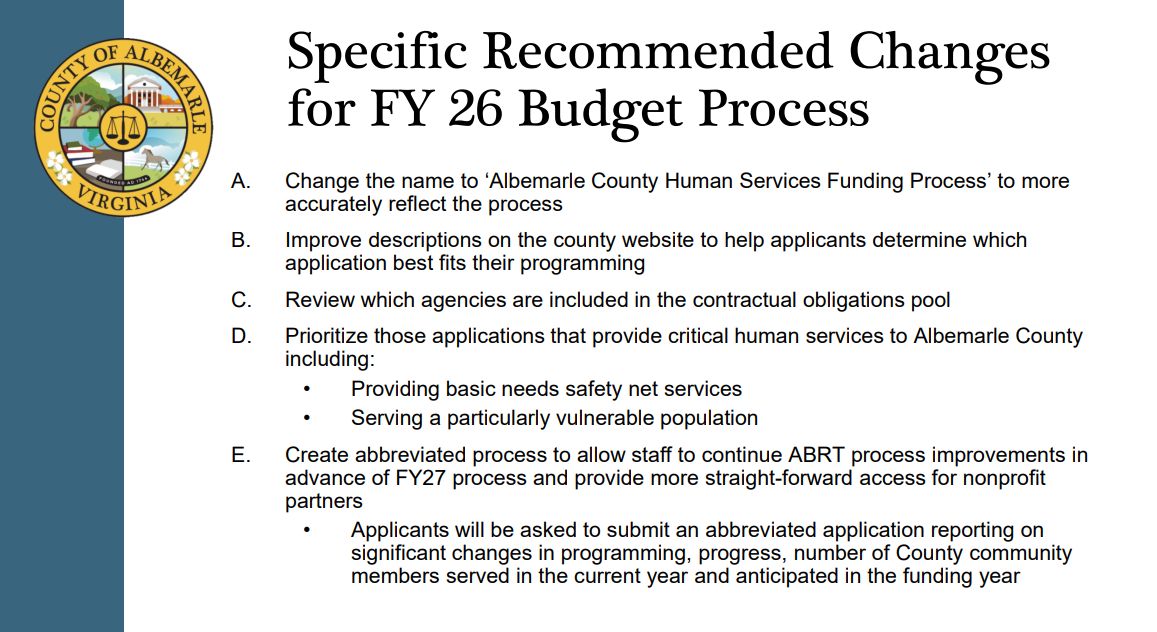
Dimock said her department wants to make some changes to the process over a two-year period. The first is to change the name to Albemarle County Human Services Funding Process.
“Agency Budget Review Team only refers to something insiders know,” Dimock said. “Even if you were on the website and you saw something that was called Agency Budget Review Team you would not assume that was about nonprofit funding and click on it to learn more.”
Dimock said another change will be to prioritize funding for groups that provide basic needs like food and shelter as well as protecting demographics identified as vulnerable. They also want to shorten the process in FY26 and plan to make further revisions in FY27.
Supervisors endorsed the changes and we’ll hear more about that as the process gets underway. Albemarle’s proposed changes would not apply to the process for cultural agencies or ones created by major agreements such as the Rivanna authorities.

Two days before, Charlottesville City Council was briefed on potential changes to its process which is known as the Vibrant Communities Fund.
Human Services Planner Hunter Smith said orientation will take place in August for both applicants and those who will be reviewing the applications.
“We actually do a prior to that for people who are just curious about it so I’ll do a Q&A session,” Smith said. “People just come down and learn what it is.”
The application window will open in September for about 30 days before teams will get work evaluating proposals, a process that can involve site visits if the request is above a certain level.
“Funding recommendations come out between January and February and then in March we come back and start meeting [with Council],” Smith said.
For the upcoming cycle, staff are recommending putting a cap of $150,000 per organization. Last year, several organizations asked for more with the BUCK Squad initially recommended for funding at $465,000 for their work to reduce gun violence in the community. That amount was later reduced.
“It is important to hear Council’s reaction to the suggestion of a cap because now is the time that that information needs to be shared so individual groups can begin to make adjustments,” said City Manager Sam Sanders.
City Councilor Lloyd Snook said there should be a cap he was not certain what the number should be.
“There ought to be a number where if the organization is going to give that much money, we probably ought to be having a more detailed look at the governance structure of the organization,” Snook said.
Councilor Brian Pinkston said he would like to see more data on distributions through the fund to come up with a cap, but he suggested increasing the maximum amount to $200,000.
Councilor Natalie Oschrin said her review of previous budgets led her to believe $150,000 is appropriate but she suggested it could be adjusted over time due to inflation. An exact number was not determined at the meeting and staff said they would come up with a new figure.
Another adjustment will be to the list of agencies considered to be fundamental, which means they are guaranteed funding. The Office of Community Solutions will provide an initial review of applicants.
“Are they eligible? Do they align with priority areas?” Smith asked. “And then the community member teams will focus on the impact.”
Smith said the goal will be to get information about the recommendations to Council sooner so there is more time to review the documents before the budget process gets too far in the cycle. He added that staff will also present recommendations for both the Charlottesville Affordable Housing Fund (CAHF) and the Housing Operations Programming Support (HOPS) fund at the same time as Vibrant Communities.
Toward the end of discussion, City Councilor Michael Payne said the entire process is inherently subjective.
“I say it every year but I’ll state it again,” Payne said. “We are a public body. There is no way to separate politics from a public body’s budget and I don’t mean that in a negative way. As elected officials, we hear from citizens. I mean, [staff does] too, but in a different way. If there’s a process, and not just this but [Community Development Block Grant], HOPS, CAHF, where 90 percent of the recommendations in the process are followed but ten percent of that total process is adjusted? To me that’s about as good a process that a public body could get to.”
Both Albemarle and Charlottesville also work with the Center for Nonprofit Excellence to coordinate on information. Charlottesville Mayor Juandiego Wade said he would like to get an update on the nonprofit community as a whole.
Before you go: The time to write and research of this article is covered by paid subscribers to Charlottesville Community Engagement. In fact, this particular installment is from the July 24, 2024 edition of the newsletter. There’s an audio version in the podcast that went out on July 27, 2024. To ensure this research can be sustained, please consider becoming a paid subscriber or contributing monthly through Patreon.
Discover more from Information Charlottesville
Subscribe to get the latest posts sent to your email.