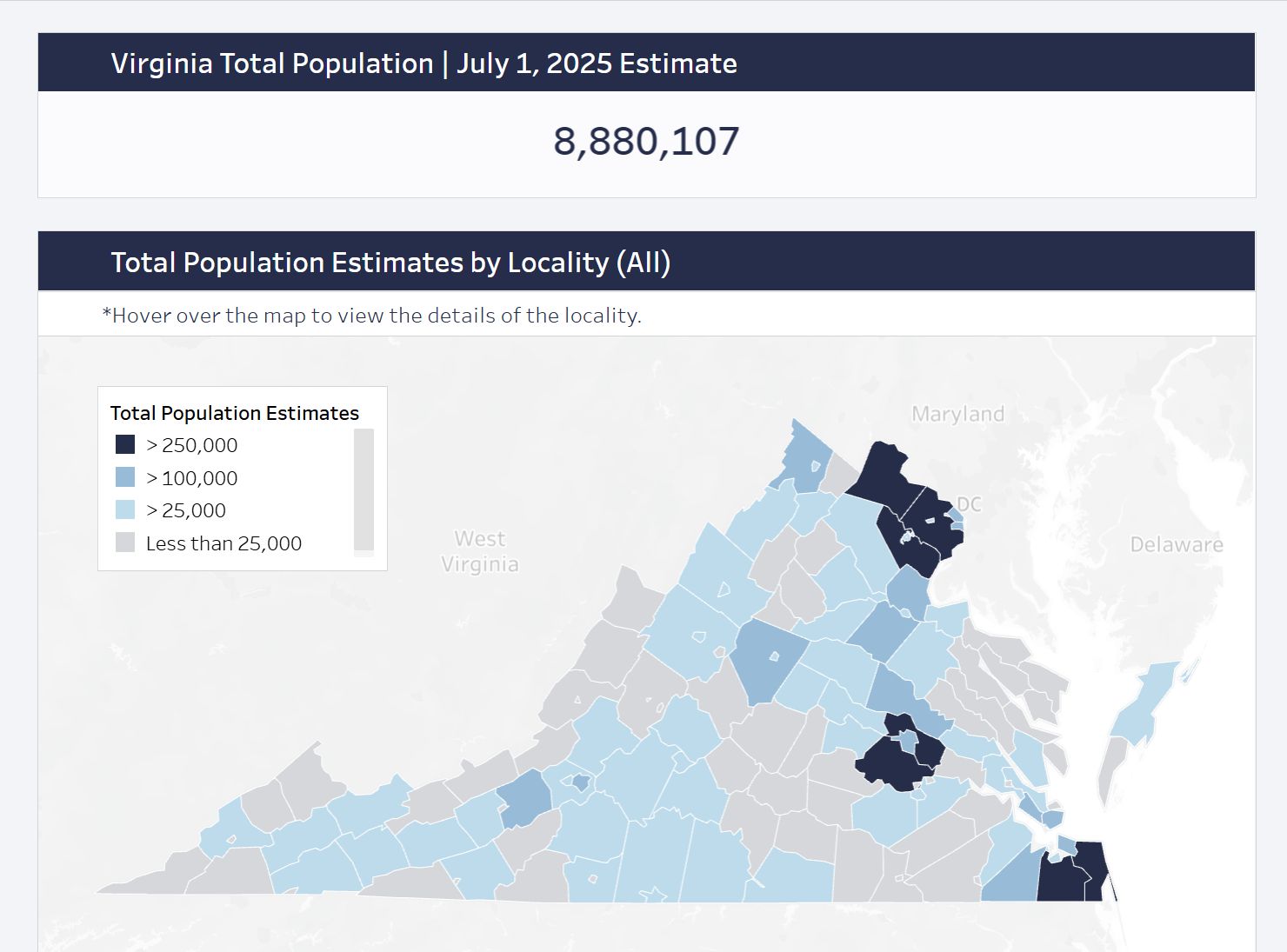
A second release of population data by the federal government confirms the city’s official count has fallen by about 5,000 people from what had been reported by an agency working on behalf of the state government.
On May 14, the United Census Bureau released a data set called the Vintage 2025 City and Population Estimates. Charlottesville is listed as the 937th largest with a population of 44,388 as of July 1, 2026.
That places Charlottesville between Lombard, Illinois, and El Centro, California.
While this data does not include counties which are not considered to be incorporated places, the table does list the populations of towns. Both Leesburg and Blacksburg have higher populations with 49,917 and 45,104. Those figures are reflected in the estimates for Loudoun County (449,749) and Montgomery County (98,434).
In Virginia, the largest city is Virginia Beach with 453,737. Chesapeake is second with 255,332 and Richmond is third with 237,257. Richmond’s growth rate over five years is 4.74 percent and is the 96th largest incorporated place in the nation in between Boise, Idaho and Frisco City, Texas.
Close to home, the current southern terminus of the western branch of Amtrak’s Northeast Regional saw its 2025 population decline below 100,000 to an estimate of 99,111 on July 1, 2025. That’s a 0.91 percent decline for Roanoke from a 2020 federal estimate of 100,017.
The next stop on the Northeast Regional is Lynchburg which grew 2.95 percent from 2020 to 2025 with a July 1, 2026 estimate of 81,347.
The City of Harrisonburg is not accessible by train but was one of several localities that the Weldon Cooper Center had used higher estimates than the Census Bureau. This was out of a belief that the April 2020 count took place during the pandemic when many college students had been sent home.
For instance, Weldon Cooper’s estimate for Harrisonburg for July 1, 2024 was 56,879 and 51,743 for Charlottesville.
For July 1, 2025, Weldon Cooper lowered the higher numbers and reported a Harrisonburg population of 53,715 and 46,923 for Charlottesville.
Qian Cai, the director of the Demographics Research Group at the Weldon Cooper Center, acknowledged the lower numbers on March 5 in response to an email query.
“The new base population for Virginia and its counties and cities is almost identical to the census count,” Cai wrote on March 5. “To be consistent with the official census numbers, the Cooper Center temporary base adjustments used for the 2021–2024 estimates have been discontinued.”
A few weeks later, the U.S. Census published their own estimates for counties in the United States of America on July 1, 2025. The figures for Harrisonburg and Charlottesville were much lower at 50,839 and 44,388 respectively.
When reached about the lower numbers in March, City Councilor Michael Payne chalked them up to a change in methodology based on new information.
“I would guess the recent reductions are a product of estimates from the pandemic-era being inflated due to methodological challenges rather than actual population loss,” Payne said.
Payne said his interpretation is that older households are living within Charlottesville which means fewer students in city schools.
“At the tax base level, this would mean Charlottesville will become even wealthier per capita: retirees will tend to be higher income, and neither UVA students nor retirees will tend to have kids in city schools to drive up expenditures on that side,” Payne said.
However, Payne said that should prompt community conversation about the kind of place people want.
Councilor Jen Fleisher on Wednesday responded to a question about the numbers by saying the actual number for Charlottesville is not as important as what happens regionally.
“Charlottesville isn’t able to grow outward, so it’s not an apples-to-apples comparison to Leesburg or Blacksburg (since they’re in counties that are absorbing regional growth),” Fleisher wrote in an email. “But the [Thomas Jefferson Planning District Commission] service area is growing, people commute to Charlottesville for work and services in high numbers, and our housing market reflects regional demand.”
In the five years since the most recent United States Census, the six localities that make up the Thomas Jefferson Planning District Commission have grown a collective 5.9 percent. Details in this story from late February.
Recent stories on population:
- Charlottesville-area population has grown 3.2 percent since 2020, January 28, 2025
- Charlottesville-area planning district has grown 5.9 percent since 2020 Census, February 27, 2026
- Charlottesville’s population estimate drops below 45,000 after new Census figures, March 26, 2026
- U.S. Census Bureau counts less than 45,000 people in Charlottesville, April 1, 2026
Before you go: The goal of Town Crier Productions is to increase awareness about what is happening at the local, regional, state, and federal government levels. Please share the work with others if you want people to know things. Paid subscribers cover the cost of conducting research for this article which was originally published in the May 28, 2026 edition of Charlottesville Community Engagement. You can either subscribe through Substack or make a charitable contribution.
Discover more from Information Charlottesville
Subscribe to get the latest posts sent to your email.