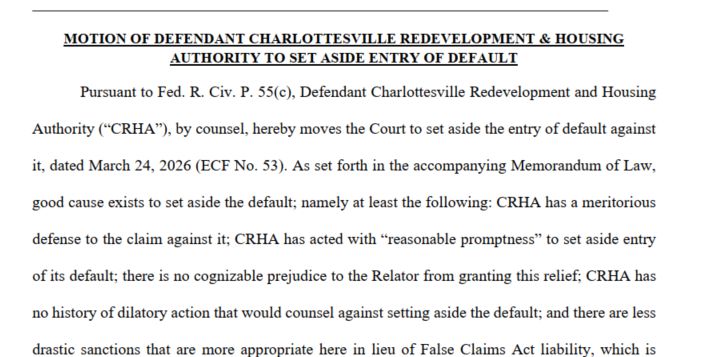
An attorney hired by the Charlottesville Redevelopment and Housing Authority has filed a motion in the United States Western District of Virginia asking for a way forward to challenge a claim that the government agency received COVID-era payroll protection loans using false pretenses.
Attorney Mark H. Churchill of the firm Holland & Knight filed a motion to set aside an entry of default entered into the record on March 24, 2026 after the CRHA failed to respond to a summons in a lawsuit seeking $1.5 million in damages under the False Claims Act.
“CRHA has meritorious defense to the claim against it; CRHA has acted with ‘reasonable promptness’ to set aside,” reads part of the motion. “CRHA has no history of dilatory action that would counsel against setting aside the default; and there are less drastic sanctions that are more appropriate here in lieu of False Claims Act liability.”
The motion also seeks 14 days to respond to an amended complaint from J. Bryan Quesenberry, a Utah-based attorney who has filed similar claims across the country related to Payment Protection Program (PPP) loans made possible in the first Congressional response to the COVID-19 pandemic.
Churchill also submitted a brief in support of the motion which included a legal declaration that CRHA Executive Director John Sales has made under oath that explains his side of the story. Sales said he received the summons on February 17, 2026 after being served.
“With the intent to defend the claims against it on the merits, CRHA promptly tendered the lawsuit to its insurer holding CRHA’s Local Government Liability Coverage, Virginia Risk Sharing Association (“VRSA”),” Sales said. “If covered by the policy, coverage counsel would have been assigned to defend CRHA in this action.”
Sales said VRSA denied covered on the same day and CRHA appealed. In paragraph 7, Sales said another firm was contacted but did not take the case due to a conflict of interest.
In paragraph 8, Sales said he was served with the entry of default and other documents on June 11 and had no prior knowledge of the action.
The VSRA formally denied coverage on June 15, 2026 because defense against the False Claims Act is not under the policy. On the same day, CRHA hired Holland & Knight to fight the lawsuit.
“CRHA disputes liability in this case and does intend to contest the merits of the claims against it, as alleged in the Amended Complaint,” reads paragraph 13.
While Quesenberry has not directly responded to the new motions related to CRHA, he filed a document on June 22 related to his request that the Rockbridge Regional Library be entered back into default. That entity has also made a claim that correspondence with the VRSA delayed its ability to respond to Quesenberry’s complaint.
“The motion to set aside default recently filed by co-defendant Charlottesville Redevelopment and Housing Authority further undercuts the Library’s effort to blame its default on VRSA,” Quesenberry wrote. “That VRSA acted within a single day for a co-defendant is difficult to square with the Library’s account of a weeks-long, deadline-distorting confusion at the same insurer, especially given the absence of any written communications during that time.”
The topic came up at the tail end of the Charlottesville Redevelopment and Housing Authority meeting on June 22 meeting. The meeting had begun with a closed session to discuss the sale and acquisition of property.
Emily Dreyfus of the Legal Aid Justice Center asked for a public comment and City Councilor Michael Payne gave said the topic came up in the closed session.
“I can’t speak for staff, but the Board, isn’t prepared to comment on legal matters at this time,” Payne said. “We’re definitely thinking about it, and there will, in the future be communication about everything about it.”
One question is how much CRHA is paying Holland & Knight for their services.
Before you go: The goal of Town Crier Productions is to increase awareness about what is happening at the local, regional, state, and federal government levels. Please share the work with others if you want people to know things. Paid subscribers cover the cost of conducting research for this article which was originally published in the June 23, 2026 edition of Charlottesville Community Engagement. You can either subscribe through Substack or make a charitable contribution.
Discover more from Information Charlottesville
Subscribe to get the latest posts sent to your email.