The amount of available space in the University of Virginia’s Emmet-Ivy corridor continues to decrease as the area that was once taxable land continues to be developed for the future of higher education.
“We’ve been working on the development of the Emmett-Ivy Corridor since the Board of Visitors approved the framework plan in 2016,” said Alice Raucher, Architect of the University of Virginia.
Under construction at the moment are the Karsh Institute of Democracy, around 800 beds of student housing, and the Virginia Guesthouse. The latter is expected to open in April.
One of the first new buildings to come into active use is the School of Data Science, which opened in April 2024. By the end of that year, the Quantitative Foundation contributed an additional $20 million for a new structure. That entity donated $120 million to the first building in 2018.
Last June, the Buildings and Grounds Committee of UVA’s Board of Visitors agreed to add an adjacent building to the Major Capital Plan for entrepreneurship. In September, the panel approved the concept, site, and design guidelines.
They got an update at their meeting on March 5.
“The site, which is directly adjacent to the School of Data Science, will enable broadcast collaborative research and entrepreneurial endeavors both within the school and across grounds,” Raucher said.

Another future project is the Center for Arts which would be built along Emmet Street to the north of an amphitheater outside the existing School of Data Science building.
Only two spaces remain to be programmed.
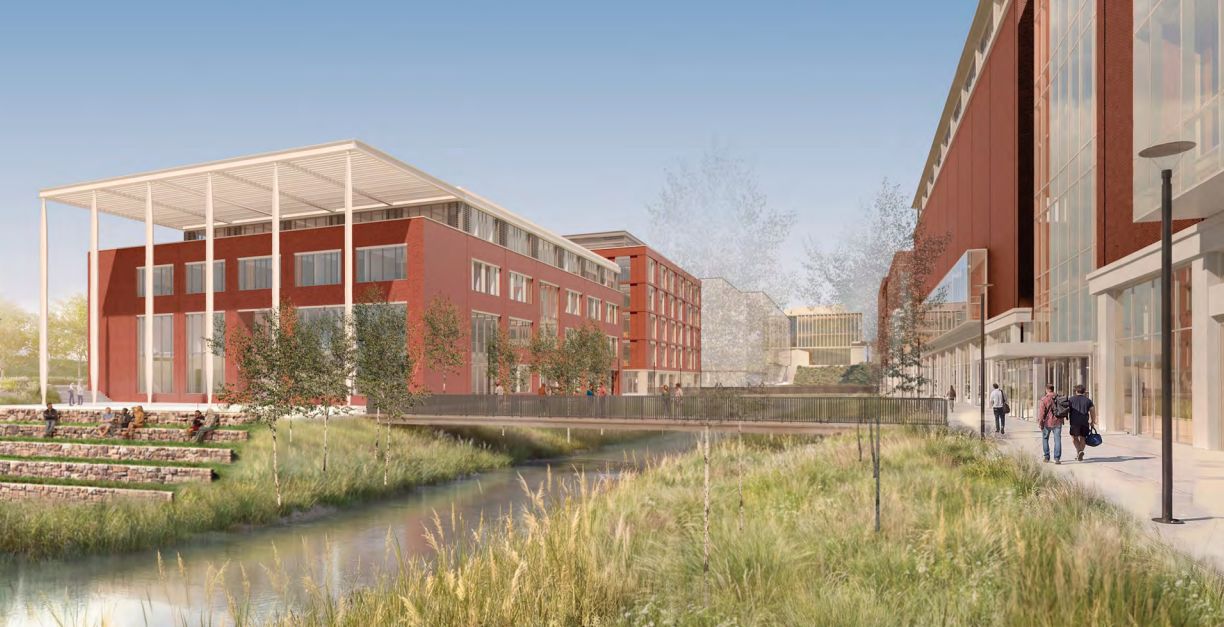
The new data science building is being designed to flow into the existing structure.
“The ground floor courtyard and the upper level connecting bridge between the two allow efficient circulation between the communal spaces and classrooms in SDS on the right and the seminar rooms and classrooms in the new building,” Raucher said.
One committee member expressed concern about how the connection to Central Grounds would be affected. Raucher responded that a lot of work has been done and will be done to increase capacity for pedestrians and bikes. For instance, the city is moving forward with a Smart Scale funded project to reconfigure the intersection of Emmet and Ivy with wider sidewalks.
“Both sides of Ivy Road have been widened and made tree lined,” Raucher said. “I think it is a natural course to be in a quasi-urban environment to be able to wait for a streetlight to cross.”
Raucher said one of the options at the Center for the Arts is to have a pedestrian bridge crossing across Emmet Street.
The design for the second School of Data Science will come back at a later date.

The Buildings and Grounds Committee also got a look at potential additions to the Major Capital Plan, the document that tracks planning for future buildings and infrastructure.
One of the additions is $100,000 to plan for a roadway to connect Copeley Road to Millmont Street across Arlington Boulevard, creating a new four-way intersection.
Copeley Road currently runs from Ivy Road through North Grounds before turning to the east where it terminates with Emmet Street.
“The 2019 North Grounds Athletics plan recommended road construction from Copeley Road to the Milmont and Arlington Boulevard intersection to relieve congestion during peak commute times and for patrons when they’re exiting the large [John Paul Jones] arena events,” said Lois Stanley, UVA’s senior vice president for operations.
Copeley Road currently runs from Ivy Road through North Grounds before turning to the east where it terminates with Emmet Street.
“The 2019 North Grounds Athletics plan recommended road construction from Copeley Road to the Milmont and Arlington Boulevard intersection to relieve congestion during peak commute times and for patrons when they’re exiting the large [John Paul Jones] arena events,” said Lois Stanley, UVA’s senior vice president for operations.
Few details about the scope of the future roadway were mentioned at the meeting, but the UVA Foundation owns all of the land immediately to the south of Millmont Road’s intersection with Arlington Boulevard. In December 2019, the foundation paid $10 million for Arlington Park Townhomes and its 2.12 acres. In June 2020, the foundation paid $10 million for an apartment building just to the south.
The UVA Foundation is a result of an agreement signed in 1986 between Albemarle, Charlottesville, and UVA to set expectations about how each would approach growth. The foundation pays real property taxes to the city, but that stops when the Board of Visitors formally takes ownership.
Other additions to the major capital plan include a $13 million for construction multipurpose practice field and $12.5 million for two new Health System buildings. The plan will come back for formal approval at the BOV meeting in June.

Before you go: The goal of Town Crier Productions is to increase awareness about what is happening at the local, regional, state, and federal government levels. Please share the work with others if you want people to know things!
Paid subscribers cover the cost of conducting research for this article which was originally published in the March 9, 2026 edition of Charlottesville Community Engagement. You can either subscribe through Substack or make a charitable contribution.
Discover more from Information Charlottesville
Subscribe to get the latest posts sent to your email.