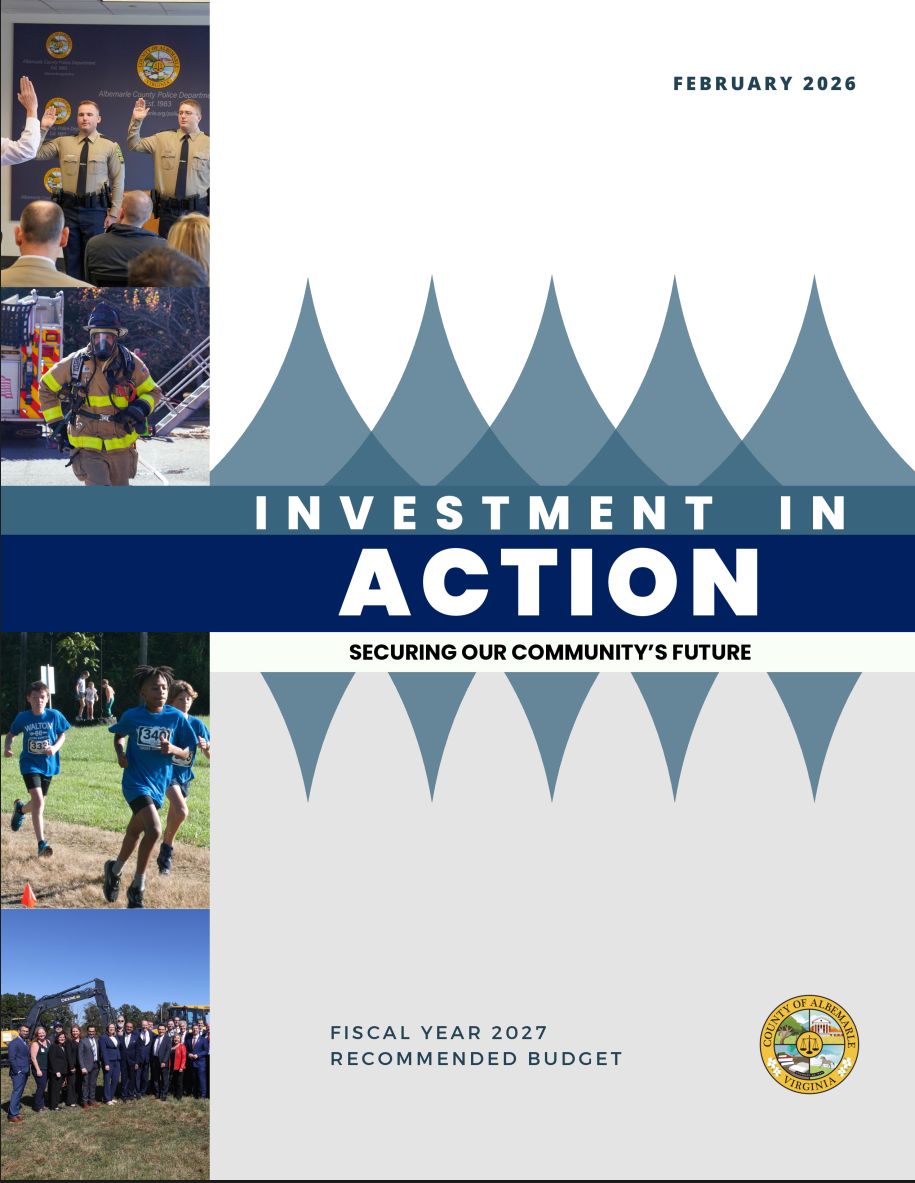
Albemarle County Executive Jeffrey Richardson’s proposed total budget of $724,021,078 in FY27 will utilize reserves in order to maintain government services while avoiding an increase in tax rates.
“This budget is balanced on a real estate tax rate of 89.4 cents per $100 of assessed value,” Richardson said at a briefing Wednesday afternoon. “There are no recommended changes to the tax rates from what we adopted in the FY26 budget.”
Supervisors agreed last year with Richardson’s recommendation to raise the real property tax rate by four cents to fund additional firefighters as well as create a dedicated funding source for affordable housing. This year’s draft budget anticipates using reserve funds to avoid another increase.
Albemarle brought in $307,736,723 in property taxes in FY25 and is anticipated to bring in $323,769,578 in FY26. That includes both real property as well as personal property. For FY27, Albemarle is projecting a collection of nearly $352 million, or 48 percent of the total budget.

County government operations will go from $191 million in FY26 to over $207 million in FY27. Much of that increase is related to public safety with expenditures of $76 million in FY26 climbing to $87.6 million in FY27.
However, that is not enough to maintain higher levels of public service.
To fill revenue gaps, the budget outlines several uses of contingency funds, such as the use of $2.971 million from a stabilization reserve.
“This reserve may be used from time to time as necessary to meet unanticipated one-time emergencies and unanticipated expenditures required to pay costs necessary to maintain the quality or level of current services or to smooth/offset revenue fluctuations occurring within a fiscal year,” reads a portion of the Board’s Financial Management Policies.
The budget anticipates tapping into this reserve again in FY28.
The county will also use $4.9 million from its fund balance compared to a projected $1.57 million in FY26. No money from the fund balance was used in FY2025.
“The County maintains a fund balance for cash liquidity purposes that will provide sufficient cash flow to minimize the possibility of short-term tax anticipation borrowing,” reads page 100 of the recommended budget.
The county anticipates there will be money left over at the end of the current fiscal year. Richardson proposes a transfer of $4.15 million to an Economic Development Fund and $3.7 million to the Affordable Housing Investment Fund.
The recommended budget includes for the first time direct funding for an Office of Emergency Management with $440,727.
“The Office of Emergency Management (OEM) is being created in FY 27 as a dedicated office within the Public Safety Function of Albemarle County,” reads page 152 of the recommended budget. “OEM is responsible for the strategic planning, coordination, and execution of emergency management activities across all phases of emergency management.”
Expenditures for the police department will jump 8.3 percent to nearly $35.87 million and includes the hiring of three new police officers in January 2027.
“Over the past three years, we had a 19 percent increase in calls for service in the Albemarle County Police Department,” Richardson said. “In 2025, calls for service were 92,727 calls. You can take that and divide it by 3, 365 to get a flavor for what the per day average is on call volume in the police department.
Expenditures for fire and rescue will climb 11.2 percent to $36.84 million. Both increases reflect a continued tapering of Federal Emergency Management Agency grants used to pay for more professional personnel. Richardson said the county is going to pursue a fifth grant to hire even more firefighters, a cost that will eventually be picked up by Albemarle taxpayers.
The budget also includes increased obligations for nonprofits that provide contractual services. Albemarle’s payment to the Albemarle Charlottesville Regional Jail climbs 24.1 percent to $5.95 million and 58.6 percent for the Charlottesville-Albemarle SPCA.
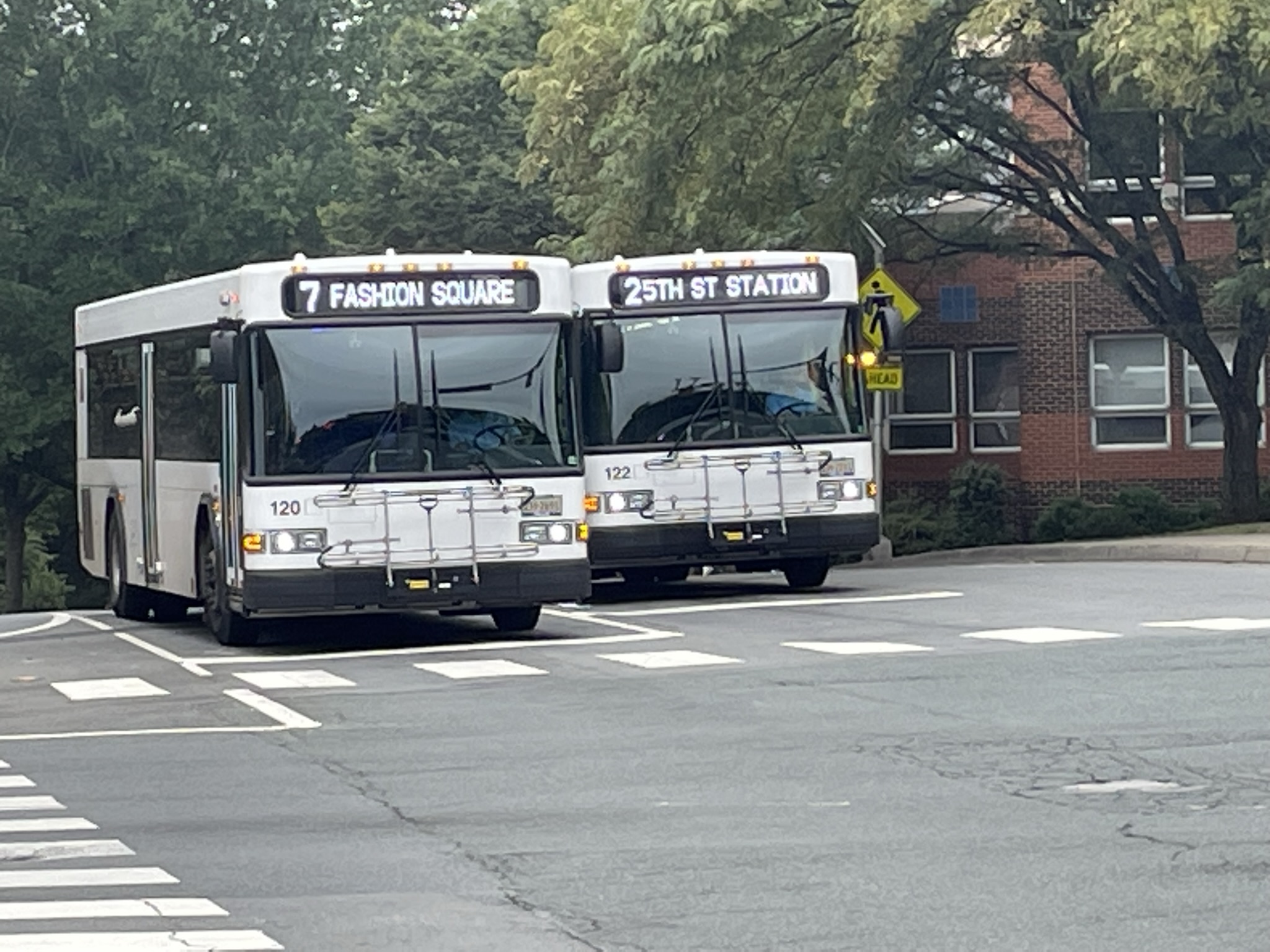
The county will also contribute 21 percent more to Charlottesville Area Transit for a total of $3.24 million. For comparison, Albemarle contributed $1.86 million in FY25.
“This increase will provide for the County’s share of the operational costs for transit services and routes provided by CAT in Albemarle County,” reads page 200 of the budget. “The majority of the increase is to provide for the addition of drivers in FY27.”
There is an eight percent increase in funding for the Jefferson Madison Regional Library.

The capital improvement plan for FY27 is recommended at $95,395,301 with $54.4 million slated for spending in the “community development” category. The bulk of that, or $40.8 million, is slated for the extension of Boulders Road at Rivanna Futures. At least half of that amount comes from the Commonwealth of Virginia. Albemarle will need to incur $8.8 million in debt for its share of the project.
There is another $13.6 million slated to build Eastern Avenue in Crozet programmed in FY27.
The total five-year CIP plan totals $361,742,473. In December, members of the School Board had requested funding for construction for a fourth high school but that is not included in the draft document. There is an $8 million placeholder programmed in FY31.
“This placeholder is to provide flexibility in the out years of this CIP to address high-priority projects determined by the School Board and approved by the Board of Supervisors,” reads page 248 of the budget.
The CIP does not include any funding that might come through a one-cent sales tax for school construction. Legislation is making its way through the General Assembly to allow for a referendum to ask voters if they would support levying such a tax.
There is $500,000 in the five-year plan for a contribution to the Salvation Army for a shelter as well as $250,000 for the Dogwood Memorial.
Other tidbits:
- Revenue from the Commonwealth of Virginia is anticipated to grow from $115.2 million in FY26 to $150.6 million in FY27.
- School operations make up 45 percent of the recommended $724,021,078 in spending for FY27.
- Albemarle County’s payment to the City of Charlottesville for the revenue-sharing agreement will increase from $20,175,533 in FY26 to nearly $21.9 million in FY27. Details on how this is calculated are on page 207.
Richardson said the future looks brighter as economic development deals such as the landing of two AstraZeneca facilities will help increase the proportion of the budget that comes from commercial activity.
“We know that we’re positioning ourselves hopefully for future economic growth over the next five to seven years,” Richardson said. “ And Board Jacob and his team have modeled that in the next five years.
Richardson said if the AstraZeneca announcement had not happened, he would have recommended a two cent increase on the property tax rate.
“I could not have in good faith recommended that we pull from the budget stabilization fund,” Richardson said.
A public hearing on the budget will be held on March 4, 2026 followed by the first work session on March 9. Consult the full calendar here.

Before you go: Paid subscribers cover the cost of conducting research for this article which was originally published in the February 25, 2026 edition of Charlottesville Community Engagement. You can either subscribe through Substack or make a charitable contribution. The goal of Town Crier Productions is to increase awareness about what is happening at the local, regional, state, and federal government levels. Please share the work with others if you want people to know things!
Discover more from Information Charlottesville
Subscribe to get the latest posts sent to your email.