


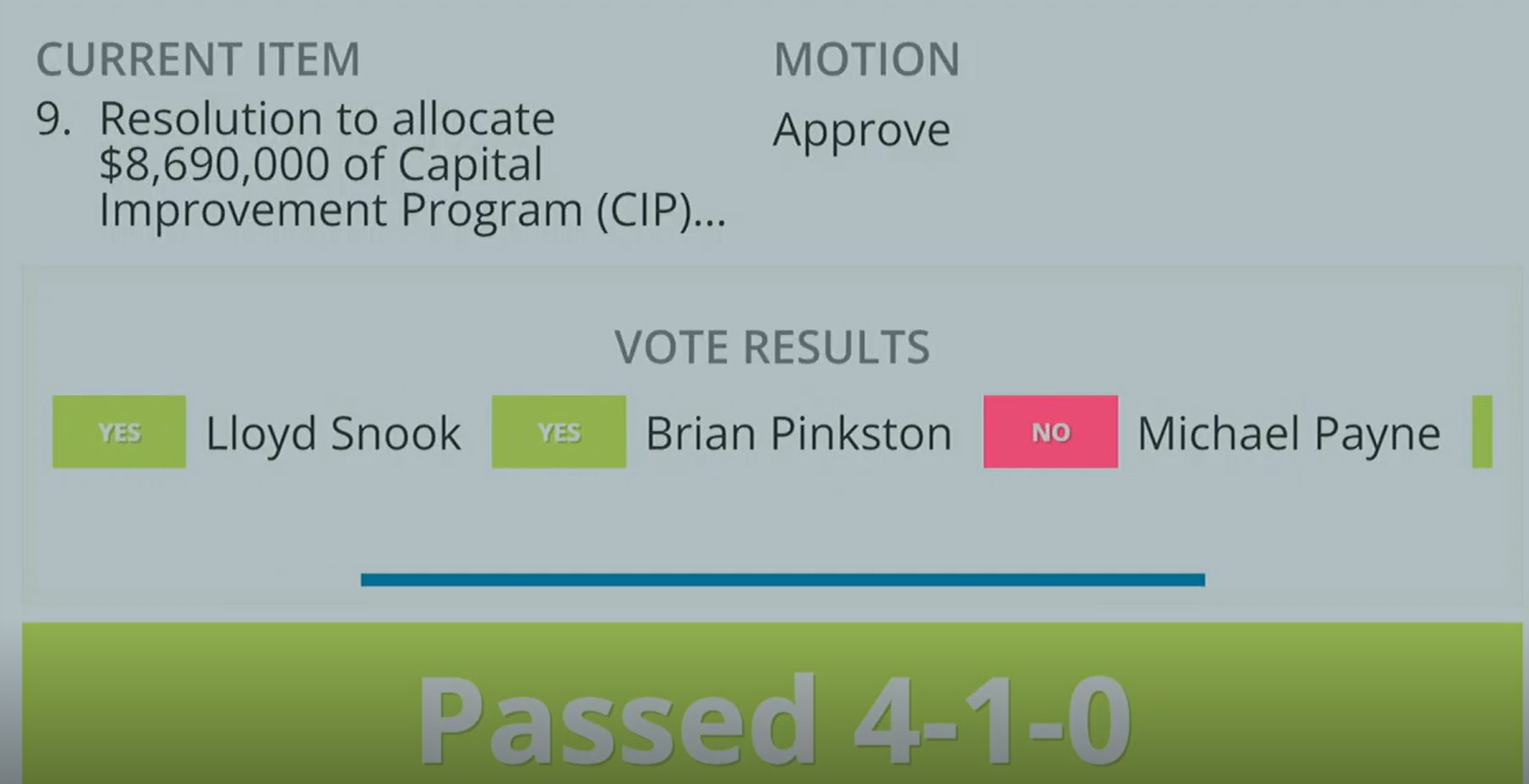
At the June 16, 2025 meeting of the Charlottesville City Council, Councilors used for the first time a new system to run meetings.
Longtime observers of City Council might recall that a voting board was on the stage right side of the City Council dais. This displayed how each of the five elected officials voted on matters. That system has now been replaced with a computerized system that displays results on two computer screens.
The system was not working at the beginning of the meeting and so a series of voice votes were taken and entered in manually by City Council Clerk Kyna Thomas.

Afton Schneider, the director of the city communications and public engagement, said the system is an extension of the Civic Plus system that has been in place for a while. After many years of using the old board, it was time to make a change.
“When Council elections occur and members cycle on and off, it is becoming increasingly challenging to schedule Facilities staff who are trained or skilled in wiring the old voting board to the voting buttons on the dais, especially when Council’s seating arrangement changes,” Schneider said.
The new system allows for votes to be recorded more easily and for the City Council Clerk and her staff to incorporate votes into the system.
“On the occasion when a Councilor needs to participate in a meeting electronically, they will be able to cast their vote through the same process as those in the room by logging in to their device,” Schneider said.
Because the system wasn’t quite working in time, a series of voice votes had to be held. One of them was for the closed session resolution. Council met privately to conduct a performance review for City Manager Sam Sanders and to consider nominations to two appointed bodies.
On another voice vote when they came back, Council made appointments to the Charlottesville Retirement Commission but not to the Charlottesville Redevelopment and Housing Authority. The terms of Wes Bellamy and Laura Goldblatt end on June 30.
There were three public hearings. The first was to appropriate additional funds from the Virginia Department of Transportation for various road projects. This is to make up for cost overruns.
“Though it looks relatively complicated, it’s actually a fairly simple resolution,” said Mike Goddard, Charlottesville’s deputy director of public works. “We’re appropriating, with two exceptions. We’re appropriating VDOT funding for VDOT projects that the city is administering.”
No one spoke at the public hearing and there was no need for a vote because the item will be on Council’s consent agenda on July 7 for a second reading. Councilor Natalie Oschrin had asked if it would be useful to vote to waive second reading, something that has become much more common in recent years.
The next item was to approve a lease renewal for the Blue Ridge Coalition for the Homeless to rent a portion in CitySpace. This also took a public hearing, no one spoke, and the vote was taken on voice vote.
A third public hearing was held for amendments to Charlottesville’s allotment from the federal government for Community Development Block Grants and the HOME program. Anthony Warn works for the city’s soon-to-be-dissolved Office of Community Solutions.
“It’s my pleasure to come before you tonight and announce that we received a little bit more money, much to our surprise, for both the community Development block Grant program and the home Investment Partnerships program this year,” Warn said.
The difference is under $10,000. Warn recommended allocating a proportion of the additional CDBG funding to entities already awarded funds and that all of the additional HOME go to the Piedmont Housing Alliance so they can close a funding gap for a project to build 12 units at a single family house at 905 Rives.
Council agreed, but one member said they should waive the required second reading.
“My only comment would be, as we know the speed with which federal money can be or federal gifts can be rescinded, I would say that maybe we vote this through today,” said Councilor Natalie Oschrin.
It takes a supermajority of four votes to waive a second reading. The vote was about to be taken until City Council Clerk Kyna Thomas said she wanted new city attorney John Maddux to weigh in.
“This is an appropriation of these funds per 2-98 of the city code,” Maddux said. “That would require a second reading. I’m sorry, I. Even with the second to step back in. Yes, this would require a.2 readings and you cannot waive appropriation.”
Councilor Michael Payne said he felt Council should take the two votes even if they could waive the rules.
“I think doing these two readings is good on our end for both compliance and transparency and I just still come down there,” Payne said.
No one spoke at the public hearing.
This item will be on the consent agenda on July 7.
Before you go: This is a very wonky story written to document the passage of technology. My memories of City Council Chambers echo with the sound of the mechanisms that ran the old vote board. I wanted to document that sound and that ended up in the June 20, 2025 podcast edition of the newsletter. Of course, the story also went out in the June 17 and June 23 print editions. And now it is here in the archive podcast. Why? Because.
Discover more from Information Charlottesville
Subscribe to get the latest posts sent to your email.


