A lawsuit filed by a group of Charlottesville property owners can proceed to the next step where plaintiffs can present evidence to support claims that city officials did not follow Virginia’s regulations to study the impact increased density would have on transportation infrastructure.
Charlottesville Circuit Court Judge Claude Worrell’s latest ruling in White v. Charlottesville came at the end of a thirty-minute hearing on April 16 where several matters were pending.

Background
The suit was originally filed in January 2024 a month after the City Council approved a new zoning ordinance known as the Development Code. The plaintiffs are G. Edward White, Susan D. White, Roy Van Doorn, Kristi Van Doorn, Jenny Clay, Michael Bevier, Lilian Bevier and two trustees of the Thomas J. Hill Trust. They claim they will suffer harm as a result of additional density allowed by-right under the new code.
At a 90 minute hearing on June 27, 2024, Judge Worrell asked both sides to submit a closing argument in writing to persuade him whether the matter should proceed to a trial. In November, Worrell issued a three-page written ruling that concluded plaintiffs had legal standing to bring the case forward.
In January, counsel for the plaintiffs filed an amended complaint that refined their argument that the city failed to comply with specific sections of Virginia code such as §15.2-2222.1. That requires a locality to submit a Comprehensive Plan to the Virginia Department of Transportation “if the plan or amendment will substantially affect transportation on state-controlled highways.”
Shortly afterward, the city’s legal counsel filed their own amendments to a motion called a “plea in bar” as well as one known as “demurrer.” The latter asked Judge Worrell to dismiss the complaint.
The April 16, 2025 hearing
At the hearing on April 16, 2025, Ryan Starks of the firm Gentry Locke went first and argued that the plaintiffs’ case is based on an argument that the city did not do enough to study traffic impacts. He reminded the court that the Development Code came at the end of a long study period that began in 2019. The new zoning code is the third and final result of the Cville Plans Together initiative.
“There is no universe in which plaintiffs can say the city did not consider [impacts],” said Ryan Starks of the firm Gentry Locke. The city is still without an official attorney following the departure of Jacob Stroman last year.
Judge Worrell interrupted Starks to ask why that matters when the plaintiffs are citing specific sections of Virginia code. Starks said the standard is whether the city had a sufficient public process.
“All the City had to do is proffer some evidence of reasonableness,” Starks said. “They’ve done that.”
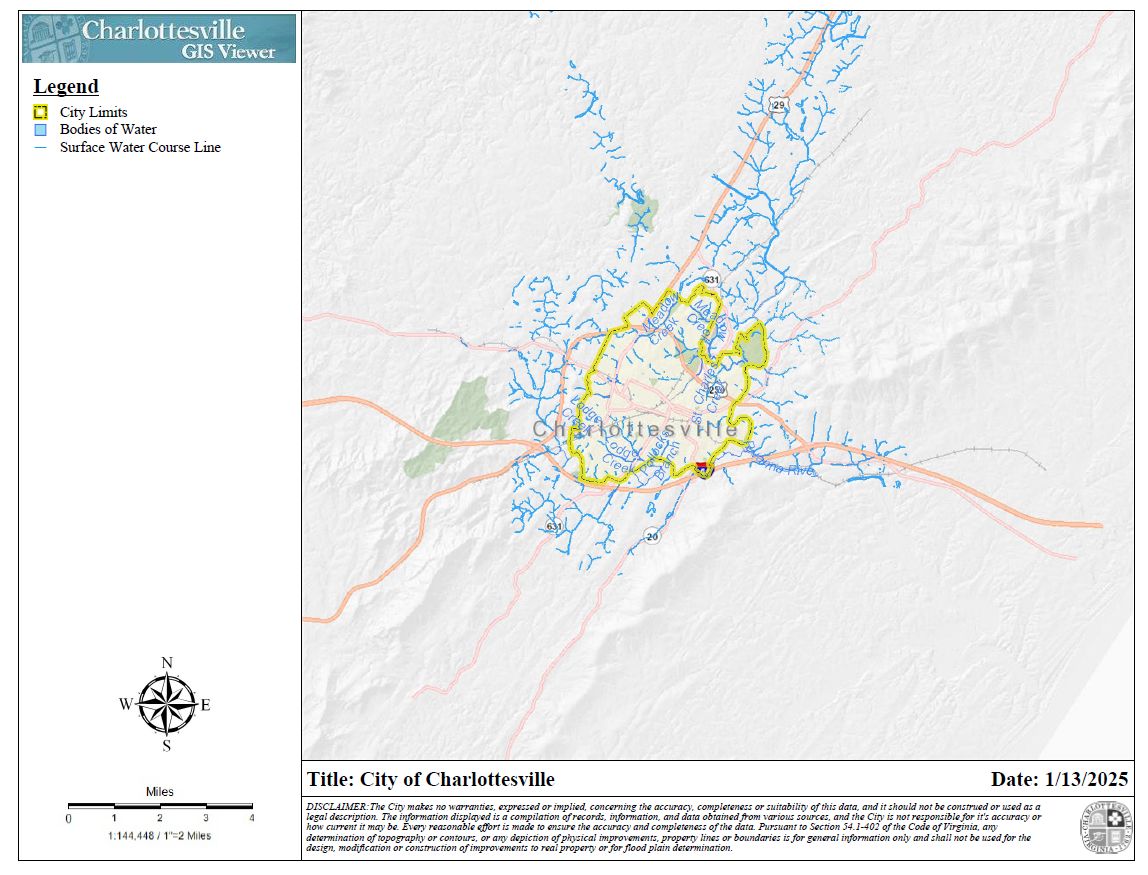
Starks said the plaintiff’s amended complaint is an example of additional requirements being added. He also added they had no right to enforce regulations that are the responsibility of the Virginia Department of Transportation. Starks also argued that Charlottesville maintains its own roadways and that the only “state-controlled highway” is a small sliver of Interstate 64.
In both versions of their complaint, plaintiffs pointed out the hypothetical maximums that could occur under the new Development Code and used the Greenbrier neighborhood as an example.
“The number of additional housing units permitted by the [New Zoning Ordinance] at base density is almost three times the number of existing number of units,” reads paragraph 40 of the amended complaint.
Starks also cited an analysis put together by consultants in August 2022 that showed that the rate of change would not be rapid as the Development Code went into effect.
“Charlottesville will not become Manhattan overnight,” Starks said. “That’s just not the case.”
Starks said the plaintiffs are seeking to draw the case out and he asked Judge Worrell to dismiss the case.
When it was his turn to respond, attorney Mike Derdeyn said he felt the city was misinterpreting the plaintiffs’ argument. He argued that under Virginia law, localities must perform what the state government says they must do.
“What we are seeking to do is enforce the Dillon Rule which in this case means that [the New Zoning Ordinance] is void for not complying,” Derdeyn said.
Derdeyn cited a 2010 Virginia Supreme Court case known as Schefer v. City Council of Falls Church which related to a zoning change in that locality related to the calculation of building heights. The plaintiff was a property owner who owned 12 lots and argued that the new rule violated a uniformity principle in state code (see §15.2-2282) as well as equal protection rules.
Derdeyn also argued that the city did not do any traffic impact analysis to determine what the impact additional density would have on city roads. He said that even if Judge Worrell took into account Starks’ point about state-controlled highways, the Greenbrier neighborhood is close enough to Rio Road East in Albemarle County which is under VDOT’s administration.
There are similar cases to White v. Charlottesville across Virginia including Arlington County and the City of Alexandria. He cited another Virginia Supreme Court case from 1959 called Board of Supervisors v. Carper. This case was decided at a trial.
In his rebuttal, Starks argued again that the City Council made a reasonable effort to have a thorough public process that led to the new Development Code. He said if plaintiffs seek to change the rules, the new rules can be revisited over time. Starks said the cases in Alexandria and Arlington County are at the Circuit Court level and thus have no binding precedent.
Before announcing his decision from the bench, Judge Worrell noted the Carper case was from a different era, but said it did conclude that people have a right to challenge changes made to a locality’s zoning.
That may now happen after Judge Worrell overruled the city’s request for a demurrer asked both sides to consult their schedules for a further hearing. The next step is a motion for summary judgment where Judge Worrell will be asked to rule on the facts.
“Where we are is where we are,” Judge Worrell said.
Stay tuned.
Previous stories:
- Circuit Court Judge reduces Charlottesville Comprehensive Plan lawsuit to one count, throws out three others, August 29, 2022
- Lawsuit filed seeking voidance of Charlottesville’s new zoning code, January 17, 2024
- Charlottesville served with lawsuit seeking voidance of the new zoning code, March 1, 2024
- Charlottesville has responded to lawsuit seeking overturning of new zoning code, March 27, 2024
- Charlottesville Circuit Court Judge Worrell to take time to decide on court trial for zoning lawsuit, July 7, 2024
- Judge strikes down Arlington’s Expanded Housing Option ordinance, October 1, 2024
- Written opinion issued in legal ruling that halted Arlington’s missing middle zoning, October 31, 2024
- Judge Worrell is ready to rule in lawsuit against Charlottesville’s new Development Code, but allows time for more evidence to be filed, November 16, 2024
- Arlington to appeal judicial ruling invalidating middle missing zoning, November 22, 2025
- Plaintiffs file amended complaint in case against Charlottesville’s new zoning code, January 15, 2025
- Charlottesville responds to new anti-zoning complaint; Plaintiffs call for Judge Worrell to recuse himself, January 30, 2025
- Charlottesville responds to new anti-zoning complaint; Plaintiffs call for Judge Worrell to recuse himself, January 30, 2025
- Judge Worrell will not step away from lawsuit against Charlottesville’s new zoning, February 8, 2025
Before you go: This story was originally sent out in the April 16, 2025 edition of Charlottesville Community Engagement. There’s another version of it published on the website of C-Ville Weekly. To keep this information going, consider becoming a supporter. If you have questions, let me know!