


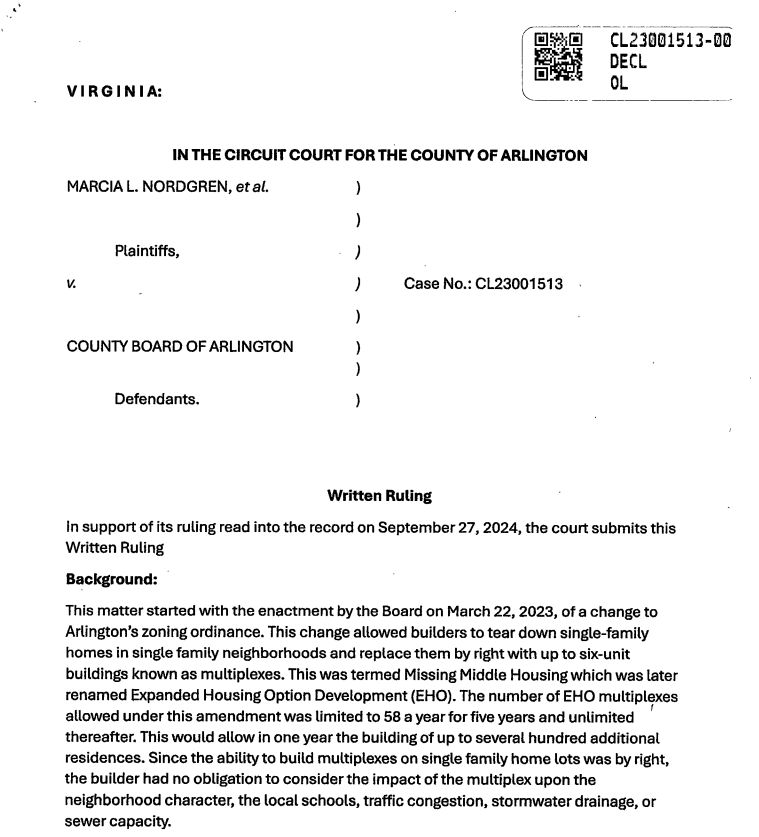
Charlottesville Circuit Court Judge Claude Worrell has still not issued a ruling on whether a lawsuit against the city’s zoning can proceed, but Fairfax County Judge David Schell has published a written opinion explaining why he ruled against Arlington County on a similar lawsuit in that locality.
“This matter started with the enactment by the [Arlington] Board on March 22, 2023 of a change to the Arlington’s zoning ordinance,” Schell wrote as background. “This change allowed builders to tear down single-family homes in single family neighborhoods and replace them by right with up to six-unit buildings known as multiplexes.” (read the ruling)
A group of plaintiffs filed suit arguing that allowing the changes by-right meant that no analysis had to be done on the impacts to sewer capacity, stormwater drainage, traffic congestion, local school enrollment, or neighborhood character.
“A zoning amendment that could essentially restructure the entire county and severely impact the rights of its citizens must be scrutinized carefully to ensure that the protections built into the Code of Virginia are respected and satisfied.”
The case of Nordgren v. Arlington did go to trial this summer with post-trial briefs turned in on August 23. On September 27, Judge Schell ruled in favor of the plaintiffs on four of seven counties and found that Arlington did not follow requirements laid out in the Code of Virginia.
These are:
- Count 1: The Board failed to promulgate an initiating resolution or motion for the Zoning Amendment in accordance with Virginia Law
- Count III: The Zoning Amendment is void ab initio because the Board acted ultra vires by failing to reasonably consider many Virginia Code 15.2.2284 factors
- Count IV: The Board unlawfully delegated legislative authority in granting a special exception for [Expanded Housing Options] Development
- Count VII: The landscaping provision of the Zoning Amendment renders the Zoning Amendment void ab initio because the Board acted ultra vires by acting contrary to Virginia Code 15.2-961
Ab initio means “from the beginning” and ultra vires means “acting or done beyond one’s legal power or authority.”
In his ruling, Judge Schell writes that the case is not about the merits or need for additional housing, but whether Arlington followed the rules correctly.
That’s the same question in Charlottesville where a group of plaintiffs argue the city did not perform a sufficient transportation analysis to see if the city is prepared to handle the theoretical maximum density allowed under a new Development Code that allows for additional density without legislative review by the City Council.
Judge Schell was assigned to the case after judges on the Arlington County Circuit recused themselves due to perceived conflict of interest for them being homeowners in that locality. Judge Claude Worrell did not recuse himself despite owning property in Charlottesville.
Before you go: The time to write and research of this article is covered by paid subscribers to Charlottesville Community Engagement. In fact, this particular installment is from the October 29, 2024 edition of the newsletter. To ensure this research can be sustained, please consider becoming a paid subscriber or contributing monthly through Patreon.
Discover more from Information Charlottesville
Subscribe to get the latest posts sent to your email.


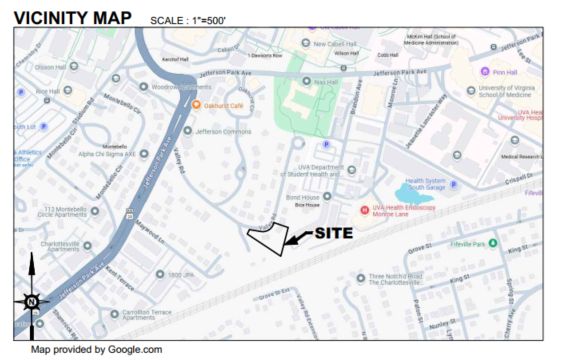

The Judge’s house is safe, his zoning is R-A. Which means the lowest density. He could put in a basement apartment and an tiny house in the yard.