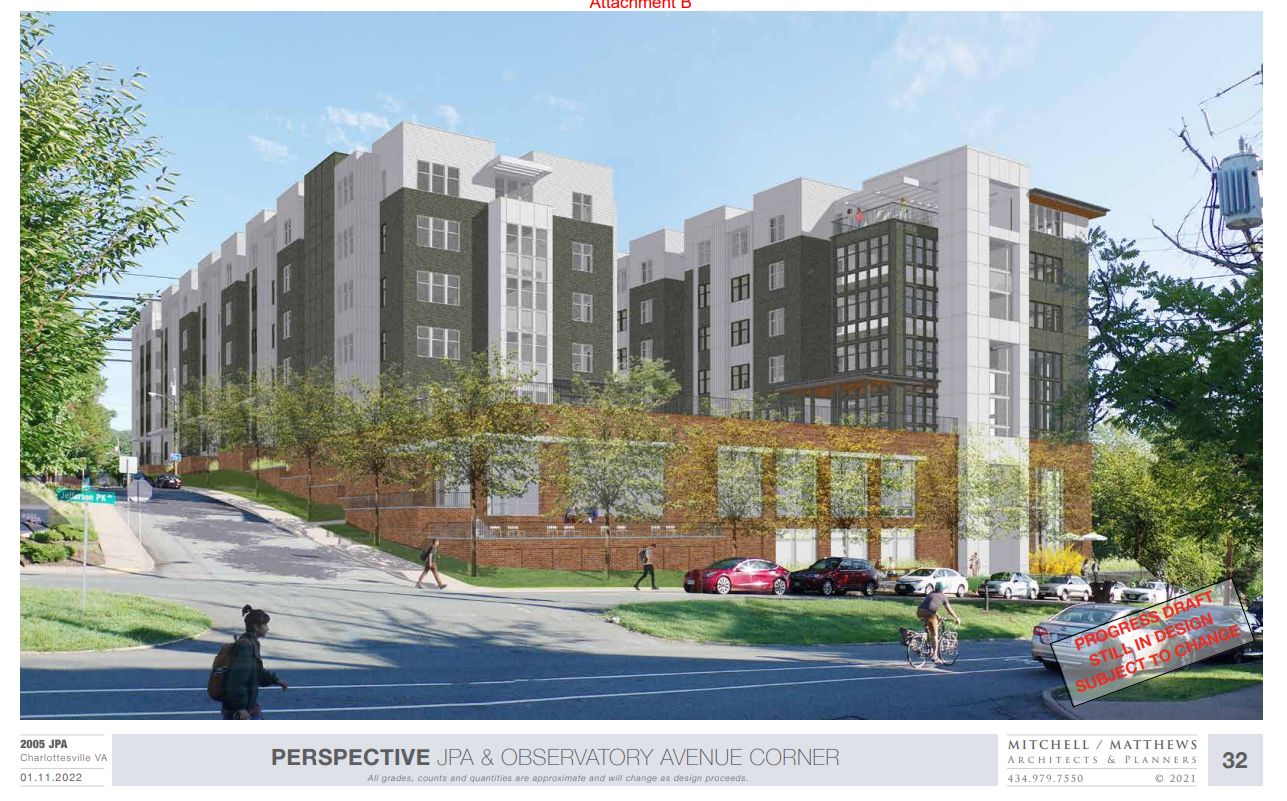
Charlottesville Circuit Court Judge Claude Worrell has ruled that a group of property owners in the Jefferson Park Avenue neighborhood were entitled to bring a lawsuit against Charlottesville City Council, but also that the elected body had the authority to grant a special use permit for a 119-unit apartment complex on JPA.
“The fact that the plaintiffs disagree and wish a different decision was reached does not render that decision void,” Worrell wrote in an opinion letter dated January 14.
The project at 2005 Jefferson Park Avenue was approved under the old rules, which required Council to grant a special use permit for additional density. Council approved that request on September 19, 2022, as I wrote at the time.
A month later, over a dozen nearby residents and property owners filed a suit seeking to overturn Council’s action.
“City Council’s authorization of the SUPs permits the construction of a building that will diminish the quality of life of all the Observatory Avenue and Washington Avenue plaintiffs in ways not shared by the general public and compromises their health, safety, and general welfare in a variety of ways,” reads paragraph 27 of that complaint.

The city responded with a legal motion called a demurrer that argued the plaintiffs lacked standing to bring the case and that they failed to demonstrate how they would be harmed by Council’s action.
“The Complaint fails to allege facts demonstrating particularized harm from the City’s zoning decision to any of the Plaintiffs,” reads the demurrer.
On Tuesday, Judge Worrell issued his written opinion which first ruled that the plaintiffs did have standing but that Council had authority to act under the older zoning code.
“The City Council is entitled to a presumption of legislative validity that attached to the Board’s approval of the Special Use Permit for 2005 JPA,” reads the ruling. “The court’s review of the legislative record reveals the City’s zoning plan reflects a change in priorities regarding density.”
Worrell said the issuance of the permit is consistent with the policy in place at the time.
“Some if not all of the plaintiff’s participated in the zoning process through their letters and public statements,” the opinion continues. “The City considered their questions and comments and issued the requested special use permit.”
The project is now making its way through the administrative review process with permits filed today for plumbing and electrical work. The estimated cost for Breeden Construction to run power to and through the building is listed at $2.157 million.
Before you go: This article was originally sent out as part of the Charlottesville Community Engagement newsletter in the January 16, 2025 edition. Both are functions of Town Crier Productions. You can support the work by purchasing a paid subscription or contributing monthly through Patreon. You can also send in a check or send an email, but drop me a line first.
Discover more from Information Charlottesville
Subscribe to get the latest posts sent to your email.