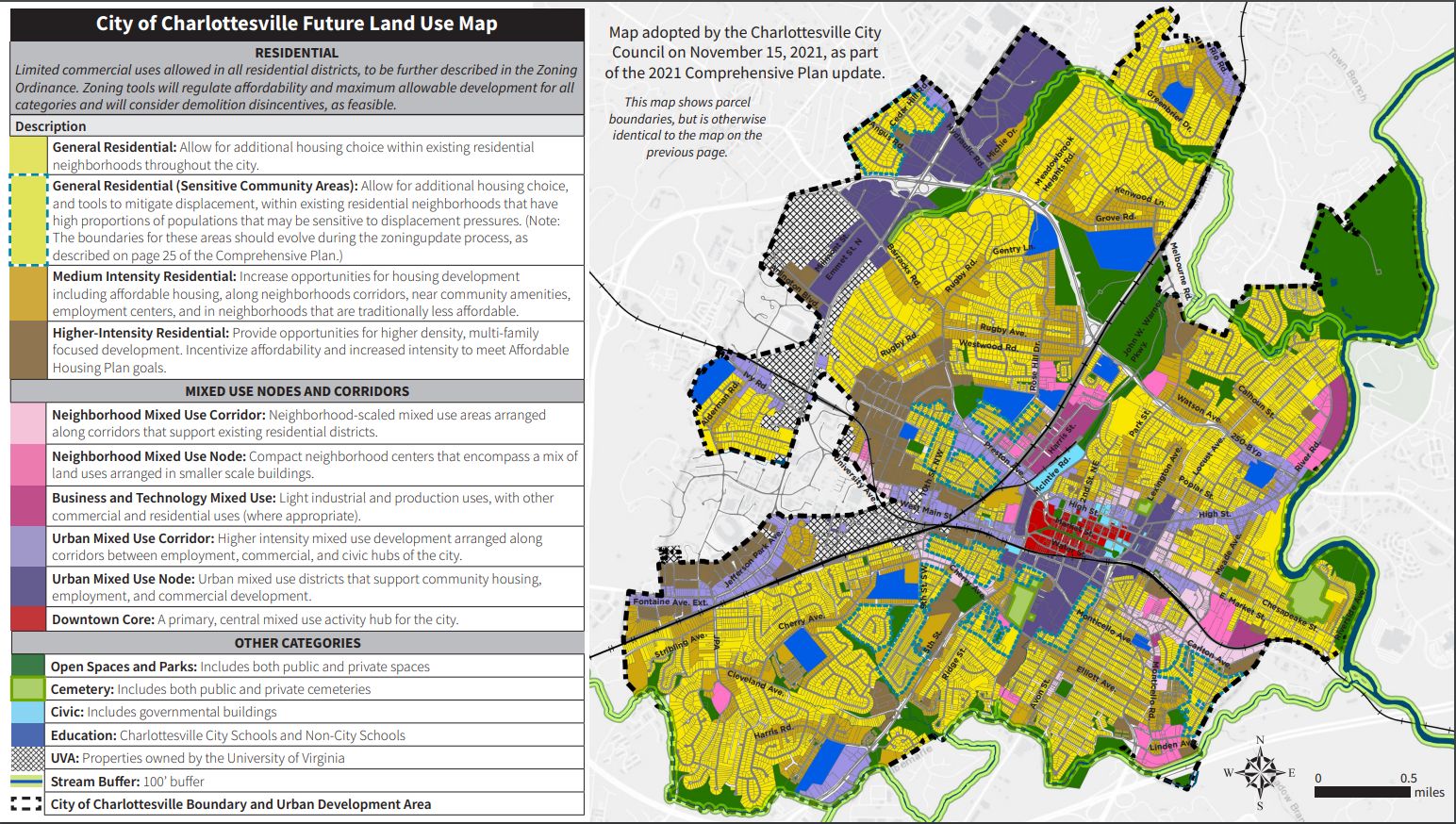
On February 19, 2024, Charlottesville’s new Development Code went into effect and almost everyone involved in the world of land use has begun using a new set of rules intended to make it easier for developers to build more residential units throughout the city’s 10.4 square miles.
On February 5, 2024, City Council took two actions required before new applications can technically be processed, one is the adoption of the affordable dwelling unit manual which I wrote about earlier in the week if you want to read that story.
Council also adopted a new manual to guide how staff in the Department of Neighborhood Development Services will process new applications into permits.
“Our objective here is to balance between what is needed to complete the review both in terms of submissions and process,” said NDS Director James Freas. “We’re also paying attention to and trying not to increase the cost of compliance. We recognize particularly for smaller projects that the cost of compliance can be a substantial cost and we want to make sure we are addressing that issue.”
Freas said the city and the community will be learning about the Development Code as it goes into effect and changes to the manual are highly likely.
The manual introduces the new component of the “development plan” which Freas said provides a chance for the city to check to see if the zoning for a particular property allows whatever the developer has planned.
“And we have a particular interest in seeing those development plans submitted early and that will give us an opportunity to approve those early,” Freas said.
The Planning Commission got a chance to review their manual in January as I reported at the time.
All of these changes come at the same time that the city has a new way for members of the public to review permits. Access the portal here.
“Anyone can view the projects that are in front of the city through our public portal so you can pull that open, see the plans and see what’s coming and then of course you can submit questions directly to the Neighborhood Development Services office, if you have questions about the project or that kind of thing,” Freas said.

Another new process will be the provisions that require a permit if a property owner wants to remove a tree with a diameter in excess of eight inches. To find out the rules, you have to look at the standards in section 4.9.1 of the Development Code as well as section 2.6.1 of the development process manual.
“The purpose of the tree permit at the end of the day is to ensure compliance so any replacement plan is towards the goal of maintaining and restoring compliance with the ordinance,” Freas said. “So the main thing there is our canopy requirements, right? So if I’m taking down trees and it knocks me below my canopy level on my site, then what’s the level of planting necessary to restore that canopy requirement.”
Another new feature of the code is there will no longer be site review conferences that members of the public can attend to ask questions of developers. These have existed for by-right projects but will not exist when the Development Code takes effect.
“The original community meetings that we’ve been doing for years was mainly in place to let the community know that something was going on,” said city planner Matt Alfele. “Our new software system will really help with that.”
Alfele said community meetings can often lead to animosity between developers and members of the public because many requested changes can’t be made or are not required.
“By the time you’re having a community meeting for a by-right development, you’ve come in with your plan, you’ve submitted your plan, you’re starting to go through that process,” Alfele said.
And now, most projects will be developed by-right. Unless a project needs approval by the Entrance Corridor Review Board or the Board of Architectural Review Commission, the only community meetings will be for projects in excess of 50,000 square feet and that will be to allow public review of the transportation demand management plan.

Council allows more projects to proceed under old zoning rules
When Charlottesville City Council adopted the new Development Code on December 18, they set an date of August 31 for when site plans would be evaluated under the new zoning as opposed to the old one.
On February 5, a representative from the Charlottesville Area Development Roundtable asked Council to reconsider for five applications that were submitted after August 31 that would require significant revisions in order to comply with the new rules. Those five projects represent a total of 1,062 new housing units, according to a letter sent on February 4. (read the letter)
“Each of these involves a significant amount of investment on the part of the property owners and the applicants and their design,” said Valerie Long, a CADRE member and attorney with the firm Williams Mullen. “It takes a lot of money and time and resource to get a site plan application to the stage at which it is deemed complete by the city staff and accepted for review.”
Long said none of the developers were notified before December 13 that submissions made after September 1 would be reviewed under the new code. She said communication during the Cville Plans Together initiative was always effective, but this question was one the development community had wanted to know.
“We were asking the question without and never were provided any information about when that would be,” Long said.
The information did come, but very close to the adoption date as related by another CADRE member.
“On December 13, we were given notice that staff had recommended adopting an 8/31 cut-off date,” said Kelsey Schlein, a planner with Shimp Engineering. “This was just incredibly problematic and somewhat disheartening as we had asked several times throughout the review process. ‘Can we still move forward with projects? We know the new ordinance is coming but we have these applications that have been in the works.’”

The matter came up at the very end of the agenda and was not listed in advance. City Attorney Jacob Stroman said there was no legal requirement for the developers to have been told of the new date, but that the earlier date should not have come as a surprise.
“The state of Virginia law on what happens in a general rezoning with respect to vested rights could not be more well established,” Stroman said. “Those who are making decisions about moving projects forward during a period when the city is considering a zoning amendment or a comprehensive rezoning are fully aware of that law.”
On December 18, City Council had been split 3-2 on setting the August 31 cut off date. Councilor Michael Payne stood by that decision.
“The rules are very clear, the rules that people who are paid well to closely follow the rules all know,” Payne said.
Under the old and the new zoning, developers can pay into the Charlottesville Affordable Housing Fund if they don’t want to guarantee income-restricted units will be built in their projects. Payne’s main objection was that these five applications would pay less under the older set-up.
City Councilor Natalie Oschrin was not yet in office when the vote was taken but she was in the audience.
“I thought it was very strange that it was retroactive and it was a 3-2 vote and if I had been up here that day it would have been a 3-2 vote in the other direction,” Oschrin said.
Payne disagreed with the usage of the word retroactive, arguing that state law allowed Council to have picked the August 31 date.
“If we have projects that come to us if we change the effective date, and they’re coming for a special use permit or a rezoning that is not permitted under that old existing zoning, and they say but your Future Land Use Map says this, and they’re not following the affordable housing rules, what is your position going to be?” Payne asked.
Payne said 1,062 new units would require over 100 affordable units under the new zoning, and the city will lose either way. However, when the vote was taken, Council moved 3-2 to rescind their previous date and change it to December 18.
Before you go: The time to write and research of this article is covered by paid subscribers to Charlottesville Community Engagement. In fact, this particular installment comes from the February 16, 2024 edition of the newsletter and podcast. To ensure this research can be sustained, please consider becoming a paid subscriber or contributing monthly through Patreon.
Discover more from Information Charlottesville
Subscribe to get the latest posts sent to your email.