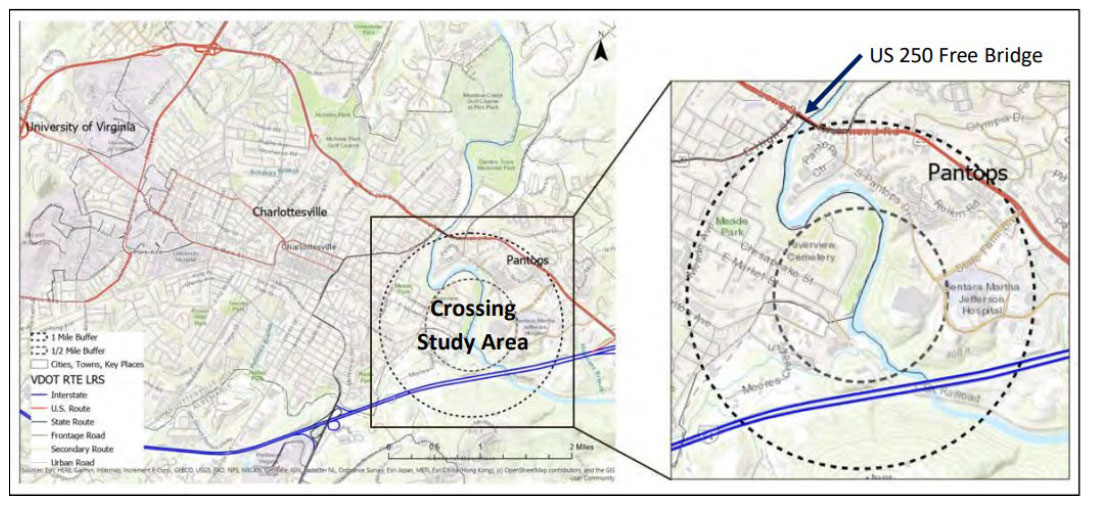
A committee of elected officials who make decisions about transportation projects has endorsed a letter of support for a federal grant to further evaluate a bike and pedestrian bridge over the Rivanna River to connect Woolen Mills and Pantops.
If awarded, the funds would pay a firm to conduct preliminary engineering to help further refine a cost estimate for a project that failed to qualify in the most recent round of the Virginia Department of Transportation’s Smart Scale process. The project had a cost estimate of $42.5 million
The project has been championed by staff at the Thomas Jefferson Planning District Commission, an organization that doubles as the federally-mandated Metropolitan Planning Organization.
“The MPO has done a significant amount of work to move forward from a feasibility study that identified two potential alignments to create a bicycle and pedestrian bridge between Pantops and the Woolen Mills area of Charlottesville and urbanized Albemarle County,” said Sandy Shackelford, the planning and transportation director for the TJPDC.
A lot of that early work is posted to the TJPDC’s website and shared here now for reference:
- A nine page document lists the early history of the project
- VHB memo to the Virginia Department of Transportation with two potential alignments
- A three page document with answers to questions from a November 12, 2020 virtual workshop on the project
- Two page summary of feedback from the online workshop held on November 12, 2020
In 2022, the MPO selected an alignment that would connect at the Wool Factory at the end of the county’s Broadway Street corridor.

Shackelford said the Smart Scale scoring for the bridge showed a high number of benefits, but that $42 million cost estimate was too high to qualify for funding.
“The project had a very high price tag due to a lot of unknown contingencies, being constructed in an environmentally sensitive area, and not having a good understanding of the mitigation measures that would be required as part of that bridge,” Shackelford said.
The preliminary engineering would seek to answer some of those questions through hydrologic and geotechnical analysis. The technical aspects of the project would be administered by VDOT.
The MPO applied for a RAISE grant last year but did not qualify, but Shackelford said the Federal Highway Administration encouraged a resubmission. The MPO Policy Board agreed. Read the resolution for details.
The MPO meeting was the first for City Councilor Natalie Oschrin. She wants to make progress with implementing more options for non-motorized transportation.
“My priorities are very transit-focused, bike lanes, buses, pedestrian flexibility, to get people out of their cars as much as possible which is going to be necessary if we’re going to hopefully see the density that we’re inviting in the new upzoning,” Oschrin said.
Supervisor Ned Gallaway took over as the chair of the MPO Policy Board.
Before you go: The time to write and research of this article is covered by paid subscribers to Charlottesville Community Engagement. In fact, this particular installment comes from the January 31, 2024 edition of the newsletter and podcast. To ensure this research can be sustained, please consider becoming a paid subscriber or contributing monthly through Patreon.
Discover more from Information Charlottesville
Subscribe to get the latest posts sent to your email.