One of the final land use stories in Charlottesville in 2025 is one that will continue as this year continues to get underway. There were several voices at the January 5 meeting of City Council calling on the elected body to make changes to the city’s zoning to restrict heights on West Main Street and nearby neighborhoods.
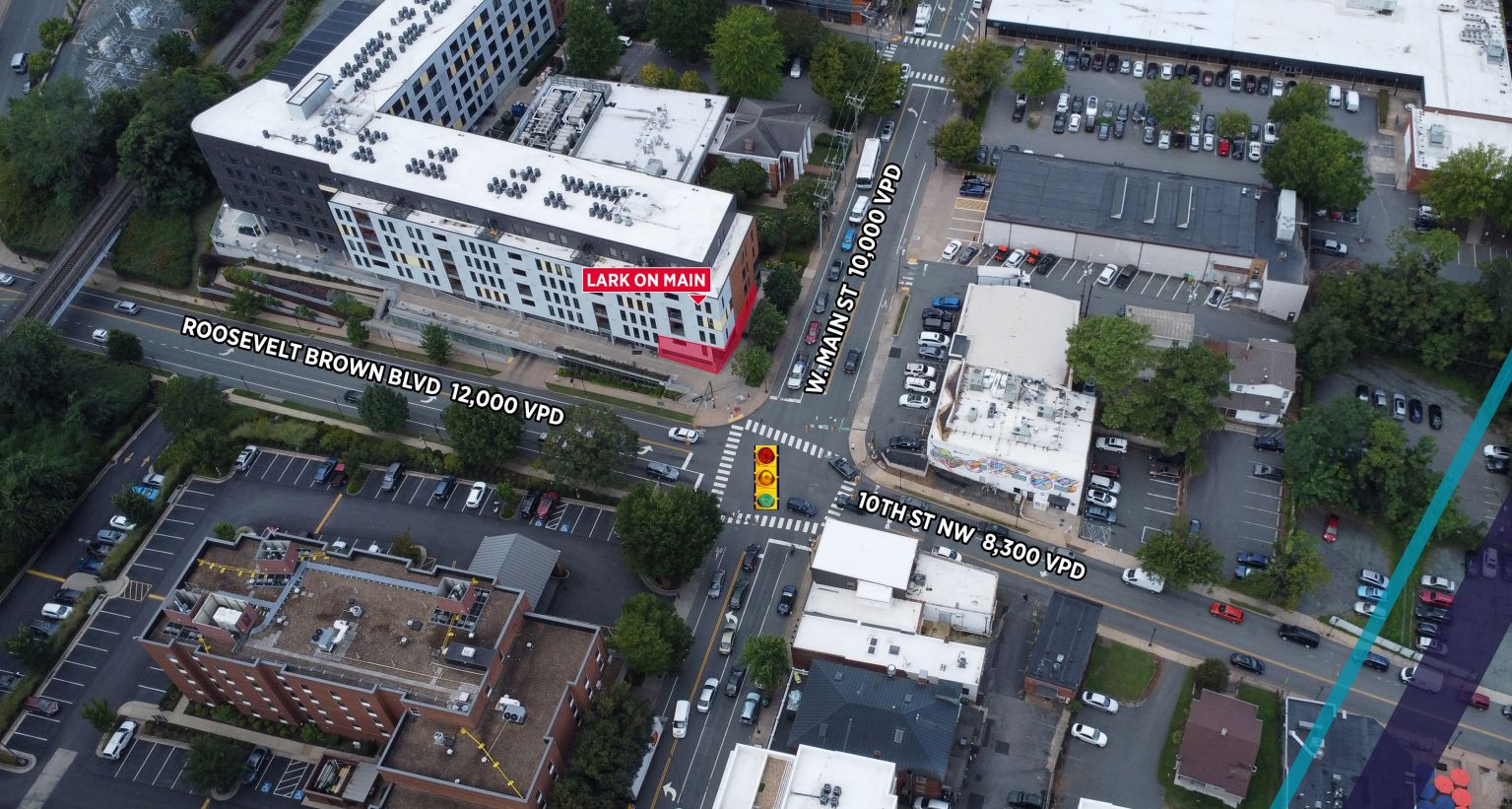
Many of the arguments were also made at the December 16, 2025 meeting of the Charlottesville Board of Architectural Review. An ownership entity called LCD Acquisitions is seeking to build an apartment building to be marketed to University of Virginia Students on five parcels in Fifeville on land zoned Residential-Mixed Use 5. That allows for a seven story building with unlimited density. That is a major feature of the new zoning code adopted in December 2023 that has since survived a legal challenge from a group of city property owners.
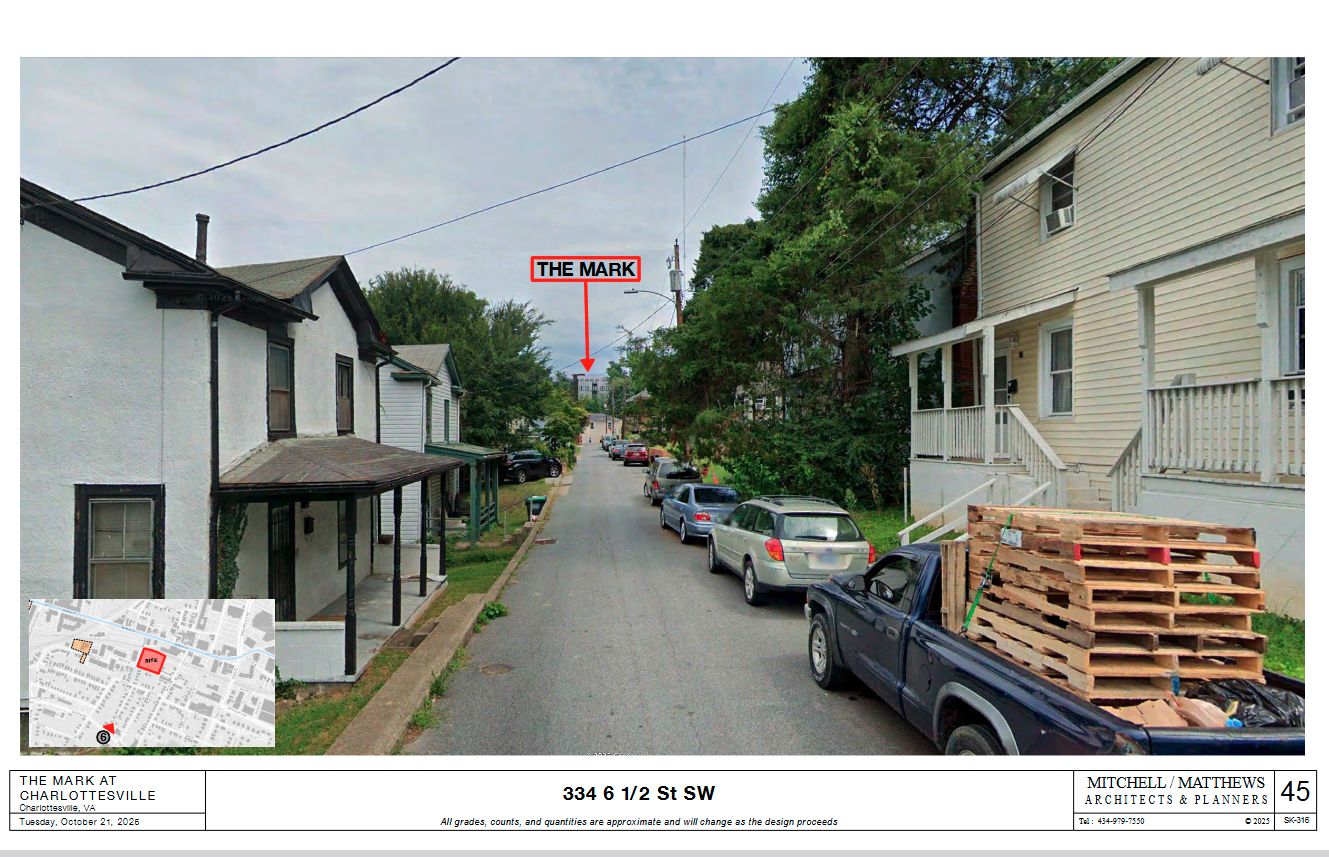
Two of those parcels are designated as “individually protected properties” which means the BAR must grant permission for any alteration to the exterior or demolition of any kind. The two houses on 7th Street SW trace back to the mid 19th Century and are associated with a builder named James Hawkins.
“What you have to evaluate are those two structures and the rehabilitation that’s being proposed on them and the impact of this new development,” said Jeff Werner, the city’s historic preservation planner. “Were this project to not include those two buildings at all, there would be no design review.”

In addition to the historic review, the Department of Neighborhood Development Services is also reviewing the major development plan and a denial letter for that was sent on November 13. Werner said there was nothing in that letter that determined the project could not be built.
“We have a zoning ordinance adopted by City Council two years ago now that allows much larger buildings much closer to the street and much closer together than had been contemplated when the BAR design guidelines were developed,” Werner said.
The project known as The Mark had gone before the BAR for three preliminary reviews but this was the first time a request was up for a vote.
John Matthews with the firm Mitchell Matthews Architects said the project has improved because of the BAR’s input with the massing slightly reduced in some locations. He said the building could still be constructed without touching the two 19th century structures but would be better with them.
“It complies with the comp plan, the zoning ordinance, the affordable housing manual, and contributes millions of dollars to the city’s essential public services,” Matthews said.
If included in the development, the two houses would be adapted for some use but that has not yet been decided. Neither has been occupied for some time. Matthews reminded the BAR that the largest property involved with this development was zoned for industrial use in the previous zoning.
“Neighborhoods like Fifeville are not static,” Matthews said. “They evolve. They continually change over time. Older homes are renovated, additions are built and uses shift. Introducing buildings like The Mark is a continuation of this natural evolution and not a disruption of it.”
Because there were many people who wanted to speak, the BAR agreed to alter their roles to limit public comment to two minutes.
Many people took advantage of the public comment period to protest the project including one nearby resident who said his light would be blocked by the new building.
“Charlottesville has a history of not doing right by historically Black communities,” said James Carr. “Walker Square, where we live, is probably not something that would have been welcomed in Fifeville if there had been a chance to fight it.”
Another nearby resident, Stephanie Lawson, said she acknowledged that the zoning allows the building but that doesn’t make it right.
“It doesn’t fit the scale and the size of the neighborhood,” Lawson said.
Angela Carr, a member of the Public Housing Association of Residents Board of Directors, grew up in what used to be called Garrett Square but now lives on U.S. 29.
“I just kind of feel like every place in Charlottesville that is predominantly black or that has history with black literally is just being snatched up,” Carr said. “And I feel like it’s being snatched up because a lot of people that look like me are not showing up to express how we truly feel about it.”
In the 2010’s, John Mason served on the Blue Ribbon Commission that made recommendations on what to do with Confederate statues.
“We learned that history matters and we also learned that symbolism matters,” Mason said. “And if this building is constructed, it will be a new symbol of white domination in the city of Charlottesville.”

City Councilor Michael Payne said he made a mistake when he joined his four colleagues in voting for a Development Code that allows tall buildings on West Main Street. He said that Council should amend the zoning to give protections such as those exist on Preston Avenue and Cherry Avenue where developments have to prove they will benefit the community.
“Our zoning doesn’t reflect that,” Payne said. “And that’s something I hope City Council can understand the impact of the mistake we made and correct it.”
Payne encouraged the BAR to deny the request and allow Council to take up an appeal.
After a lengthy discussion, the BAR voted 6 to 1 to deny what is called a “Certificate of Appropriateness.”
“One thing that is in our purview is materiality, scale, massing of a building,” said BAR member Katherine Snider Tabony. “And I do believe that this is out of character.”
BAR Chair James Zehmer agreed the project was out of scale but he added that one silver lining is that the two structures would be kept.
“And I worry if something isn’t done, they’ll be lost forever,” Zehmer said.
BAR member Roger Birle said the project had improved over different iterations but he said it still did not meet the city’s design guidelines, guidelines he said are in conflict with the zoning.
Fellow member Ronald Bailey agreed.
“I don’t know how we can resolve that here and I think that’s the real problem,” Bailey said. “If the city, if the citizens of the city do not want that zoning, we are the wrong people to talk to about that.”
BAR Member Cheri Lewis said Council’s decision with the zoning has put the BAR in an uncomfortable position and that the both the zoning and guidelines need to be updated.
“We can find places where certainly density and growth can happen and we’re comfortable with it,” Lewis said. “But this is just a radical, radical disruption in this neighborhood.”
The developers had until January 2, 2026 to appeal the decision.
Before you go: Paid subscribers cover the cost of conducting research for this article which was originally published in the January 6, 2026 of Charlottesville Community Engagement. You can pay for a subscription through Substack, make a monthly contribution through Patreon, or consider becoming a sponsor. That last one is still in the works do drop me a line!
The goal of Town Crier Productions is to increase awareness about what is happening at the local, regional, state, and federal government levels. Please share the work with others if you want people to know things.
Discover more from Information Charlottesville
Subscribe to get the latest posts sent to your email.